
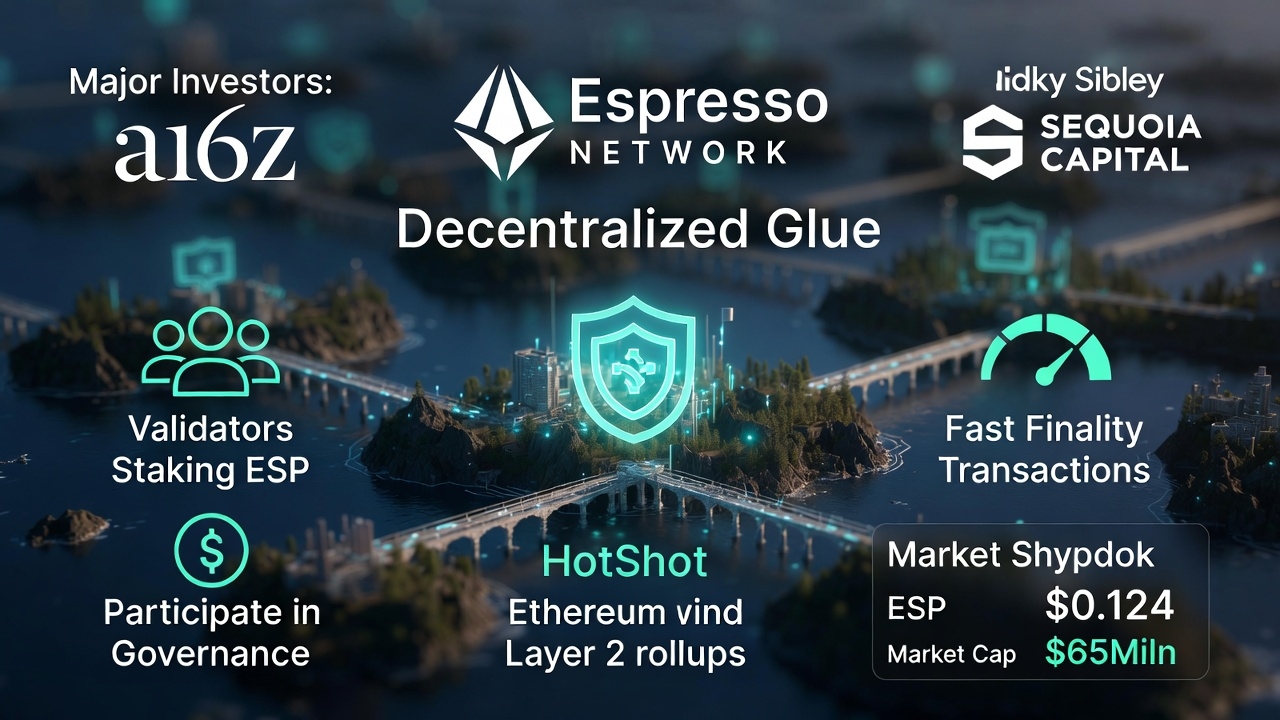
If you’ve been following the Ethereum scaling saga, you know the drill: we have dozens of Layer 2 rollups like Arbitrum, Polygon, and Optimism that are incredibly fast and cheap. But there’s a catch.
They’re basically digital islands isolated from each other with their own sequencers (the computers that order transactions) often being managed by a single, centralized entity.
This is where the Espresso Network and its ESP token come in. Launched in February 2026, Espresso isn't trying to be another blockchain; it’s building the decentralized glue that connects these islands together.
What is the ESP Token actually for?

Think of ESP as the fuel and the security guard for this new shared infrastructure. It’s not just a speculative asset; it has some heavy lifting to do
Securing the Network (Staking): For the network to stay decentralized, it needs validators. These folks have to stake ESP tokens as collateral. If they try to cheat or the system goes down on their watch, they lose their stake.
Governance: If you hold ESP, you get a seat at the table. You can vote on which new blockchains join the network or how the protocol should upgrade next.
Transaction Fees: While rollups still use their own tokens for execution, they pay for Espresso’s sequencing and fast finality services using ESP.
Market Snapshot (March 3, 2026)
The token had a wild first month. After debuting on major exchanges like Binance and M-X on February 12, it hit an all-time high of $0.218 before settling into its current range.
Current Price: $0.124
Market Cap: $65 million
Circulating Supply: 520.5 million ESP (out of a 3.59 billion total cap)
Why Should You Care?

The big sell here is interoperability. Usually, moving funds between different Layer 2s is a headache it’s slow and involves risky bridges. Espresso uses a tech stack called HotShot that can finalize a transaction's order in about 2 seconds, compared to the 12+ minutes it takes on Ethereum's main layer. This allows for atomic transactions: you can swap a token on Chain A for one on Chain B in a single step. If one side fails, the whole thing cancels, so your money never gets stuck in bridge limbo.
The Bottom Line
Espresso is backed by some of the biggest names in the space, like a16z and Sequoia, and they’ve already partnered with the teams behind Arbitrum and Polygon.
The network just finished a massive 10% community airdrop to reward early users, but as with any new infrastructure project, it's still early days. It’s a high-stakes bet on whether the future of crypto stays fragmented or finally becomes a unified ecosystem.