
Picture a delivery robot rolling up to your door. It doesn’t smile. It doesn’t ask for a signature. It doesn’t even wait for eye contact. It drops the package, pivots, and disappears down the sidewalk. Later, a notification appears on your phone: Delivery confirmed.
Confirmed by whom?
That quiet question sits at the heart of a much bigger shift in the global economy. Machines are doing more and more of the world’s real work — driving forklifts, scanning warehouses, inspecting bridges, managing crops, moving goods through ports — yet our systems for deciding whether that work actually happened still depend on human-style trust. A person signs a form. A manager reviews footage. An auditor checks paperwork. But robots don’t sign forms. They execute code.
This is the gap that Fabric Protocol is trying to close. Its central idea is deceptively simple: if machines are going to participate in the economy as independent actors, they need a way to prove — in a way everyone can verify — that they did what they claim to have done.
Not prove it emotionally. Prove it mathematically.
For decades, cryptographers have worked on something called verifiable computation. The premise is elegant: one party does heavy computational work, then produces a small mathematical proof that the work was done correctly. The verifier doesn’t need to redo the entire computation; they just check the proof. In blockchain circles, this idea matured into zero-knowledge proofs — systems that let you prove something is true without revealing all the underlying data.
When you move that idea from pure software into the physical world, things get complicated fast.
A robot doesn’t just calculate. It moves through space. It reacts to weather, lighting, obstacles, hardware wear, and unpredictable human behavior. It generates huge streams of sensor data. If a warehouse robot claims it moved 1,000 boxes, you could store terabytes of video footage to prove it. But that’s inefficient, invasive, and commercially sensitive. No company wants to publish its entire operational data just to settle a payment.
So instead of proving everything, you prove properties. You prove that the robot entered a specific zone. You prove that a package’s coordinates matched a delivery address within tolerance. You prove that safety thresholds weren’t violated. The raw data can remain private; the proof becomes a compressed, cryptographic certificate of compliance.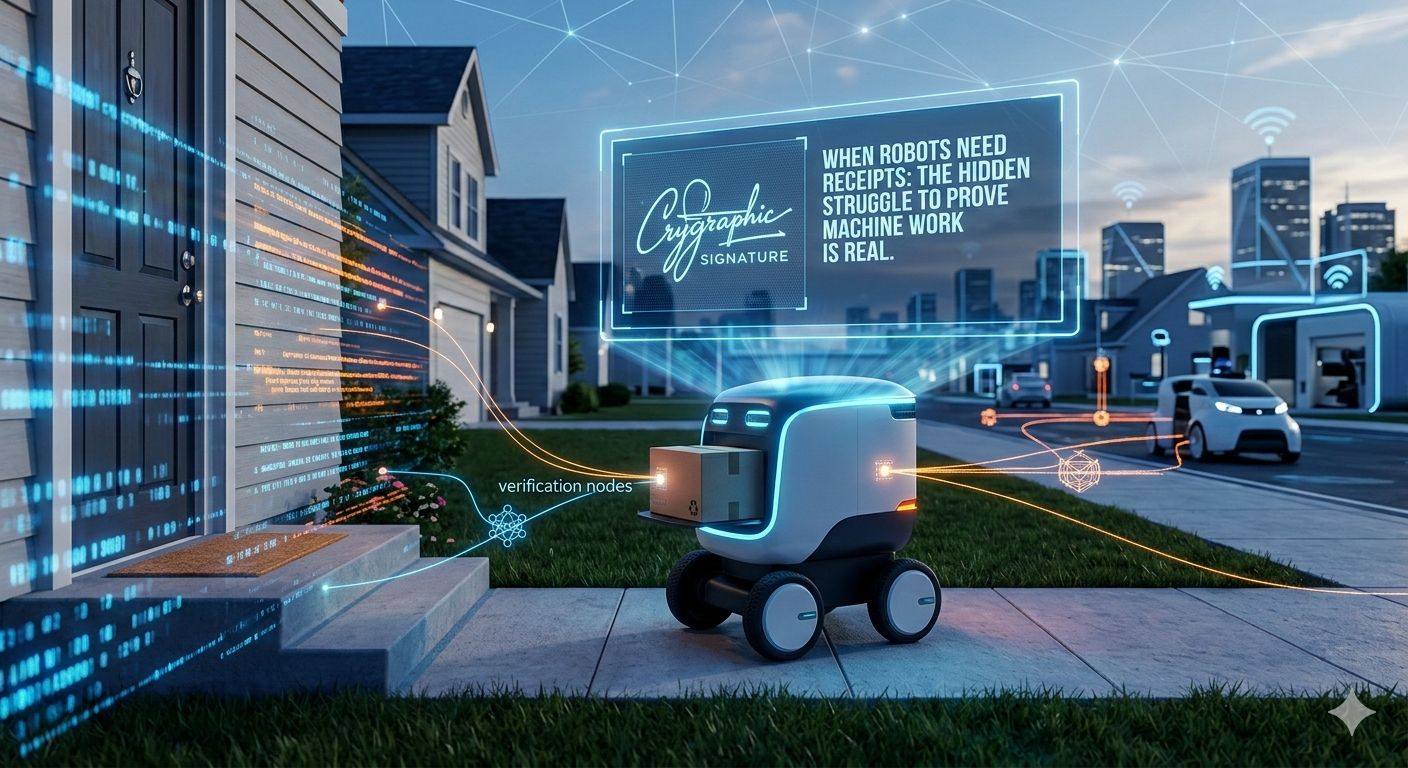
That’s the promise.
Fabric’s vision stretches beyond proofs into infrastructure. The idea is that robots and autonomous agents would have on-chain identities and wallets. They could earn tokens for completing verified tasks. Nodes in the network would validate proofs. Incentives would reward honest verification and penalize dishonesty. It starts to resemble a kind of economic nervous system for machines.
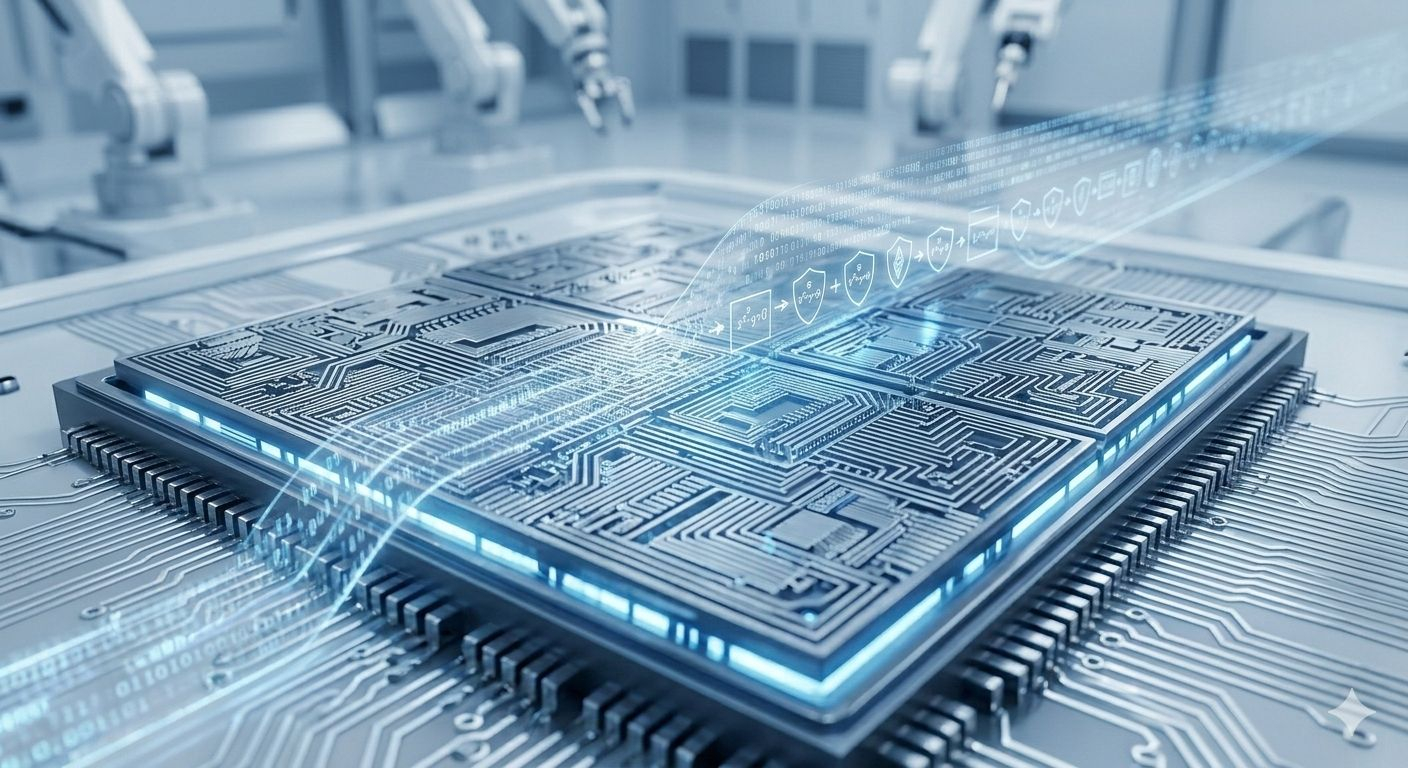
But there’s a technical obstacle hiding under the surface: generating these proofs is expensive. Zero-knowledge cryptography involves complex math — large integer arithmetic, hashing, constraint systems — and doing it repeatedly at machine scale strains conventional processors. That’s why partnerships like the one between Polygon Labs and Fabric have explored specialized hardware called Verifiable Processing Units. These chips are designed specifically to accelerate proof generation, much like GPUs accelerated graphics and AI chips accelerated neural networks.
The existence of such hardware hints at how serious this direction could become. When industries start designing silicon around a concept, they believe it’s foundational.
And yet, there’s something quietly unsettling about it.
If verification becomes dependent on specialized hardware, who controls that hardware? If a small number of manufacturers dominate the supply chain, then trust migrates from public math into private silicon. Decentralization becomes aspirational rather than practical. We’ve seen versions of this before in enterprise blockchain efforts like Hyperledger Fabric, where infrastructure that began with open ideals often ended up shaped by consortium power structures. The lesson isn’t that decentralization fails — it’s that governance always creeps back in.
Beyond governance, there’s the human layer.
A cryptographic proof can confirm that a robot followed its programmed instructions. It cannot confirm that those instructions were fair. If an AI-driven delivery network systematically avoids certain neighborhoods because historical data labeled them “high risk,” the proofs will faithfully attest to correct execution. The bias hides upstream in design choices. Verification solves honesty of execution, not justice of intention.
There’s also the issue of visibility. To anchor digital proofs in the real world, machines need trusted inputs — time, location, environmental signals. The more valuable verification becomes, the stronger the incentive to instrument environments densely. Sensors become economic infrastructure. In warehouses, that might mean efficiency. In cities, it edges toward pervasive monitoring. A system built to create trust can inadvertently reshape privacy norms.
And yet, it would be unfair to dismiss the potential benefits.
Supply chains today are riddled with opacity. Counterfeit goods slip into legitimate channels. Maintenance logs are falsified. Safety inspections are sometimes reduced to paperwork rituals. If robots could produce tamper-evident attestations that a bridge was inspected within certain parameters, or that pharmaceuticals were transported within temperature tolerances, that could strengthen accountability. Insurance models could shift from trust-based underwriting to proof-based risk assessment.
There’s an almost poetic irony in this movement. For centuries, proof of work was deeply human — sweat, presence, witness. In digital culture, “proof of work” became an abstract mining concept. Now, we’re circling back to embodied labor, but filtering it through algebra. The robot lifts the box; the chip proves the lift happened within acceptable force thresholds; the network confirms it; the payment clears. Action becomes equation. Equation becomes currency.
The philosophical tension is hard to ignore. Human societies rely on stories to validate action. “I saw it happen.” “We agreed to it.” “They were there.” Cryptographic systems replace narrative with math. They reduce ambiguity. That can be liberating in corrupt systems where paperwork is forged and witnesses are unreliable. But it also narrows what counts. Only what can be formalized becomes economically legible.
Over time, markets may tilt toward tasks that are easy to prove. Binary actions outperform nuanced ones. Measurable compliance outcompetes relational trust. A machine economy optimized for verifiability may gradually favor the kinds of work that fit cleanly into constraint systems. That doesn’t make it dystopian — but it does make it directional.
What makes Fabric and similar efforts fascinating isn’t the token economics or the branding. It’s the attempt to answer a question we’re only beginning to confront: when machines act independently, who certifies reality?
If the answer is “nobody,” automation stalls. If the answer is “corporations,” trust centralizes. If the answer is “mathematics,” then we enter a world where algebra becomes a witness.
Turning machine work into verifiable reality is not just a technical challenge. It’s a cultural shift. It asks us to decide what kinds of truth we are willing to compress into proofs, what kinds of nuance we’re willing to lose, and who we trust to build the circuits that define economic legitimacy.
Somewhere, that delivery robot is still rolling up to doors. The packages are real. The work is real. The only thing being redesigned is how we decide that it counts.
