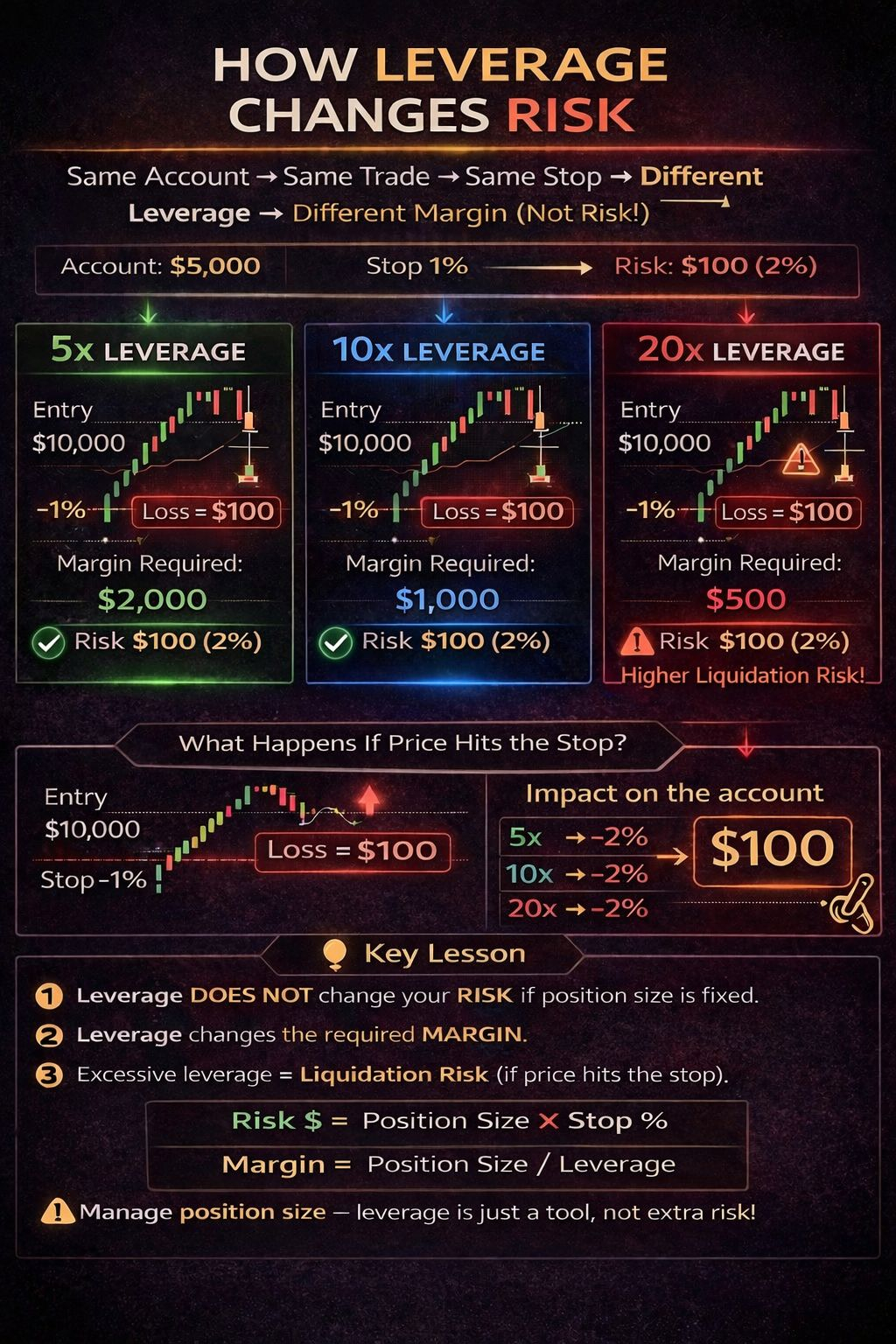
If we make structural mistakes, there are only two outcomes when they turn into losses:
The loss is contained.
The error is amplified and removes us from the market.
This is where leverage intervenes.
Controlled Risk
Account: $5,000
Position Size: $10,000
Stop Distance: 1%
Risk = Position Size × Stop %
10,000 × 1% = $100
$100 is 1% of the position.
$100 is 2% of the account.
That is the true exposure.
If the stop is hit, capital survives.
Margin Mechanics
At 20x leverage:
Initial Margin = Position Size / Leverage = 10,000 / 20 = $500
Exchanges also require a maintenance margin — a percentage of total position size.
Liquidation occurs when:
Equity ≤ Maintenance Margin
As leverage increases:
Margin shrinks.
The liquidation threshold moves closer.
Tolerance to volatility compresses.
The stop did not change. The structural buffer did.
Where Fragility Becomes Visible
In low-volatility phases:
Position size increases.
Open Interest builds.
Margin buffers tighten.
When volatility expands:
Equity deteriorates faster.
Maintenance levels are reached sooner.
Liquidations accelerate the move.
Fragility exists before leverage exposes it.
Structural Reality
Trade Risk = Position Size × Stop Distance
Liquidation Risk ≈ Margin Structure × Leverage × Maintenance Requirement
If you calculate only the first, you ignore capital fragility.
Risk must be defined relative to capital.
Position size sets exposure.
Leverage compresses error tolerance.
Volatility exposes the imbalance.
Risk comes first.
Since The First Block.