

The more I think about Fabric Foundation and $ROBO , the less I care about the narrative and the more I care about the moment when incentives disappear. Because that’s the real audit. Not the launch. Not the hype cycle. Not the early community growth. The real audit is what happens when rewards slow down and nobody is being paid to pay attention anymore.

Fabric is stepping into a space most crypto projects avoid entirely — the operational layer of robotics and autonomous systems. And that space is not clean. It’s not abstract. It’s not theoretical. It’s where machines break at inconvenient hours, logs don’t reconcile, clients demand answers, and someone has to explain what actually happened. That’s where trust becomes expensive.
I’ve seen enough systems fail quietly to know that the biggest cost in automation isn’t speed. It’s ambiguity.
Fabric’s pitch revolves around identity, verification, and coordination for machines. On paper, that sounds straightforward. Robots need wallets. Robots need verifiable task records. Robots need payment rails. But once you move from slides to operations, the story changes.
This is an example: imagine a warehouse operating 200 autonomous picking units overnight. One unit fails to complete a batch of orders. The logs say the task was executed. The client says it wasn’t. The internal monitoring system shows conflicting timestamps. Now someone has to reconcile it. If records can be altered or fragmented across systems, disputes become political instead of technical.
Fabric is positioning itself as the single, auditable layer where that story gets settled.
And that’s not a small claim.
Because dependency doesn’t come from innovation. It comes from pain relief.
I keep coming back to one simple question: if Fabric disappeared tomorrow, would operators feel it immediately?
Incentives can create temporary engagement. Staking rewards can simulate activity. Early positioning can simulate ecosystem growth. But none of that proves product–market fit. Real dependency only shows up when removing the tool makes the old problem worse again.
This is an example: if a robotics operator stops using Fabric and suddenly reconciliation time doubles, disputes increase, and insurance claims take longer to resolve, then Fabric has earned something real. If nothing changes except token rewards, then the usage was rented.
The boundary of what goes on-chain versus off-chain is where this project either matures or collapses.
Put too much operational logic on-chain and you risk introducing latency into systems that require real-time response. Put too little and you’re back to trusting centralized logs that can be edited later. That balance isn’t cosmetic. It’s the architecture.
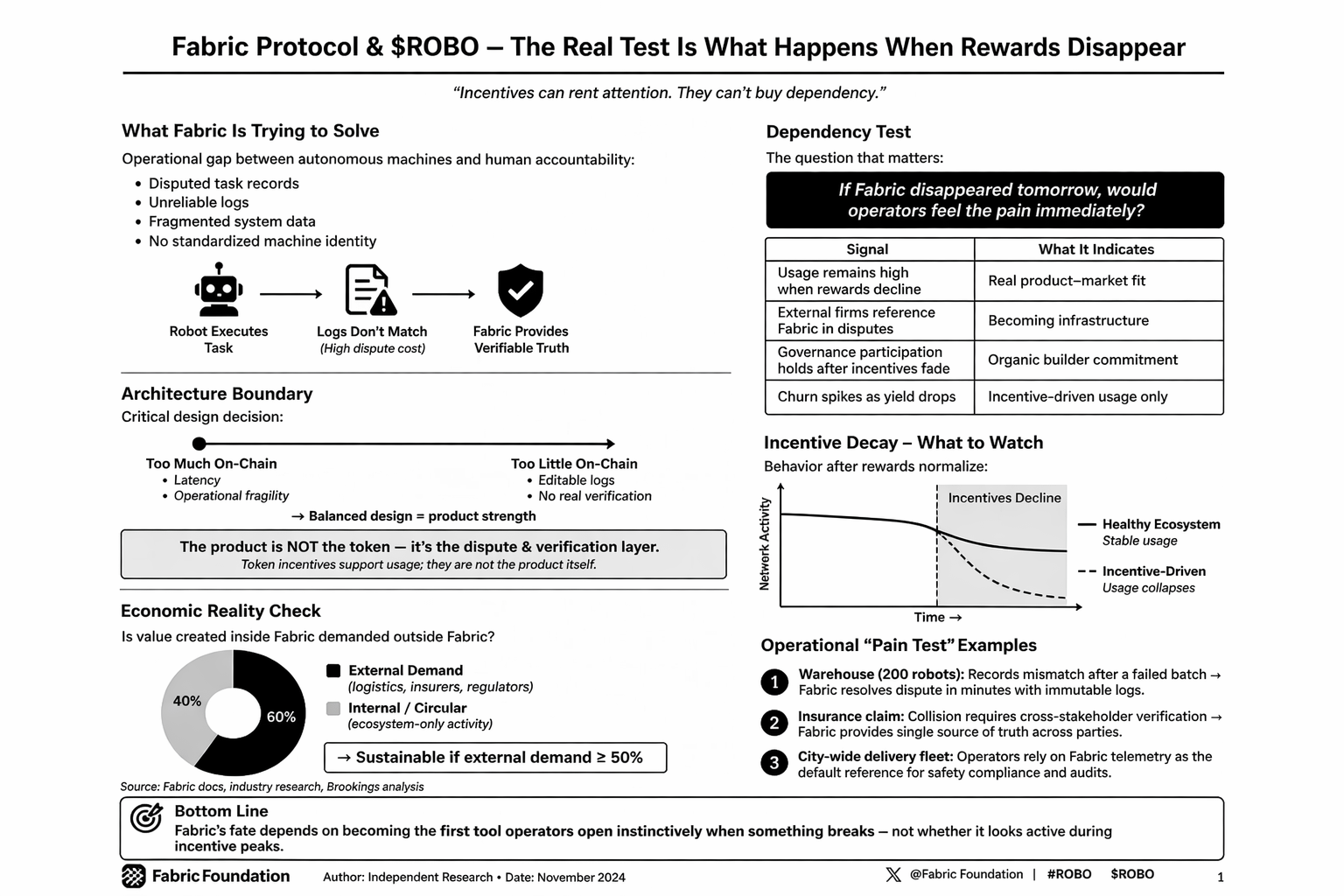
I don’t think the token is the product here. I think the product is the dispute layer.
Robotics doesn’t need more dashboards. It needs proof under stress.
This is another example: consider an autonomous delivery fleet that operates across city borders. A collision happens. Insurance providers need verified telemetry. Regulators need timestamped logs. Operators need immutable proof that safety protocols were followed. If Fabric becomes the place where those records are standardized and accepted across stakeholders, then it’s infrastructure. If it’s just another optional layer, it’s a feature.
And infrastructure survives incentive cycles.
There’s also the economic question that I don’t see enough people asking: does the value generated inside Fabric have demand outside Fabric?
A lot of crypto ecosystems become self-referential. Tokens reward activity that primarily benefits the token economy itself. But if Fabric’s verification services are only meaningful within its own staking loop, it risks becoming circular.
This is an example: if “verified work rewards” are distributed to participants who are primarily interacting with each other to earn those rewards, then the system may look active but not externally valuable. However, if logistics companies, insurers, hardware manufacturers, and even regulators rely on Fabric’s records as authoritative references, then value flows from outside inward.
That’s the difference between motion and traction.
I also think about operational fatigue. Real-world systems don’t tolerate fragility. If a robotics platform fails during a peak window, nobody cares about decentralization philosophy. They care about uptime.
Fabric can’t afford to be experimental in production environments. It has to be boring. Predictable. Uneventful. The kind of system nobody talks about because it just works.
There’s a psychological test here too. When something goes wrong, where do people look first?
If operators instinctively open Fabric’s dashboard before checking internal logs, that means trust has shifted. That means it’s no longer optional.
The hardest part will be surviving the quiet phase.
Every crypto project looks impressive during incentive peaks. But the real maturity phase begins when the token is no longer the primary attraction.
Will builders keep integrating Fabric when rewards normalize?
Will operators keep staking when yield compresses?
Will governance remain active when speculative energy fades?
I’m not dismissing the ambition. In fact, I respect it. Fabric isn’t chasing memetic narratives. It’s attempting to sit in the uncomfortable space between machine execution and human accountability.
But that space doesn’t forgive weakness.
Robotics operates in warehouses, ports, factories, hospitals — environments where mistakes have physical consequences. If Fabric can reduce dispute time, increase verification clarity, and standardize machine identity in a way that operators genuinely rely on, then it becomes part of the stack.
If not, it becomes a distribution event.
And I don’t think the team misunderstands that. The messaging increasingly feels less like “look at the tech” and more like “here’s the operational gap we’re trying to close.”
That’s the right direction.
Still, I’m watching for the boring metrics.
Repeat usage when rewards are thin.
Integrations driven by necessity, not speculation.
External stakeholders referencing Fabric records during real disputes.
Because that’s where the truth shows up.
I’m not asking whether Fabric is innovative.
I’m asking whether it becomes the place people reach for when something actually breaks.
If it does, $ROBO becomes infrastructure.
If it doesn’t, it becomes history.
So I’ll end with what I genuinely want to hear from others:
When incentives cool down, what would make you keep using Fabric?
What operational pain would it need to remove for you to depend on it?
Because that’s the only question that really matters.