Trust is expensive, but failure in a machine economy is even costlier. We are currently sitting in the first week of March 2026, and the dust from the ROBO Token Generation Event on February 27th is finally starting to settle. Traders are moving past the initial price discovery phase and starting to ask the real questions about what actually keeps this network from becoming just another inflationary mess. If you have been looking at the Fabric Foundation whitepaper, you might have noticed a specific variable called Q^* or the Service Quality Threshold. It’s tucked away in the math of the Adaptive Emission Engine, but it is probably the most important guardrail for anyone holding ROBO for the long term.
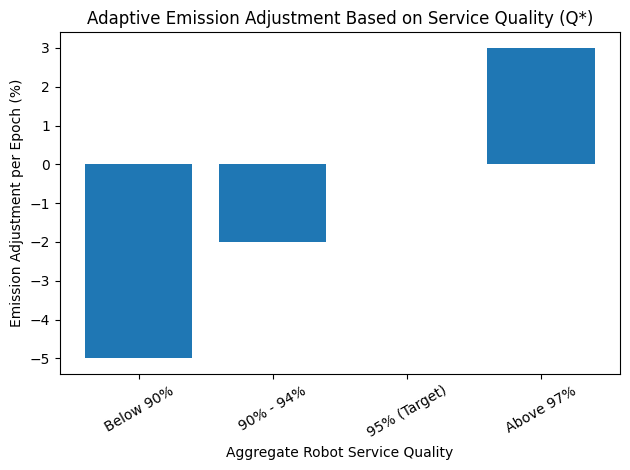
Most crypto projects use a fixed emission schedule where tokens are printed regardless of whether the network is actually doing anything useful. Hmmm... we’ve seen how that ends, haven't we? It usually leads to a slow bleed in price. Fabric Foundation takes a different, almost cold-blooded approach. They’ve set a target quality threshold of 95 percent. Think of it as a GPA for robots. If the aggregate performance of the robots on the network—verified through the Proof of Robotic Work or PoRW mechanism—drops below this 95 percent mark, the economic engine automatically starts throttling the supply. It doesn't matter how high the demand is; if the machines are failing their tasks, the system stops rewarding the operators.
This isn't just a technical quirk; it’s a fundamental shift in how we think about token supply. In the old days of DeFi, we rewarded participation. In the new era of the "world of atoms," Fabric is rewarding reliability. You see, when a robot is operating in a warehouse or delivering a package, a two percent error rate isn't just a "bug" in the code—it’s a physical liability. By tying the ROBO emission rate to Q^*, the protocol ensures that the token remains a high-beta asset backed by high-quality labor. If the quality falls, the emission engine acts as a circuit breaker, reducing the per-epoch adjustment by up to 5 percent. This protects the integrity of the network and prevents the market from being flooded with tokens that represent failed or mediocre work.
As a trader who has watched countless "AI" narratives blow up since 2023, I find this "economic immune system" refreshing. Usually, when a network struggles, the team has to manually intervene or propose a DAO vote to change the inflation. No, not here. The Adaptive Emission Engine is a discrete-time feedback controller. It’s autonomous. It reacts to live signals from the OM1 operating system, which is currently being integrated by major manufacturers like UBTech and Fourier. If their robots don't hit that 95 percent quality mark, the ROBO supply contracts relative to its projected growth. It’s a built-in mechanism for price stability that relies on physics and performance, not just social media hype.
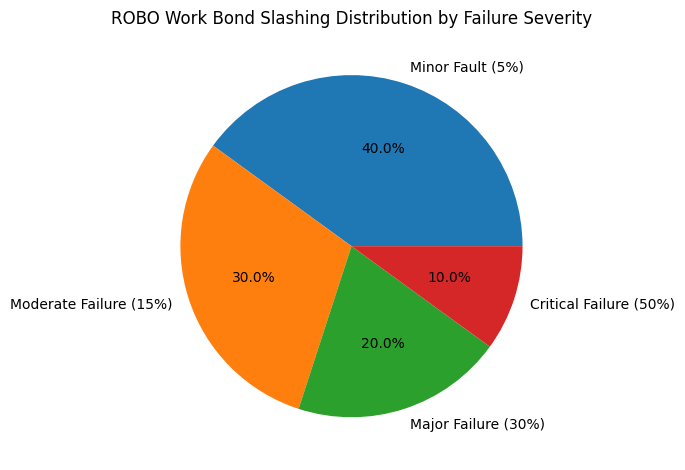
Is it harsh on the operators? Yes, absolutely. If a robot operator provides poor data or fails to complete a task, they don't just lose their reward—they risk their ROBO work bond being slashed by 5 to 50 percent. This creates a high-stakes environment where only the most efficient "fleets" survive. For us investors, that is exactly what we want to hear. We want a network where the "invisible hand" is actually a set of algorithms enforcing a gold standard of service. It’s about building a machine economy that is predictable and observable, which is the core mission the foundation laid out in their Q1 2026 roadmap.
Philosophically, I believe we are moving toward a future where "value" is no longer a social consensus but a performance metric. We are witnessing the birth of a system where inflation is a privilege, not a right. If the machines can't maintain the 95 percent standard, they don't get paid. It’s as simple as that. This creates a layer of trust that doesn't depend on a CEO's promises but on a mathematical threshold. If you are trading ROBO on Binance Alpha or the new perpetual contracts, you aren't just betting on a coin; you are betting on a global standard for machine labor. And in my opinion, that Q^* variable is the most honest thing I’ve seen in tokenomics in a very long time. Trust, but verify... and if the verification fails, let the engine cut the supply. That is the only way a machine economy actually scales.
@Fabric Foundation #ROBO $ROBO