
@Fabric Foundation #ROBO $ROBO
Decentralization is transforming how advanced technologies are built and governed. At the intersection of robotics, artificial intelligence (AI), and blockchain infrastructure stands FABRIC, a decentralized AI collaboration platform developed under the stewardship of the Fabric Foundation.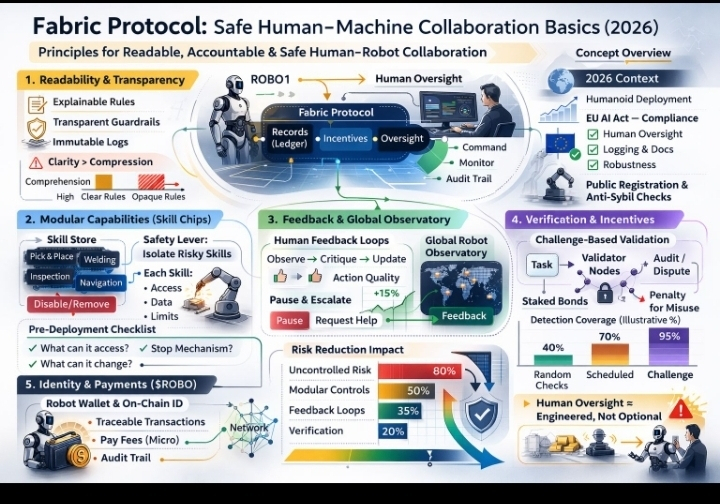
The foundation is an independent nonprofit focused on building open governance, economic infrastructure, and coordination systems that enable humans and intelligent machines to work together safely and productively. Its mission centers on ensuring that robotics and AI remain open, collaborative, and aligned with human values rather than controlled by centralized entities.
What Is FABRIC?
FABRIC is a decentralized AI collaboration platform designed to provide a trusted, open foundation for the AI robotics ecosystem. It enables the secure flow of:
Data
Tasks
Value
Across robots, developers, organizations, and autonomous agents.
The platform introduces infrastructure that allows robots and AI agents to function as network participants — with verifiable identities, secure communication channels, and programmable economic capabilities.
From Isolated Systems to a Robot Economy
Most robotic systems today operate in closed, proprietary environments. Fleets are centrally managed, data is siloed, and cross-platform coordination is limited.
FABRIC proposes a different model — an open, decentralized network where:
Robots can hold cryptographically verifiable identities.
Tasks can be assigned and validated across independent operators.
Services can be compensated transparently.
Collaboration can occur without a central controlling authority.
This model supports the emergence of a Robot Economy, where robotic labor, AI services, and machine-generated value can be coordinated and rewarded at a global scale.
Core Components of the FABRIC Platform
1. On-Chain Identity and Trust
Robots and autonomous agents are assigned persistent digital identities. These identities allow verification of capabilities, performance history, and permissions. Trust becomes programmatic rather than dependent on centralized operators.
2. Decentralized Task Coordination
FABRIC enables task allocation through decentralized protocols. Robots and AI agents can participate in shared work environments, where assignments and completions are recorded transparently.
3. Secure Machine Communication
Encrypted and blockchain-anchored communication layers allow robots to exchange operational data and coordinate activities securely. This enables multi-agent collaboration without reliance on a single control hub.
4. Economic Infrastructure
The ecosystem introduces a native token designed to power network fees, incentives, and governance participation. This economic layer supports compensation for completed tasks, verification services, and network contributions.
Governance and Open Participation
The Fabric Foundation emphasizes open governance and public-good infrastructure. Its approach encourages:
Developer participation
Community-driven protocol evolution
Transparent decision-making mechanisms
Alignment between human oversight and machine autonomy
By combining decentralized technology with governance research, the foundation aims to ensure that intelligent machines contribute positively to society.
The Broader Vision
FABRIC is not just a technical platform — it represents a structural shift in how AI and robotics systems interact economically and socially.
If successful, the platform could:
Enable cross-border robotic collaboration
Create programmable economic models for machine labor
Improve transparency and accountability in autonomous systems
Expand global access to robotics innovation
The long-term vision is clear: build an open, collaborative AI robotics ecosystem where robots are not only intelligent but capable of secure cooperation and value creation — alongside humans.