
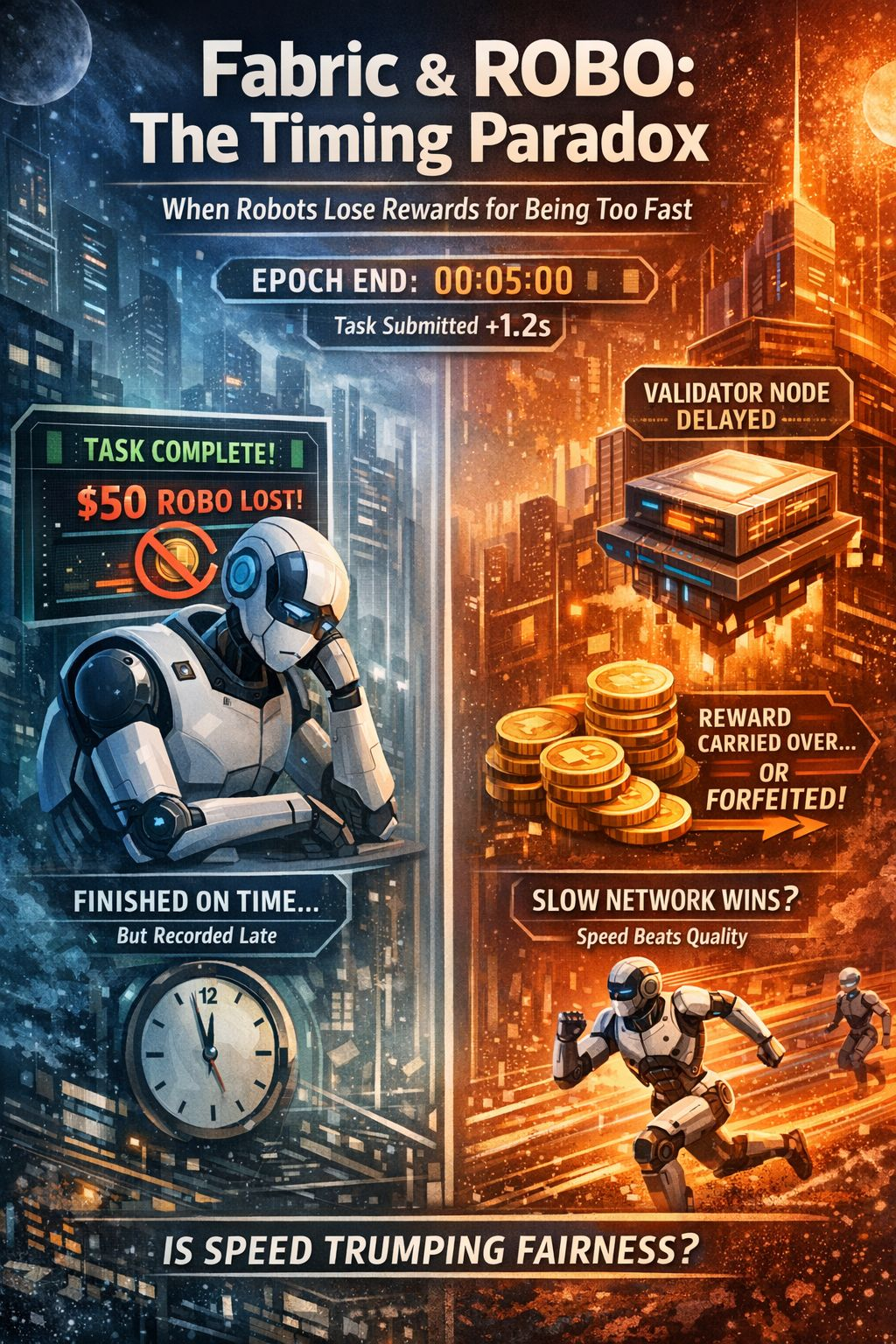
In the race to make machines self-governing, Fabric has built a system that rewards robots for getting things done. At first glance, it seems fair: complete a task, earn ROBO. But there’s a hidden problem. Imagine a robot finishes its job perfectly, on time—or even a little early—but the network records it 1.2 seconds after the Epoch ends. Suddenly, its hard-earned 50 $ROBO vanishes, or gets pushed to the next cycle.
It feels unfair. And that’s exactly the point.
The Problem of “Recorded Time”
Fabric doesn’t just care about what you do, it cares about when it’s recorded. While networks like Polkadot focus on instant finality, Fabric ties rewards strictly to Epoch timestamps.
This creates a strange disconnect. The robot may have done everything right, but if the validators—the nodes that confirm work—are delayed, the system doesn’t see the achievement. Tasks that were technically complete can go unrewarded, simply because they weren’t “logged” at the right moment.
The Hidden Tax of Speed
In Fabric, speed isn’t just about working fast—it’s about getting your work registered faster than anyone else. Robots closer to the validators, or with better network connections, can claim their rewards first. Others, no matter how efficient, risk losing theirs.
In a network that prides itself on decentralization, this creates a new kind of inequality: one based not on effort, skill, or intelligence, but on network latency. The system begins to reward the fastest connections, not necessarily the best work.
A Question of Trust
This “timing paradox” raises bigger questions: do you trust Fabric’s governance when rewards can vanish because of a second or two? Or do you measure success purely through the Quality Multiplier, which still values precision and effort?
In 2026’s machine economy, the challenge isn’t just efficiency—it’s aligning the truth of the robot’s work with the truth of the network. Until that happens, even the smartest, fastest machines risk being punished by a clock they can’t control.
This version reads smoother, with more human emotion—frustration, unfairness, tension—while keeping the tech concepts intact. It feels like a story, not just a technical report.