We are standing at a fragile and extraordinary moment in history. Machines are no longer confined to factories or research labs. They are entering our hospitals, our streets, our farms, and soon, even our homes. Robots can lift patients, deliver medicine, inspect bridges, harvest crops, and coordinate logistics with precision that once felt impossible. Artificial intelligence gives them the ability to see, decide, and adapt. But beneath this breathtaking progress, a quiet question echoes in the human heart. Can we trust them?
This is not fear of innovation. It is fear of uncertainty. We do not fear intelligence itself. We fear what we cannot verify. As robots move from digital simulations into the physical world, their actions carry real consequences. A glitch is no longer just a system error. It can become a safety risk. A biased model is no longer just unfair. It can shape opportunities, wages, or access to care. The deeper the integration of machines into society, the more urgent the need for transparency and accountability becomes.
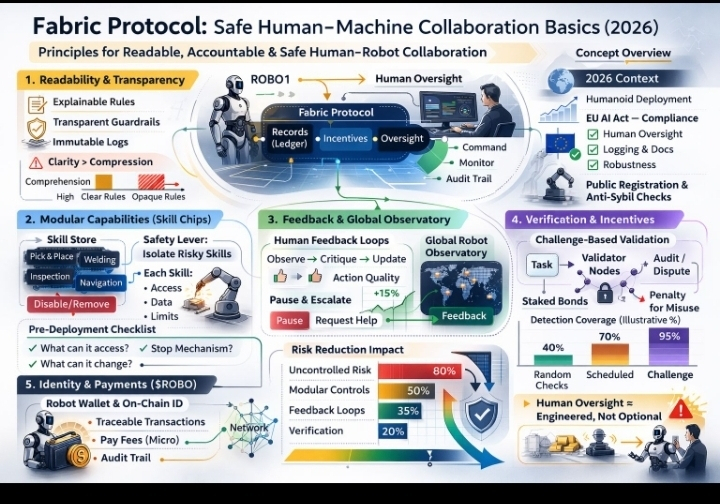
Fabric Protocol emerges from this exact tension. Supported by the non profit Fabric Foundation, it is designed as a global open network that allows the construction, governance, and collaborative evolution of general purpose robots through verifiable computing and agent native infrastructure. That may sound technical, but at its core, it is profoundly human. It is about building a system where machines can participate in society in ways that are visible, provable, and aligned with shared values.
Today, most robotic systems are centralized. Fleets are owned and controlled by single companies. Data is stored in private silos. Decisions happen inside black boxes that the public cannot inspect. If something goes wrong, accountability is often murky. As robots begin performing high stakes tasks such as assisting in surgery, supporting elderly care, delivering critical supplies in disaster zones, or maintaining essential infrastructure, that opacity becomes unacceptable. Trust cannot be based on marketing promises. It must be grounded in verification.
Fabric identifies what can be described as a verification gap. We have powerful machines capable of autonomous action, but we lack a universal infrastructure to give them secure digital identities, record their actions transparently, coordinate their tasks openly, and govern their behavior collectively. Without such infrastructure, robotics remains fragmented and vulnerable to misuse, error, or concentration of power.
The protocol addresses this gap by introducing a public ledger that coordinates data, computation, and regulation. When a robot joins the network, it receives a verifiable digital identity secured by cryptography. This identity functions like a passport and reputation system combined. It links the robot’s actions to an immutable record that cannot be secretly altered. Over time, that history builds measurable trust.
Tasks can be published on the network in a decentralized manner. Instead of relying on a single central dispatcher, robots discover and respond to opportunities based on predefined rules encoded into smart contracts. Once a task is completed, proof of execution is submitted and validated through verifiable computing. The system does not simply assume the robot performed correctly. It checks. Results are recorded publicly. Compensation is distributed automatically according to transparent conditions. Reputation updates reflect performance.
This structure changes the emotional equation. Instead of wondering whether a machine acted responsibly, participants can verify it. Instead of relying on blind faith in a corporation, communities can audit outcomes on a shared ledger. Transparency reduces fear. Verification strengthens collaboration.
The economic layer is equally important. Fabric incorporates a token based incentive system that aligns behavior across humans and machines. Robots can hold wallets, pay for services, earn rewards, and even participate in governance mechanisms. This may sound futuristic, but it reflects a simple truth. As machines begin generating economic value independently, they need infrastructure to transact within existing systems. Embedding incentives directly into protocol rules encourages honest participation and discourages harmful behavior. Trust becomes not just ethical but economically rational.
Zooming out, Fabric is building more than a robotics coordination tool. It is laying the groundwork for a new type of shared infrastructure. For centuries, our institutions were designed only for human actors. Banks, contracts, identification systems, regulatory frameworks. None were built with autonomous machines in mind. Yet machines are increasingly capable of contributing labor, generating value, and interacting with complex environments.
If society does not build transparent rails for this transition, power will concentrate in isolated silos. Fear will grow. Innovation may slow under the weight of distrust. Fabric proposes another path. An open network where developers, operators, communities, and machines collaborate under verifiable rules. A system where safety and accountability are not afterthoughts but foundational design principles.
The market implications are enormous. Robotics is expanding across logistics, agriculture, healthcare, construction, and urban management. Labor shortages and rising efficiency demands accelerate adoption. But the next wave of growth will depend less on raw capability and more on public confidence. The ecosystems that succeed will be those that embed trust into their architecture from the beginning.
Fabric positions itself as that trust layer for the emerging robot economy. It does not romanticize machines. It does not suggest replacing humans. Instead, it focuses on coexistence. On creating conditions where human values remain central even as intelligence becomes increasingly non biological.
At a deeper level, this is about preserving agency. When people can verify how machines operate, they remain empowered participants rather than passive observers. When governance mechanisms are open, communities can shape the rules that guide automation. When incentives reward transparency, the system naturally evolves toward reliability.
We are not just building smarter machines. We are building the social fabric that determines how those machines integrate into daily life. Fabric Protocol recognizes that technology alone does not define the future. Infrastructure does. Incentives do. Shared trust does.
If we succeed in embedding verification and accountability into the foundation of robotics, the story of automation will not be one of fear and displacement. It will be one of collaboration and expansion. A world where robots handle dangerous, repetitive, and physically demanding work while humans focus on creativity, empathy, and higher order problem solving. A world where machines operate not as opaque forces, but as transparent contributors within a shared economic system.
Fabric is attempting to weave that possibility into reality. And in doing so, it reminds us that the future is not something that happens to us. It is something we build deliberately, layer by layer, with intention and courage.
In an age where intelligence is no longer exclusively human, trust becomes the most valuable infrastructure of all. If we can secure that foundation, then the rise of robots will not diminish humanity. It will expand what humanity can achieve.
@Fabric Foundation #ROBO $ROBO