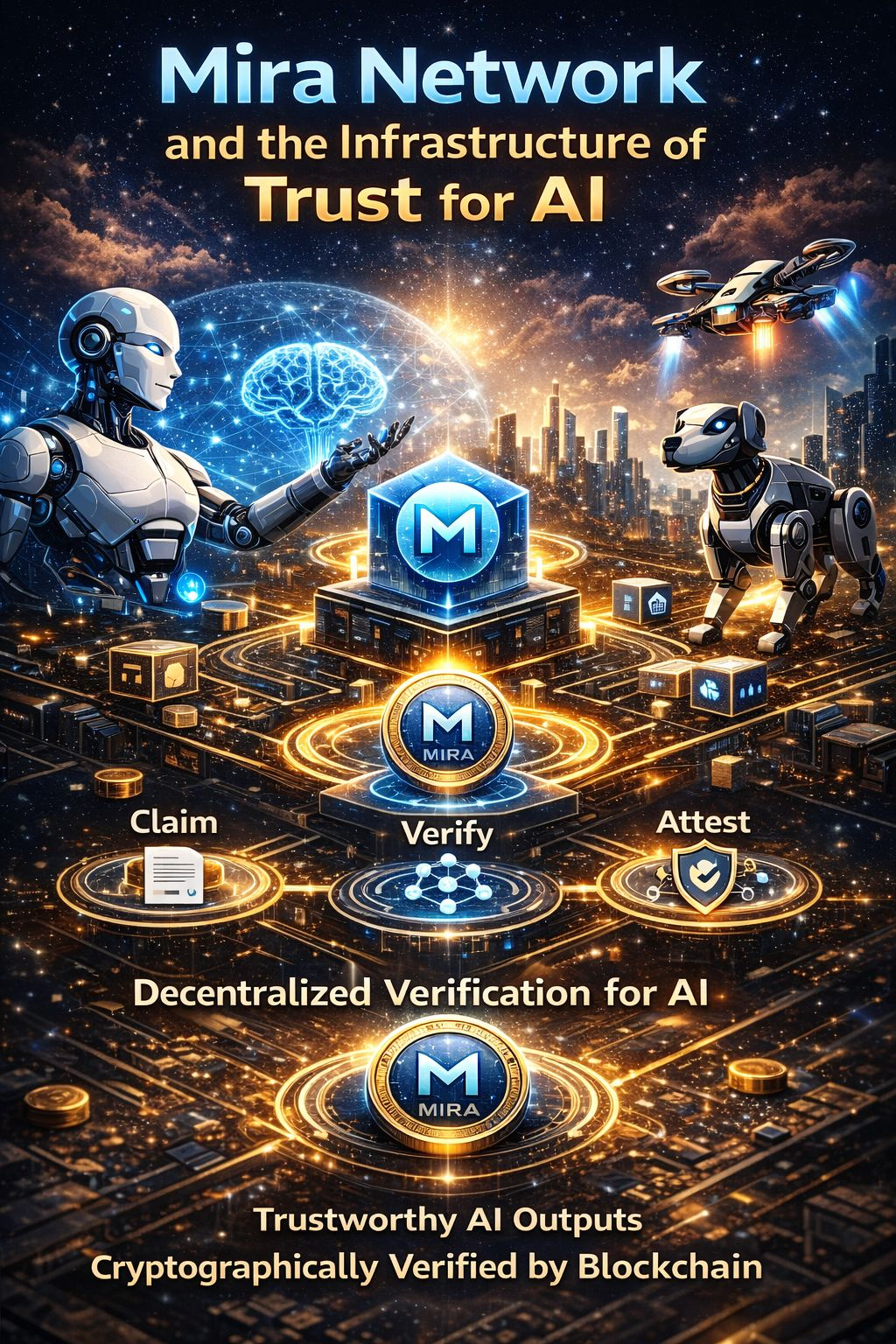
Artificial intelligence has grown at an astonishing pace, yet reliability often lags behind. Hallucinations, subtle biases, and overconfident mistakes still make AI unsafe in critical environments. Mira Network takes a fresh approach: instead of trying to perfect one model, it assumes that all AI outputs are fallible and creates a decentralized layer that ensures every response is verified before it’s trusted.
At the heart of Mira’s system is claim-based validation. When an AI generates an output, it’s broken down into smaller, verifiable claims. These claims are sent across a network of independent verifier models and node operators. Rather than depending on a single authority, consensus emerges from participants who stake tokens on their assessments. The outcome isn’t just a better guess—it’s a cryptographically recorded agreement that can be audited and trusted.
Mira combines off-chain computation with on-chain accountability. Verification models work in parallel, and their attestations are stored on the blockchain, creating tamper-proof proof. Staking ensures that verifiers have skin in the game: dishonest or negligent behavior risks slashing, while accurate validation earns rewards. Reliability becomes measurable and economically enforced, not just a promise.
The $MIRA token is central to this ecosystem. It secures the network through staking, powers payments for verification services, and governs key parameters like quorum thresholds and slashing rules. Developers pay for verification, and those fees flow back to node operators and the broader ecosystem. The token aligns incentives across builders, validators, and long-term network participants.
Mira shines as middleware. It doesn’t compete with AI models—it strengthens them. By sitting between outputs and real-world execution, Mira is ideal for industries where trust cannot be compromised: finance, healthcare, legal workflows, robotics, and autonomous systems. In these settings, unverified AI outputs are liabilities; verified outputs become assets.
 Recent updates show that Mira prioritizes usability. SDK improvements, smart routing, and integrated payments make adoption easier. If verification is slow or cumbersome, developers won’t use it. Mira’s challenge is to remain efficient while keeping the network decentralized and diverse.
There are risks. Coordinating verifiers without centralizing stake is tricky. Latency and cost must be competitive for real-time applications. Not every AI output can be converted into a binary claim suitable for consensus. Success will hinge on balancing rigor with practicality.
Still, the potential is powerful. As AI becomes more autonomous, the need for provable correctness will only grow. Black-box confidence scores won’t suffice—users and organizations will demand transparent validation trails. Mira provides that structural integrity, distributing verification across a network where incentives enforce honesty.
If AI is to move from experimental tools to mission-critical infrastructure, trust must be built in, not assumed. Mira demonstrates that reliability can be decentralized, economically secured, and cryptographically verifiable. Done well, it does more than patch AI’s flaws—it changes how intelligent systems interact with the real world.
@Mira - Trust Layer of AI $MIRA #mira