
The way people usually talk about artificial intelligence is still too narrow. Most of the focus stays locked on one question: how intelligent can machines become? People are fascinated by better reasoning, stronger memory, faster responses, and more advanced capabilities, and that fascination is understandable because intelligence feels like the most visible sign of progress. It is the part everyone can see, measure, and celebrate. But the deeper truth is that intelligence alone does not create a working future. No matter how advanced a machine becomes, that intelligence means very little if there is no system around it that allows it to operate safely, fairly, and productively in the real world. That is exactly why Fabric Protocol stands out. It is not built around the simple idea that smarter machines automatically solve everything. Instead, it is built around a more serious and more realistic belief: the true challenge is not only making machines more capable, but creating the structure that allows those machines to function within society. That is what makes the project feel different. It is looking beyond raw intelligence and focusing on the deeper layer that makes intelligence usable.
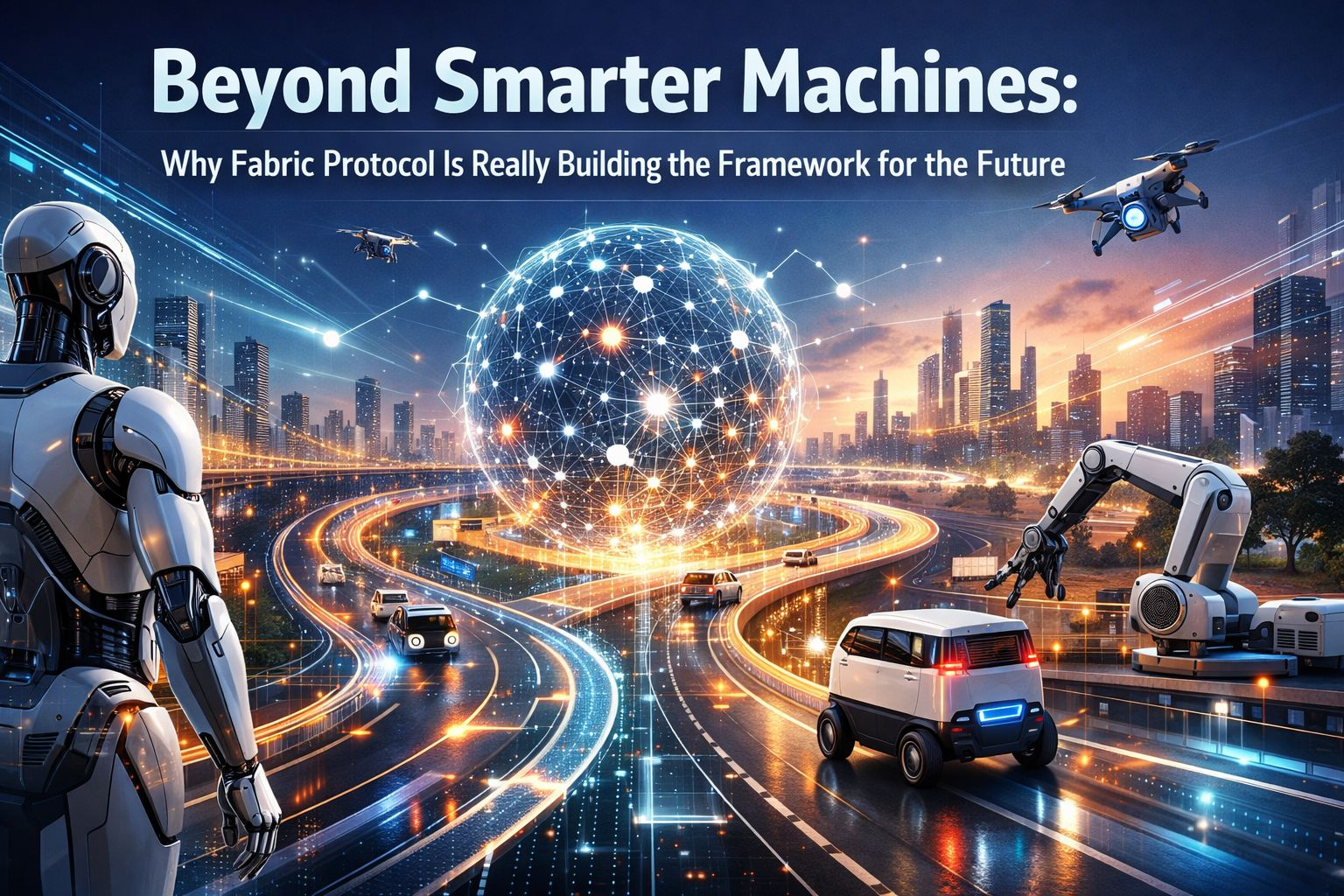
At first glance, coordination may not sound as exciting as intelligence. It does not create the same kind of headlines, and it does not trigger the same instant excitement as a breakthrough model or a powerful new robot. But coordination is the part that determines whether a system can actually work at scale. A world filled with intelligent agents and machines cannot run on cleverness alone. It needs rules, identities, incentives, permissions, accountability, and trust. It needs a shared structure that allows different participants to interact without everything turning into disorder. This is the layer Fabric Protocol is trying to address. Rather than obsessing only over how advanced machines can become, it is trying to build the infrastructure that helps those machines operate in a way that humans can understand, manage, and rely on. That focus makes the project feel less like a race for attention and more like an attempt to solve the real problem waiting ahead.
A simple way to think about Fabric is to imagine the difference between a powerful car and a functioning road system. A car can be fast, smart, and beautifully engineered, but none of that is enough without lanes, signals, maps, traffic laws, insurance, and shared expectations. What makes transportation useful is not just the vehicle itself. It is the system around the vehicle that allows millions of movements to happen with some level of order. The same principle applies to intelligent machines. A robot or AI agent may be highly capable, but if there is no clear way to identify it, authorize it, assign it work, verify what it has done, reward it properly, or hold someone accountable when things go wrong, then the larger system remains fragile. Fabric Protocol appears to be focused on creating that surrounding framework. It is not only concerned with how strong the machine becomes. It is concerned with whether there is a real road for that machine to travel on.
This is what gives Fabric a more grounded and mature feeling compared with many other narratives in the AI and crypto space. A lot of projects still tell the future as if better intelligence naturally leads to a better world. They assume that once machines become smart enough, everything else will fall into place. But history shows the opposite. Human progress has never come only from powerful tools. It has always depended on the systems, agreements, and institutions that grow around those tools. Technology may create possibility, but coordination is what turns possibility into something stable and useful. Markets needed rules. Finance needed settlement rails. The internet needed protocols. Every major leap in capability eventually reached the same point: without structure, power becomes messy. Fabric seems to recognize that the next wave of machine technology will face the same reality. It is not enough for machines to become more intelligent. They also need to become part of a system that people can trust and govern.
That becomes even more important when intelligent systems move into physical environments. Inside digital spaces, mistakes can still be serious, but in the physical world the consequences become much more immediate. A robot working in a warehouse, a delivery machine navigating a city, or an autonomous system operating in a hospital is not just another piece of software. It interacts with real people, real risks, and real limitations. In that world, it is not enough for a machine to make good decisions. It must also fit into a framework that can define what it is allowed to do, how it is monitored, how it is maintained, and how its actions are understood by others. That is where Fabric’s focus starts to feel especially practical. Intelligence may allow a machine to perform actions, but coordination is what allows those actions to belong inside a human environment without creating confusion or danger. One creates capability. The other creates order.
What makes the Fabric Protocol idea especially compelling is that it treats the future of intelligent machines as an economic and social system, not just as a technical challenge. That is a much more complete way to look at the problem. Once machines begin doing useful work, a whole chain of questions appears immediately. How do tasks get assigned? How do participants know which machine completed which task? How do payments happen? How is performance verified? How do independent operators, developers, and users interact inside the same environment? How can trust exist without forcing every interaction through one central authority? These questions may not sound dramatic, but they are exactly the questions that determine whether a machine economy can truly function. Fabric seems to be building around those very issues, and that makes the project feel deeper than something designed only to capture hype. It is not just trying to showcase technical ambition. It is trying to design the conditions under which intelligent systems can actually become part of a reliable ecosystem.
One of the most important parts of that ecosystem is identity. In a future where machines are doing work, identity becomes essential. Before any task can be assigned, verified, paid for, or audited, the system has to know what entity it is dealing with. Human societies already depend on identity frameworks even when we do not think about them directly. We have names, records, accounts, credentials, and legal recognition that allow us to move through economic systems. Machines will need something similar if they are going to participate in any serious way. Fabric’s attention to machine identity signals a vision where robots and agents are not treated as invisible background tools, but as recognized participants within a structured environment. That is a meaningful shift. It suggests a future where machines are not only intelligent, but also legible, trackable, and accountable within shared systems.
From there, the conversation naturally expands into economics. A machine economy cannot grow in a healthy way if every interaction stays trapped inside isolated private systems. If each company runs its own closed robot fleet, its own private settlement model, and its own hidden rules for verification and payments, then automation may still advance, but it will do so inside disconnected silos. That kind of future might create efficiency for a handful of large players, but it does not create broad participation. Fabric appears to be pushing toward a more open structure. Its focus on wallets, transparent coordination, programmable incentives, and decentralized participation suggests a world where machine activity can exist within a wider network rather than being locked into separate islands. In that kind of model, the key question is not only whether a machine can complete a task. The larger question is whether that task can be coordinated in a transparent and shared environment where multiple participants can interact under common rules. That is where the project begins to feel like more than a technical layer. It starts to feel like an attempt to design the economic fabric of machine cooperation.
This is also why Fabric feels bigger than a single product release or token narrative. At its core, it is addressing the invisible logic that sits behind work, trust, and value exchange. That is the part most people ignore until it becomes a problem. Real systems do not become durable because they are exciting in the beginning. They become durable because they can coordinate repeated interactions in a predictable way. That is the deeper promise inside Fabric’s thesis. Intelligence can create the ability to perform, but coordination creates the ability to participate. Without participation, capability stays trapped or becomes dangerous. With participation, intelligence can become part of something much larger and more lasting.
There is also an emotional layer to why this matters. Many people feel uneasy about the future of AI, and that concern is not irrational. Whenever powerful new technologies emerge, there is always a risk that control will become concentrated in the hands of a few institutions with the resources to dominate the infrastructure. Fabric’s emphasis on decentralization speaks directly to that fear. It carries the belief that the future of machine systems should not be controlled entirely by closed organizations with massive capital and private rulebooks. Instead, the foundations should be more open, more transparent, and more broadly participatory. Whether the project can fully achieve that vision remains to be seen, but the direction itself matters. It reflects the idea that the next era of intelligent machines does not have to lead automatically to deeper centralization. It can also be a chance to design systems where access, participation, and oversight are shared more widely.
That is why coordination is not some secondary feature in this story. It is the center of the entire argument. Coordination determines whether intelligent systems remain aligned with human interests or become tools that only serve narrow concentrations of power. It determines whether machine labor becomes something integrated into society or something locked behind private barriers. It determines whether people can still understand the systems shaping their lives, or whether those systems become too opaque to challenge. Fabric is not simply talking about making machines more capable. It is talking about building the architecture that makes coexistence possible. And coexistence is the real challenge of the coming era. The future will not only test whether machines can think. It will test whether humans and machines can share systems without losing trust, fairness, and control.
In many ways, Fabric Protocol seems to be trying to create the governance layer for intelligent machines before the world fully understands how badly that layer will be needed. That is what makes the project feel so forward-looking. Many systems wait until problems become visible and then try to patch them. Fabric appears to be taking the opposite approach. It is starting with the assumption that the weakness is already clear. If we continue building more capability without stronger frameworks, more automation without accountability, and more intelligence without coordination, then the future may become powerful but unstable. That is the risk. And what makes Fabric interesting is that it is not ignoring that complexity. It is leaning directly into it. It accepts that the future machine economy will require more than impressive technology. It will require rules, incentives, transparency, and responsibility.
So the reason Fabric Protocol focuses on coordination instead of only intelligence is actually very straightforward. Intelligence can make machines more powerful, but coordination is what allows that power to fit into the real world. Intelligence can produce action, but coordination produces trust around that action. Intelligence can push innovation forward, but coordination determines who can participate, who benefits, and who remains protected. Fabric is making the case that the most important part of the next machine era may not be the machine mind by itself, but the system that surrounds it. And that may be one of the most thoughtful ideas in the entire conversation.
If this vision succeeds, Fabric will be more than another project trying to attach itself to the AI wave. It could become part of the underlying framework that shapes how intelligent machines enter daily life. It could help define how they are recognized, how they coordinate, how they transact, how they are evaluated, and how they remain answerable to the people they are meant to serve. That may not be the loudest or flashiest path, but it is one of the most meaningful. Because the future is not built only by making intelligence more powerful. The future is built by making that power livable, accountable, and humanly sustainable. And if Fabric can truly help create that kind of foundation, then it is doing far more than building technology. It is helping shape the system that will decide how intelligent machines and human society move forward together.
@Fabric Foundation $ROBO #ROBO
