
A few days ago, I imagined a scenario that completely reshaped how I view Robo by Fabric Foundation.
Two autonomous warehouse robots are operating in different cities. A sudden spike in logistics demand hits one region. Traditionally, a centralized server would reassign workloads, optimize routes, and enforce execution. But in my imagined version powered by Robo by Fabric Foundation, there is no central dispatcher.
Instead, the machines negotiate.
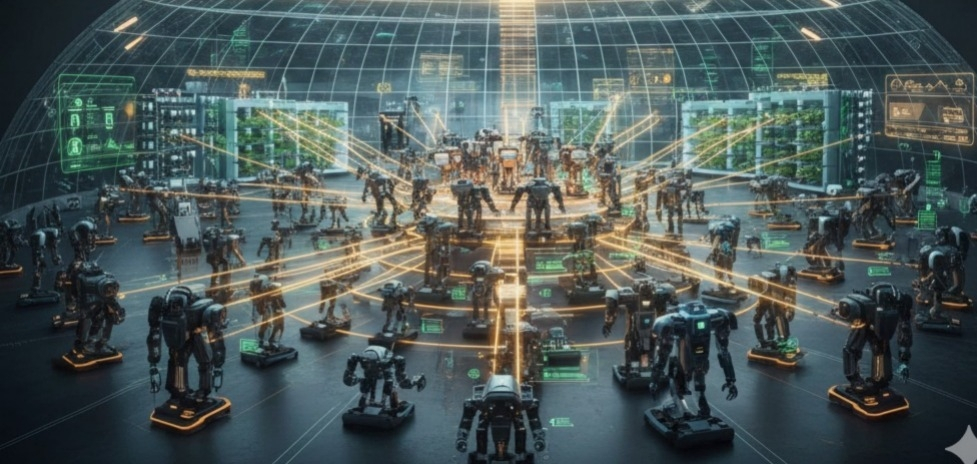
Not through voice. Not through human oversight. But through programmable economic logic embedded directly into the Robo protocol designed by Fabric Foundation.
That is when I stopped seeing Robo as just a robotics framework and started seeing it as a negotiation layer for machines.
In this scenario, the overloaded warehouse node broadcasts a coordination request across the Robo network. Nearby robotic agents evaluate the signal independently. Each one calculates operational cost, energy expenditure, reliability score, and potential reward. The decision to assist is not commanded. It is economically rational within the rules structured by Fabric Foundation.
What fascinates me is that Robo by Fabric Foundation does not automate tasks alone. It automates alignment.
Every robotic agent operates under measurable contribution metrics. If one robot consistently underperforms after accepting coordination tasks, its reliability score decreases. That directly impacts future earning potential within the Robo network. If another agent strengthens overall efficiency and maintains high performance consistency, its economic weight increases.
From my perspective, this transforms robotics from execution into participation.
Fabric Foundation’s broader vision seems centered around programmable trust, and Robo feels like the applied layer where that trust becomes operational among machines. Authority is replaced with transparent rules. Oversight is replaced with algorithmic accountability.
In centralized robotics systems, discipline comes from control. In Robo by Fabric Foundation, discipline emerges from incentives.
This difference matters.
Machines can already calculate, navigate, and execute complex tasks. What they lack in decentralized environments is a shared economic framework that allows them to coordinate without relying on a central operator. Robo appears built precisely for that purpose.
In my imagined example, over time, clusters of highly reliable robots form stronger coordination relationships. They complete tasks faster, reduce friction, and improve throughput. The Robo protocol recognizes this increased efficiency. The network begins allocating higher economic recognition to these high-performing coordination clusters.
This is not forced cooperation.
It is emergent coordination driven by incentive design engineered under Fabric Foundation’s infrastructure philosophy.
Another element that stands out to me is adaptability. Suppose demand patterns change across regions. Under Robo by Fabric Foundation, reward parameters can adjust based on measurable network conditions. During peak demand, responsiveness may carry more economic weight. During stable periods, efficiency and resource optimization may dominate.
The system recalibrates without waiting for manual governance intervention.
From my analysis, that adaptability is critical for real-world robotics deployment. Machine networks operate continuously. Their economic logic must be equally responsive.
What I appreciate most is that Robo does not treat robots as extensions of centralized entities. It treats them as independent participants within a shared coordination protocol. Fabric Foundation provides the structural backbone, while Robo operationalizes that structure inside machine ecosystems.
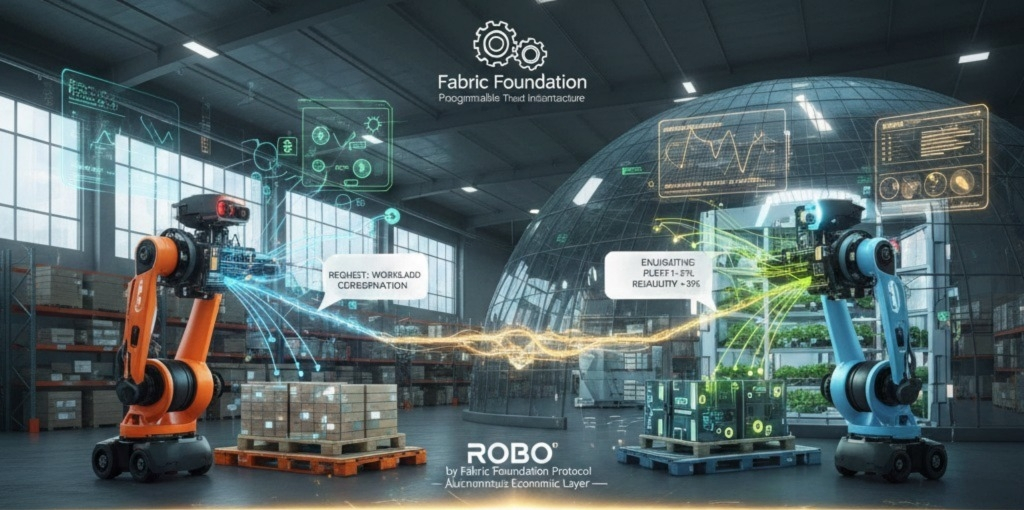
In my view, this combination signals something larger than robotics integration.
It hints at autonomous machine markets.
Markets where machines offer services to other machines.
Markets where reliability compounds into economic advantage.
Markets where trust is enforced by code rather than corporate hierarchy.
When I imagine those two warehouse robots negotiating workload through Robo by Fabric Foundation, I do not just see efficiency gains. I see the early architecture of decentralized machine economies.
That is the angle that excites me most.
Robo is not simply about robotics.
Fabric Foundation is not simply about infrastructure.
Together, they are designing the rules by which autonomous agents collaborate, compete, and create value without centralized command.
And from my perspective, that negotiation layer is where the real breakthrough lies.