
I still remember the moment it clicked for me. It was a normal day and I was reading about automation, robotics and the growing influence of AI in our everyday lives. I had gone through hundreds of crypto projects claiming they would connect the physical world to the blockchain but most of them either stayed in theory or disappeared before delivering anything meaningful. Nothing felt real enough to capture my interest. Everything looked like the same old promise wrapped in new words. But that changed when I discovered the system that Fabric Foundation was building.
It was the first time I saw a project that did not just talk about automated machines. It created a method where robots could complete a task, produce measurable output and then turn that verified output into digital value on chain. I read the idea again and again and the more I understood it the more I realized this was not a simple concept. It was a shift in how we think about work, value and the connection between machines and decentralized systems.
The idea that a robot could perform work and earn value on chain is powerful because it changes the entire relationship between automation and crypto. For years automation happened in factories, warehouses, farms and labs but the value stayed locked inside private companies. The output never touched a blockchain. It never became a measurable part of an open economy. What Fabric built feels like the first real bridge between those two worlds.
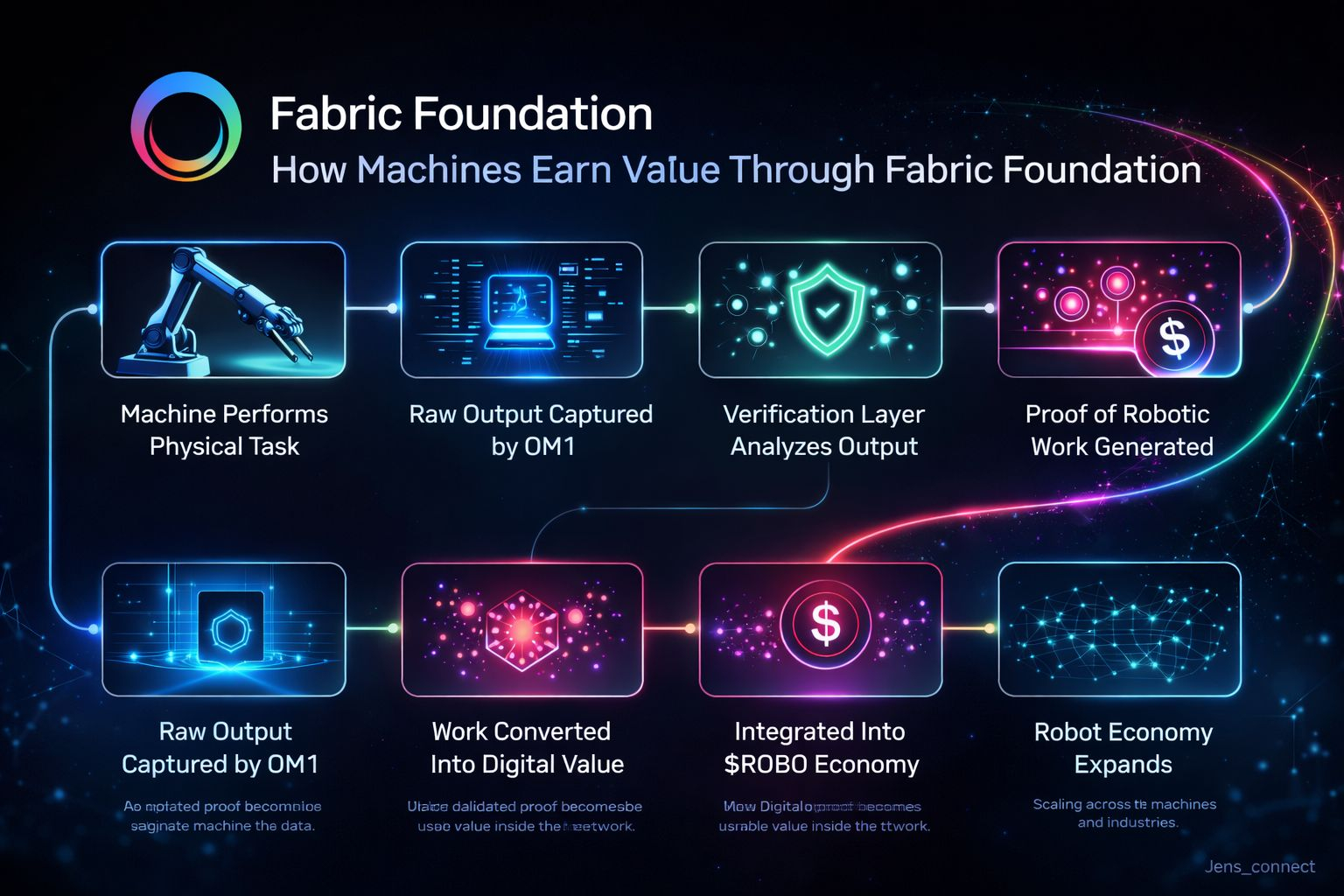
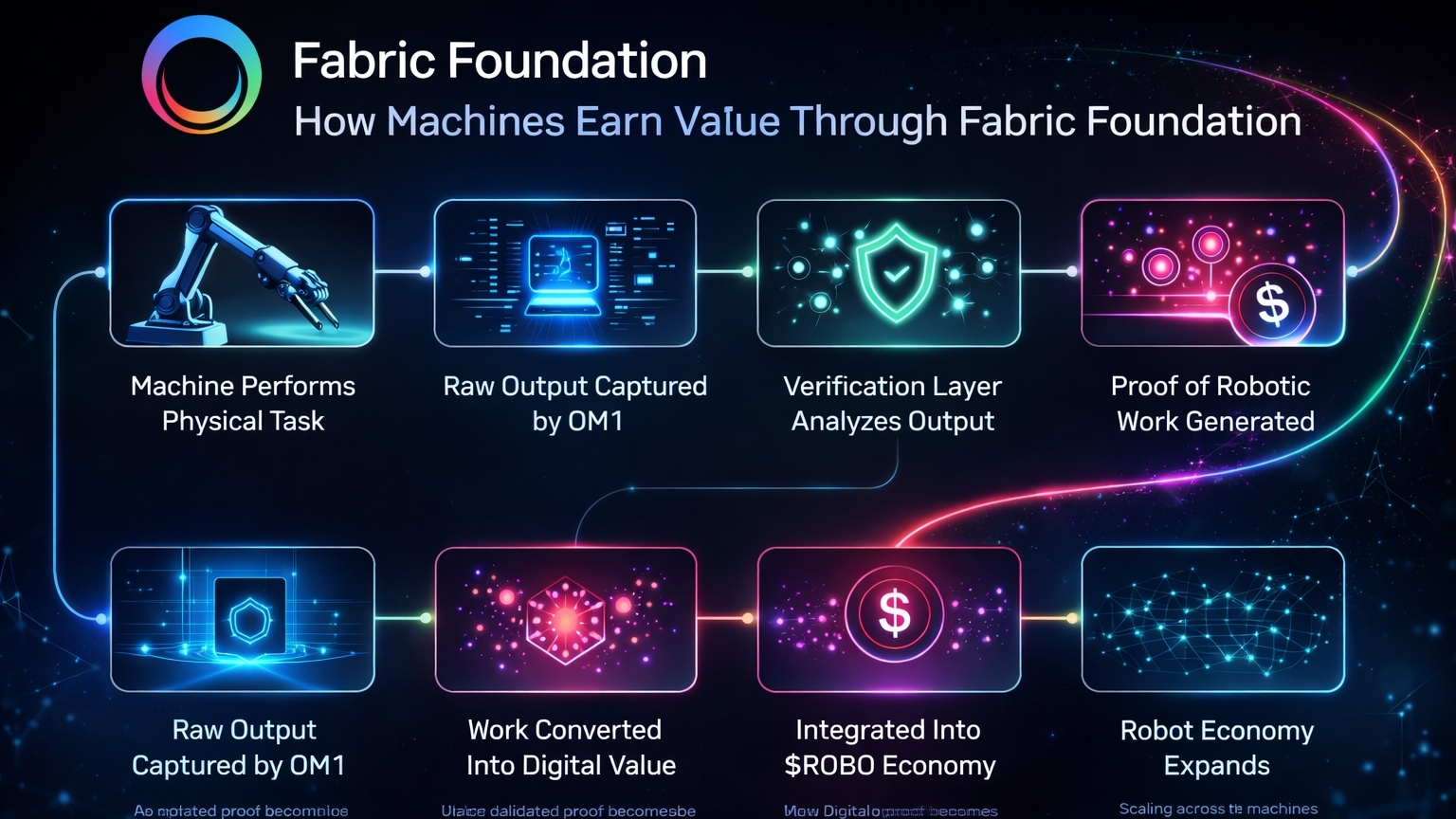
I kept thinking about the process. A robot completes a task. That task creates measurable output. The system captures that output. Then the network verifies what happened using real world data. After verification the work becomes registered as digital value. That value then becomes part of the movement of $ROBO which represents the activity happening inside the network. I sat with this idea for a long time because it almost felt too simple. Yet simplicity is usually the sign that a model is built correctly.
The more I observed the architecture the more I realized the strength of the system comes from the workflow. It does not depend on predictions. It depends on measurable work. Instead of trying to create imaginary utility for a token Fabric tied ROBO directly to verified robotic output. This design choice alone makes it one of the most grounded projects in the automation and robotics sector.
What impressed me the most was the approach. Fabric did not begin by trying to automate the entire world. It started with practical tasks. A drone scanning an area. A robotic arm assembling small components. A sensor reporting environmental readings. These are everyday tasks that thousands of machines perform right now. They are not futuristic fantasies. They are real and repeatable. By capturing and verifying the output from such tasks the network can scale from small work to large work without breaking the system.
At that moment I thought about how early blockchains attempted something similar. Many tried to tokenize activity but failed because there was no link between real world output and the digital token. The gap was too big and the models collapsed. Fabric avoided this by starting from the physical world first. The robot moves. The robot performs. The work occurs. Only after that does the digital layer come into play. That is the opposite of how most crypto projects operate. Here the real world leads and the blockchain follows.
Then I saw the role of the OM1 operating system and everything made even more sense. OM1 allows machines to become part of a unified environment where their work can be registered, measured and verified without friction. It standardizes the process in a way that lets different machines participate even if they come from different manufacturers. The design removes fragmentation which is a major barrier in robotics. Once everything flows through a unified operating system the data becomes cleaner and verification becomes far more accurate.
As I continued exploring I started imagining the possibilities. Factories where assembly robots automatically feed their output into the network. Farms where agricultural machines log their actions and generate verified work. Delivery drones whose completed routes become measurable contributions. Construction robots whose tasks become provable entries on chain. The picture that formed in my mind felt like the beginning of a genuine robot economy where machine labor is not invisible but acknowledged and rewarded.
I also thought about the social impact. There has always been fear around automation replacing human jobs. But what if the introduction of a robot economy led to a different model entirely. Instead of machines replacing people they become contributors to a decentralized system that humans also participate in. The value created by robots flows through a token that humans can hold, trade or use to access automation services. In this scenario machines and humans are not fighting for resources. They are building a shared network where verified productivity has an economic identity.
This thought stayed with me because it changes the narrative of automation. It shows robots not as silent workers whose output disappears inside a company’s private server but as active contributors in an open economy. Their performance becomes visible. Their work becomes data. Their data becomes value. And that value becomes part of a new economic cycle built around automation.
What makes this even more compelling is that Fabric is not imagining a world twenty years away. It is building for the machines operating right now. Robots already exist. Sensors already exist. Automated devices are everywhere. The missing layer was the ability to measure their output in a standardized way and to convert that output into verifiable on chain value. Fabric designed this missing layer and delivered it in a way that feels practical instead of theoretical.
There was another moment when I realized the potential. It was when I thought about how blockchains reward digital activity. A transaction happens and the miner or validator gets paid. A smart contract runs and the network processes it. But with Fabric something new happens. A machine completes a physical task and that physical task becomes part of the computation of economic value. This is a major shift because it blends the digital world and the real world in a way we have not seen before.
When you look at $ROBO inside this system it behaves as the economic language of machine work. It is not an incentive created for marketing. It is the representation of verified output. That is why the token feels different from typical crypto assets. It is backed by something measurable happening in the physical world.
The more I wrote, read and experienced the system the more I realized I was watching the early structure of an entirely new category. Not a blockchain. Not a robotics firm. Not an automation startup. It is a hybrid model where machines operate, humans build infrastructure and the network verifies real work. This tri layer collaboration is rare in crypto. That is why Fabric stands out so strongly.
By the time I finished understanding the entire cycle one thing became clear to me. This is not just a project. It is a shift in how we understand value produced by machines. This is how a robot economy actually begins. Quietly. Gradually. Task by task. Output by output. Verification by verification. And with each verified action the network grows stronger.
The day I understood that machines could earn value on chain was the day I realized how early we truly are. Most people look at robots and crypto as two separate industries. Fabric brings them together in a way that feels natural. One produces work. The other verifies and distributes value. The cycle is complete. The potential is massive.
And this is only the beginning.