
For many years robots were mostly confined to controlled environments like factories and laboratories. They performed repetitive tasks with precision and efficiency, but they rarely interacted with the broader world in a meaningful way. Today that reality is changing. Advances in artificial intelligence, computing power, and robotics engineering are pushing machines beyond isolated environments into everyday life. Robots are beginning to assist in logistics, healthcare, research, agriculture, and even household tasks. As these systems become more capable and more autonomous, a new challenge emerges. It is no longer only about building smarter robots. It is about creating the infrastructure that allows robots to operate, coordinate, and evolve safely at a global scale.

Fabric Protocol is an attempt to build that kind of infrastructure.
Fabric Protocol is designed as a global open network that supports the development, governance, and coordination of general-purpose robotic systems. The project is supported by the non-profit Fabric Foundation, which focuses on building open technologies that encourage collaboration rather than isolated development. Instead of a future where every company builds robotic systems that exist inside closed ecosystems, Fabric introduces the idea of a shared digital environment where robots and intelligent agents can interact through verifiable computing and decentralized coordination.
The concept behind Fabric Protocol begins with a simple observation about the future of machines. As robotics technology continues to improve, robots will increasingly interact not only with humans but also with other machines. Autonomous delivery robots may need to communicate with traffic infrastructure. Industrial robots may coordinate tasks across multiple facilities. Service robots in hospitals may interact with diagnostic AI systems and patient monitoring devices. Without a shared framework that allows these systems to exchange information and follow common rules, managing this complexity becomes extremely difficult.
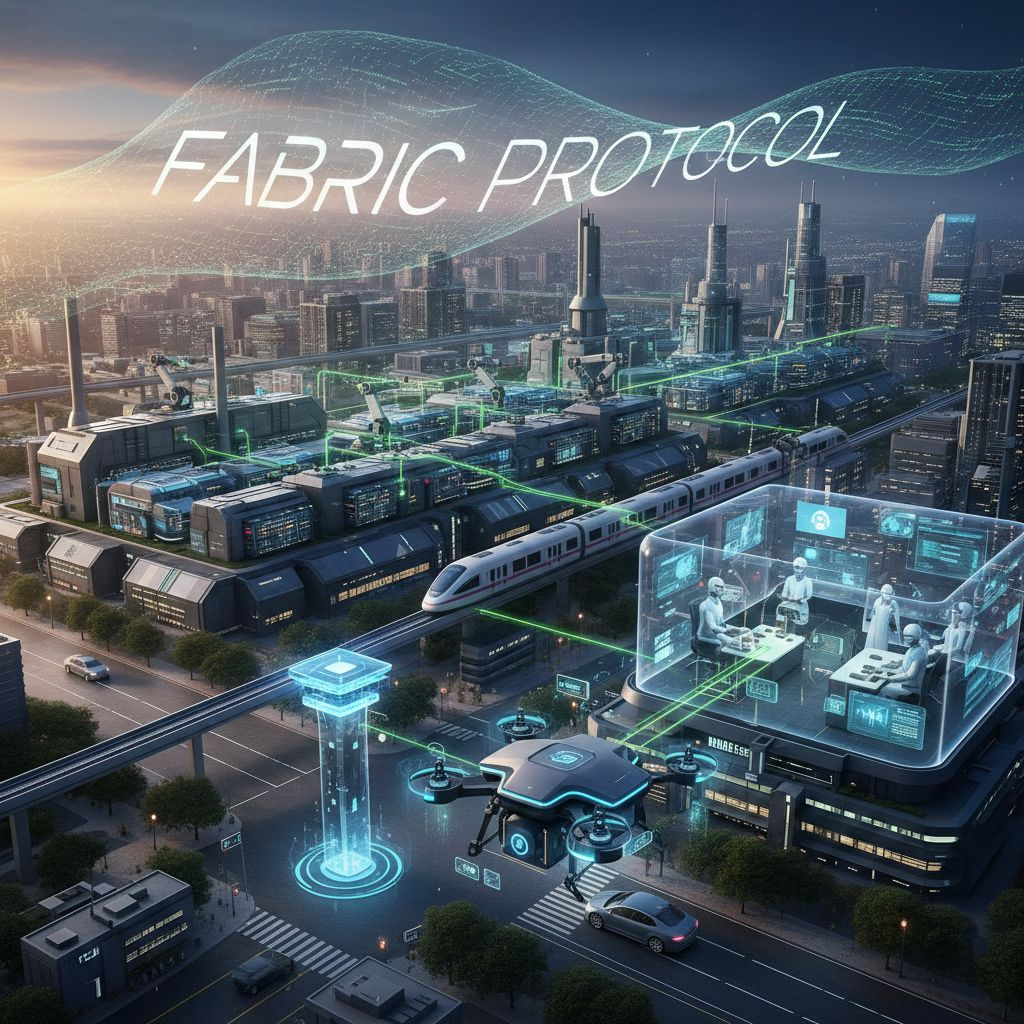
Fabric Protocol aims to create a coordination layer that allows these different systems to operate within a shared network.
At the heart of the protocol is the idea of verifiable computing. In traditional software systems, users must trust that a program performs its calculations correctly. However, when machines begin making decisions that affect the physical world, relying solely on trust becomes risky. Robots may be performing tasks that involve safety, security, or economic value. Fabric Protocol introduces a framework where computational processes can be verified rather than simply assumed to be correct.
This means that when a robot processes data or executes a decision through the network, the system can provide proof that the computation followed the expected rules. Instead of depending on centralized authorities to confirm these actions, the verification process can occur through decentralized mechanisms supported by the network. This approach helps create a higher level of transparency and accountability, which is essential when machines operate autonomously in environments shared with humans.
Another important part of Fabric Protocol is its focus on agent-native infrastructure. Most digital systems today were originally designed for human interaction. Websites, applications, and communication platforms assume that people are the primary users. Even many blockchain networks are built with human participants in mind. However, the next phase of technological evolution will likely include a vast number of intelligent agents and robotic systems interacting with each other automatically.
Fabric Protocol is built to support this emerging reality.
Instead of treating robots as external tools that connect to human-focused systems, Fabric designs its infrastructure specifically for machine interaction. Intelligent agents can exchange data, coordinate computation, and operate under shared rules through the protocol. This creates an environment where robotic systems developed by different organizations can collaborate without needing to rely on proprietary integration methods.
To coordinate this activity, Fabric Protocol uses a public ledger that records key actions within the network. This ledger functions as a transparent record of information such as computational results, governance decisions, and system updates. Similar to how blockchain technology provides transparency for financial transactions, Fabric’s ledger provides visibility into the operations of robotic systems connected to the network.
The presence of a shared ledger helps ensure that data and actions remain traceable and verifiable.
In a future where robots perform important tasks across industries, transparency will be critical for maintaining trust. If a machine executes a process or interacts with another system, the details of that action can be recorded within the network. This creates a system where participants can verify how the network operates without relying on hidden or centralized control structures.
Fabric Protocol also emphasizes modular infrastructure. Rather than forcing developers to adopt a single rigid platform, the protocol allows different components to connect through flexible interfaces. Developers can build applications, robotic systems, or artificial intelligence tools that operate on top of the network while maintaining independence in how those systems evolve.
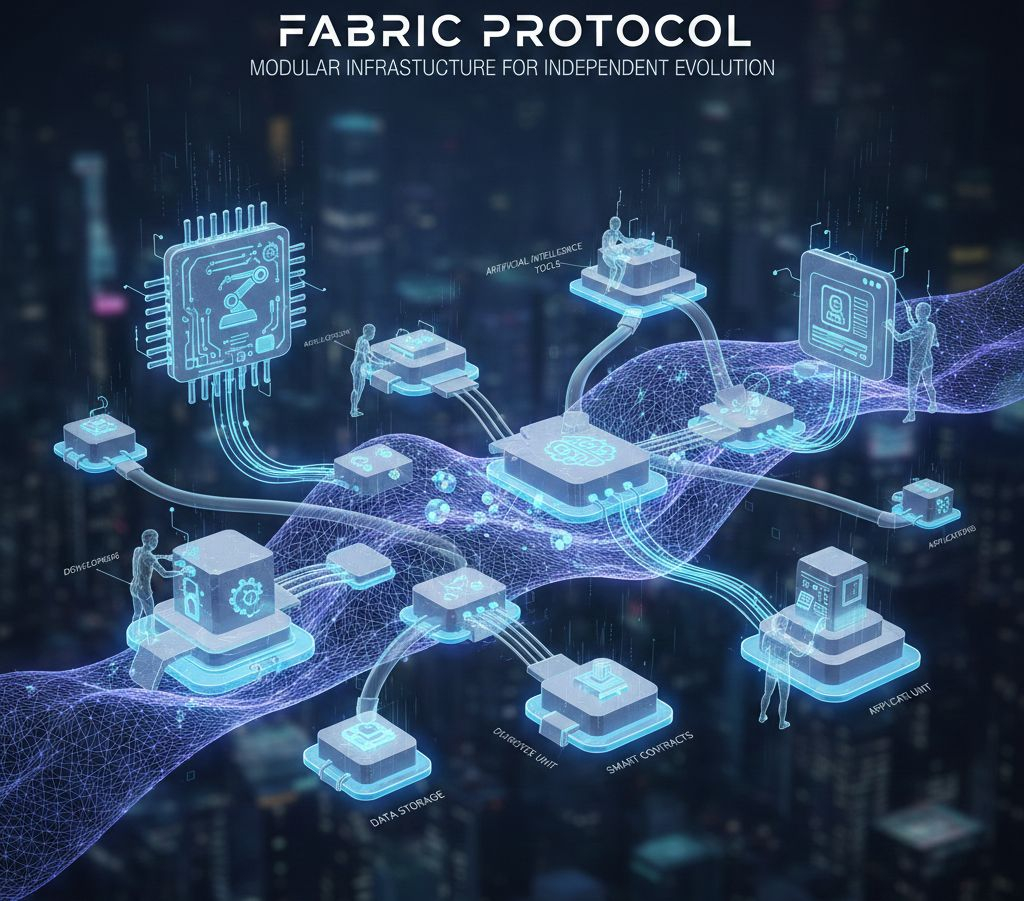
This modular design is particularly important in robotics because the field is evolving rapidly. New hardware capabilities, sensors, and learning algorithms are introduced frequently. A system that allows independent modules to improve and integrate without disrupting the entire network provides a significant advantage.
Fabric’s modular approach allows innovation to happen at multiple levels simultaneously.
Some developers may focus on building advanced robotic hardware. Others may design machine learning models that help robots understand complex environments. Still others may create governance tools or regulatory frameworks that guide how robotic systems operate in society. Fabric Protocol provides the infrastructure where all of these elements can interact and contribute to the broader ecosystem.
Another major element of the protocol involves governance and regulation. As robots become more integrated into daily life, societies will need systems that determine how these machines operate responsibly. Questions about accountability, safety standards, and ethical behavior will become increasingly important.
Fabric Protocol attempts to incorporate governance mechanisms directly into the network itself.
Through transparent processes recorded on the ledger, participants in the ecosystem can propose updates, implement rules, and discuss standards that shape how robotic systems evolve. This decentralized approach helps ensure that the development of robotic infrastructure does not become dominated by a small group of organizations. Instead, governance can involve contributions from researchers, developers, institutions, and communities.
This collaborative structure may help balance innovation with responsibility.
The protocol also opens possibilities for shared learning among robotic systems. Every robot operating in the physical world gathers valuable information about its environment. Sensors collect data about movement, obstacles, human interaction, and task outcomes. If this information can be shared responsibly across a global network, robotic systems may improve far more quickly than if each system learns independently.
Fabric Protocol creates a framework where data and computational insights can be coordinated in ways that benefit the entire ecosystem while maintaining verification and accountability.
Over time, this type of shared learning could accelerate progress in many industries. Robots used in logistics might learn more efficient routing strategies. Healthcare robots could improve patient assistance techniques. Environmental monitoring systems could gather insights that help researchers understand ecosystems more effectively.
Despite the promise of this vision, building a global network for robotics presents significant challenges. Robotics involves complex hardware, strict safety requirements, and regulatory environments that differ across countries. Integrating these factors into a unified infrastructure requires careful planning and collaboration.
Fabric Protocol does not claim to solve every challenge immediately.
Instead, it proposes a framework that could support long-term coordination between machines, developers, and institutions. By combining verifiable computing, decentralized governance, and agent-native infrastructure, the protocol attempts to create a foundation where robotic systems can grow together rather than remaining fragmented.
The broader significance of Fabric Protocol lies in how it reimagines the relationship between humans and machines. Instead of viewing robots as isolated tools performing specific tasks, the project envisions a network where machines become participants in a shared technological ecosystem.
In this ecosystem, robots can exchange information, follow transparent rules, and contribute to collective progress.
As robotics continues to expand into everyday life, the need for such infrastructure will likely become more visible. Cities, industries, and communities may depend on coordinated networks of intelligent machines that support transportation, healthcare, environmental protection, and countless other activities.
Fabric Protocol represents an early step toward exploring how those networks might be built.
If successful, systems like this could transform robotics from a collection of disconnected machines into a collaborative global network where humans and robots work together more safely and effectively than ever before.
@Fabric Foundation #ROBO $ROBO
