
I kept thinking about one uncomfortable question after reading the Fabric whitepaper.
If robots start doing most of the work…
Who gets paid?
Not in theory.
Not philosophically.
But economically.
Because here’s the reality:
Robots don’t just “assist” anymore.
They drive.
They diagnose.
They trade.
They build.
And unlike humans, when one robot learns something, thousands can copy that skill instantly.
That’s powerful.
But it’s also dangerous.
Because if one company controls that network of machines, it doesn’t just own robots —
it owns productivity.
That’s when something clicked for me.
Fabric isn’t trying to build better robots.
It’s trying to build the economic system behind them.
---
## The Part That Made Me Pause
Most tokens inflate because… well, that’s what tokens do.
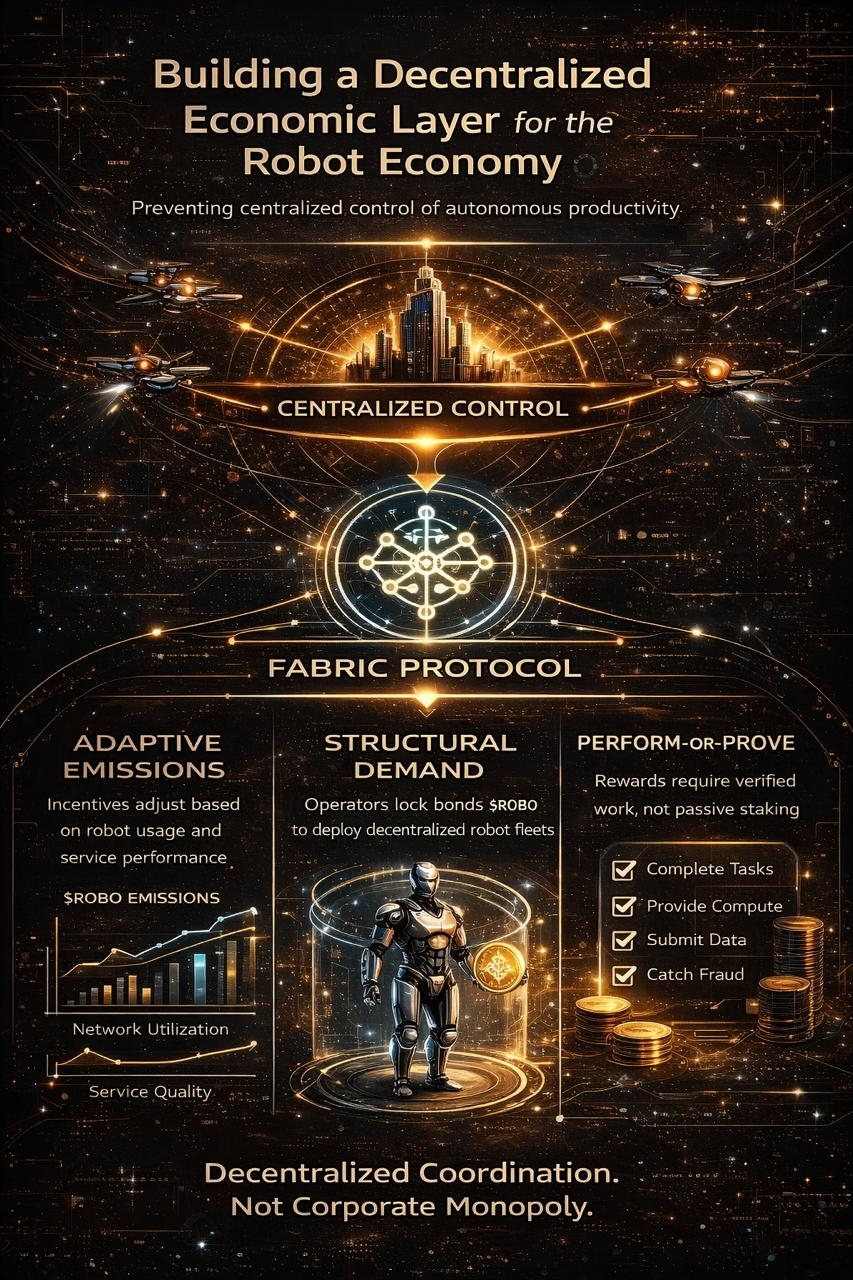
But $ROBO emissions actually adjust.
If robots are underused → emissions increase to attract participation.
If robots are highly utilized → emissions decrease.
And if quality drops?
Emissions decrease too.
That part matters.
The system doesn’t reward activity alone.
It rewards reliability.
That’s rare.

---
## And Then There’s the Bond Mechanism
Anyone who wants to deploy robots has to post a bond.
The more capacity they declare, the more tokens they lock.
So demand isn’t driven by “hype.”
It scales with actual robot throughput.
More robots working →
More tokens locked.
It’s subtle, but structurally important.
---
## No Free Ride
This might be the most honest design choice.
Holding tokens does nothing.
You don’t earn for sitting.
You earn for:
• Completing verified tasks
• Providing compute
• Contributing data
• Catching fraud
No passive yield.
No delegation farming.
No illusion of productivity.
If you don’t contribute, you don’t earn.
That changes the psychology of participation completely.
---
## The Anti-Fraud Insight
Fabric uses something called a Hybrid Graph Value system.
Early on, rewards favor activity.
Later, they shift toward revenue.
But here’s the clever part:
If someone tries to fake transactions with themselves,
they create an isolated economic “island.”
And isolated islands don’t matter.
Rewards flow through connected economic graphs.
Fraud isn’t magically impossible.
It’s just economically pointless.
That’s a smarter way to design systems.
---
## The Bigger Realization
Most crypto projects focus on scarcity.
Fabric focuses on coordination.
It assumes something bold:
Robots will become economically productive at scale.
And when they do,
the incentive layer behind them will matter more than the hardware.
If machines generate value,
how that value is distributed becomes infrastructure.
Fabric is attempting to build that infrastructure.
Not perfectly.
Not guaranteed.
But intentionally.
And that’s what makes it interesting.
#FabricProtocol #ROBO #Aİ #DePIN #BinanceSquare @Fabric Foundation