As we move into March 2026, the conversation on Binance Square has shifted from pure speculation to real-world infrastructure. Leading this movement is the Fabric Foundation (@FabricFND), which recently launched its $ROBO token to solve the most significant bottleneck in robotics: Financial Identity.
The "Android for Robots" Moment
Just as Android unified mobile software, the OM1 operating system—often called the "Android for Robots"—is unifying the hardware world. Whether it's a humanoid from UBTech or a specialized factory unit, OM1 allows these machines to "speak" the same language. But a brain needs a wallet, and that’s where the Fabric Protocol comes in.
Why $ROBO Matters in 2026
The ROBO token isn't just a digital asset; it is the "settlement layer" for autonomous machines. In the Fabric ecosystem, robots are no longer just tools; they are independent economic actors.
On-Chain Identity: Using the Fabric Protocol, robots have their own Web3 wallets. They can now "pay" for their own charging, maintenance, and data.
Proof-of-Robotic-Work: In a groundbreaking move for 2026, the foundation is rolling out incentives where ROBO is earned by robots performing verified real-world tasks.
The Skill App Store: Developers can now upload "Skill Chips," which robots autonomously purchase using ROBO to learn new tasks instantly.
Market Outlook: The Titan Launch
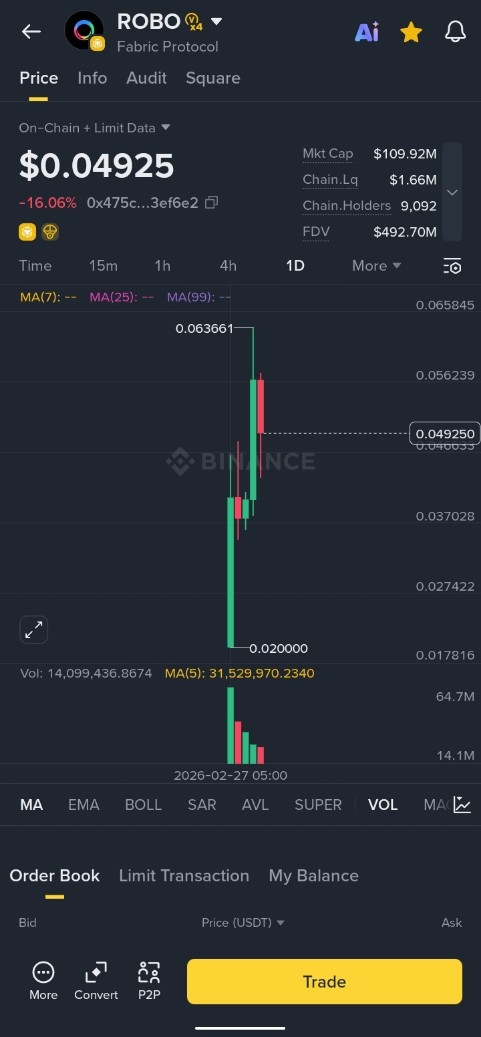
Since its Titan-mode launch on the Base network last month, $ROBO has shown incredible resilience, recently surging over 50% as institutional interest in DePIN (Decentralized Physical Infrastructure) peaks. With a fixed supply and a revenue-sharing model that includes open-market buybacks, the tokenomics are designed for long-term sustainability rather than short-term hype.
As we look toward the eventual migration to a dedicated Fabric Layer-1 blockchain, one thing is clear: the robot economy isn't a future dream—it's being built right now.
#robo #cryptojackie #crypto @Fabric Foundation