

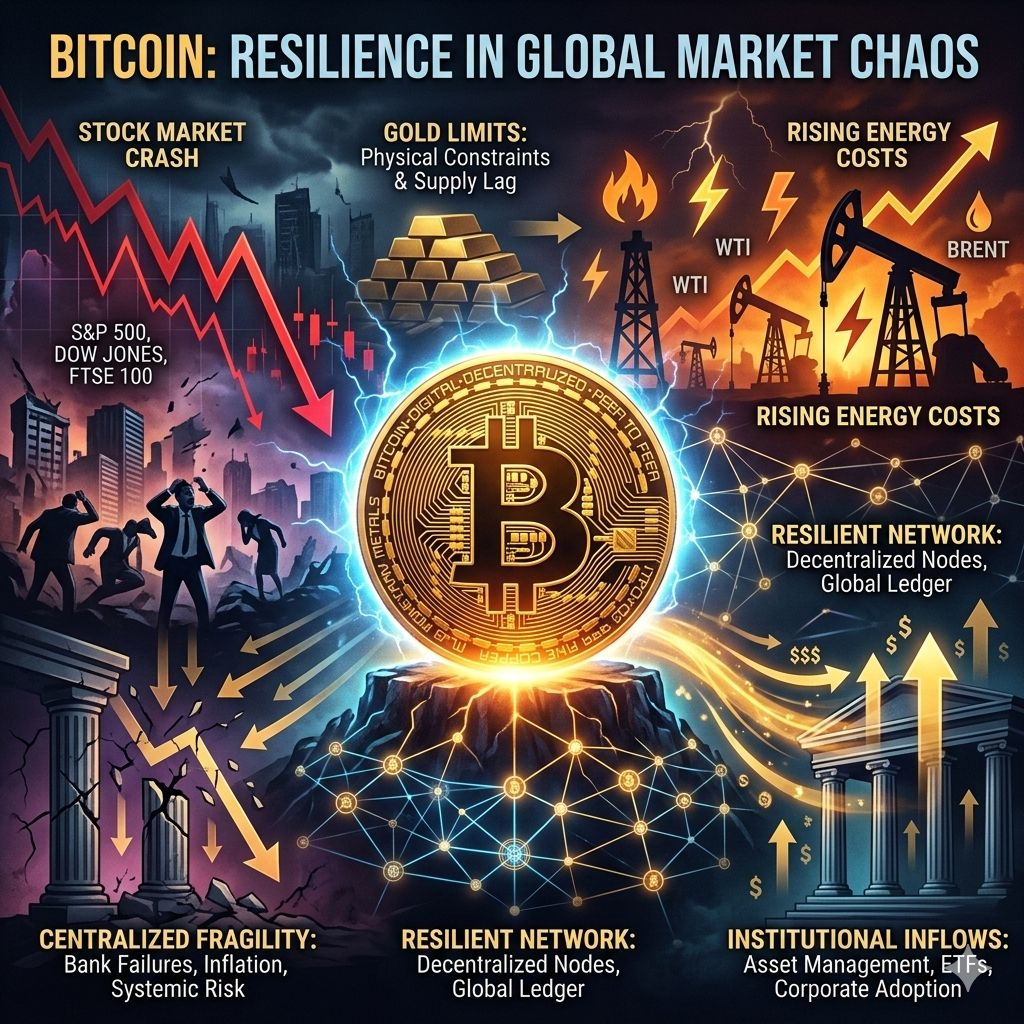
Global financial markets are navigating one of their most fragile periods in recent months. Escalating geopolitical tensions, rising energy prices, and uncertainty around global trade routes have triggered sharp reactions across equities, commodities, and currencies. Volatility is no longer localized — it is systemic.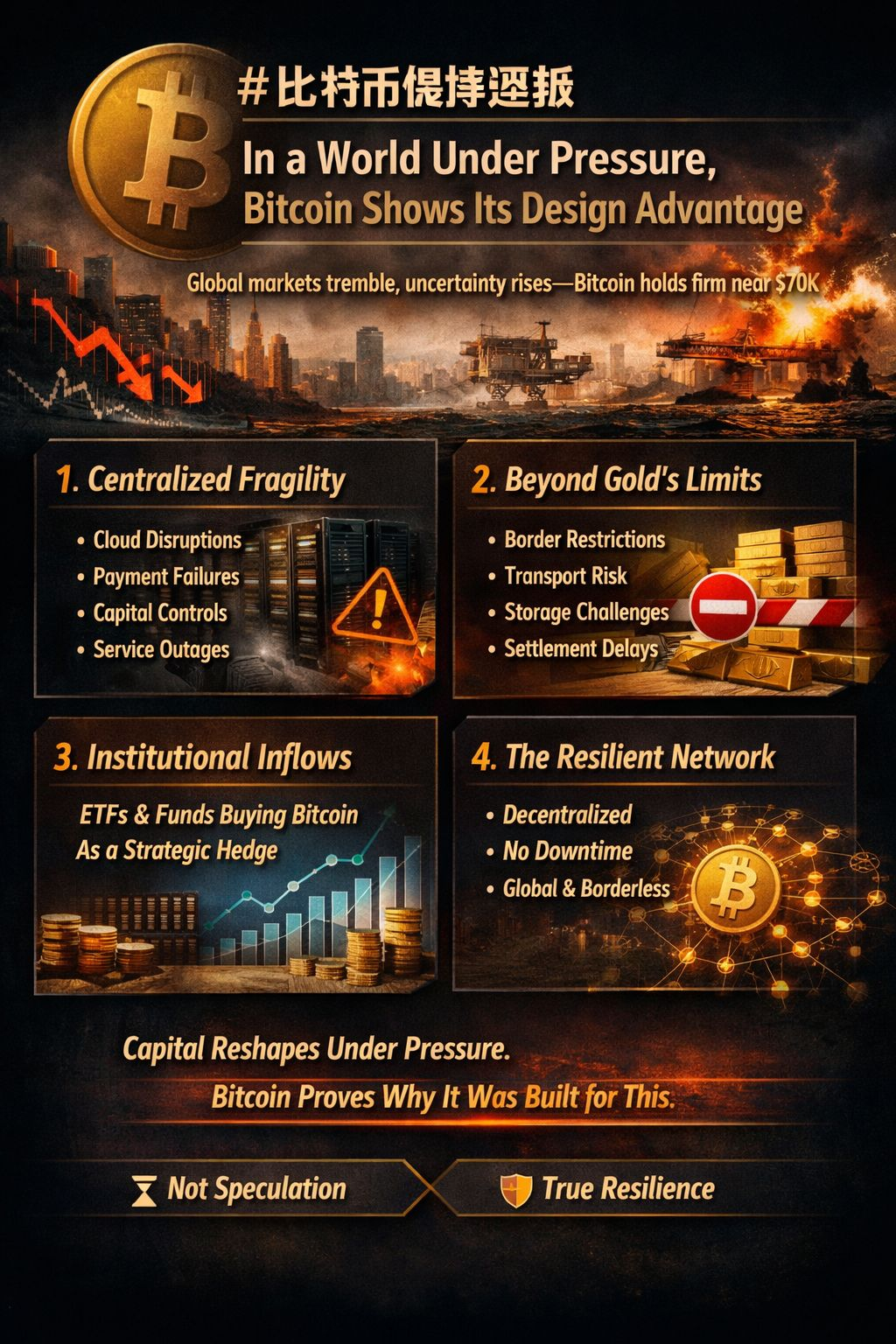
When fear spreads across traditional markets, capital doesn’t disappear.
It moves.
Against this backdrop, Bitcoin has demonstrated notable resilience. After an initial wave of risk-off selling, Bitcoin stabilized quickly and continued trading near the $70,000 region — not driven by hype, but by structure, liquidity, and conviction.
This behavior reflects a deeper shift in how the market now views Bitcoin.
01 | Stress Exposes the Weakness of Centralized Systems
Modern economies are built on centralized foundations:
cloud infrastructure
payment networks
clearing systems
regulatory permissions
These systems function efficiently in stable environments. Under geopolitical pressure, however, they reveal structural fragility. Connectivity restrictions, operational disruptions, regulatory interventions, and service outages become real risks — not hypotheticals.
Bitcoin operates outside this framework.
It has no headquarters to shut down.
No central server to disable.
No authority capable of freezing the protocol.
As long as independent nodes continue to operate globally, the network continues to settle transactions and produce blocks. This isn’t ideology — it’s architecture.
Decentralization is no longer a philosophical debate.
It’s a risk-management feature.
02 | Redefining the Meaning of a Safe Haven
For centuries, gold has been viewed as the ultimate store of value during uncertainty. Yet modern crises have introduced new constraints:
physical transport limitations
border and customs controls
storage and verification costs
delayed settlement
Preservation alone is no longer enough.
Mobility and access now matter.
Bitcoin transforms value into information. It can be held without physical storage, transferred globally without intermediaries, and verified without trust in institutions. In environments where movement, liquidity, and neutrality are restricted, these properties become decisive.
Bitcoin does not replace gold — but it competes where speed, sovereignty, and portability are required.
03 | Capital Doesn’t Lie: Institutions Are Positioning
Beyond narratives and headlines, capital allocation reveals real conviction.
Recent inflows into US spot Bitcoin ETFs signal a shift in institutional behavior. After months of cautious positioning, funds are rotating toward Bitcoin not as a speculative instrument, but as a strategic hedge against systemic risk.
Products associated with BlackRock have recorded sustained inflows, reinforcing the idea that large institutions are beginning to treat Bitcoin as part of long-term portfolio construction — not short-term trading.
Institutions don’t react emotionally.
They prepare for scenarios.
04 | Bitcoin’s Role Is Evolving — Quietly
This phase of the market is not defined by euphoria. There is no retail frenzy. No irrational leverage. What we are seeing instead is quieter, more deliberate behavior:
• Reduced panic selling
• Faster recoveries after shocks
• Stronger bids during uncertainty
• Increasing long-term holding
Bitcoin is being stress-tested in real time — and the network, liquidity, and market structure continue to hold.
Final Takeaway
When the global environment becomes unstable, some assets require stability to survive. Bitcoin is designed to operate because instability exists.
This is not a rally fueled by excitement.
It is a repricing of resilience.
Markets are learning an important lesson: In times of uncertainty, strength is not defined by promises —
but by what continues to function when everything else is tested.
Bitcoin isn’t reacting to chaos.
It’s proving why it was built for it.
