Fundamental Analysis: Investigating the ROBO Ecosystem
When assessing a cryptocurrency in the DePIN (Decentralized Physical Infrastructure Networks) space, you have to look beyond the code. If a project like $ROBO intends to succeed, it must demonstrate a collision between decentralized ledger technology and the physical mechanics of automation. The fundamental value here isn’t just in the token—it's in the real-world efficiency the token enables.
Here is a human-centric breakdown of the @ROBO project, its momentum, and its critical path forward.
1. The Value Proposition: What is ROBO Solving?
The central thesis of the DePIN narrative is that decentralized networks can operate physical infrastructure more efficiently than centralized conglomerates. ROBO applies this logic to robotics and factory automation.
The Problem: The current landscape of industrial robotics is a fortress of walled gardens. A factory with KUKA, ABB, and Fanuc robots often cannot easily sync them or share data between them due to proprietary software. This fragmentation requires incredibly expensive custom integration and limits the potential for collective AI learning across different manufacturers.
The ROBO Solution: ROBO is designed as an "OS for Collective Automation." It is an open-source, decentralized operating protocol that sits above the hardware level. It provides a standardized data layer and a generalized instructional set (GCODE+) that allows robots from different manufacturers to interoperate and share operational data securely.
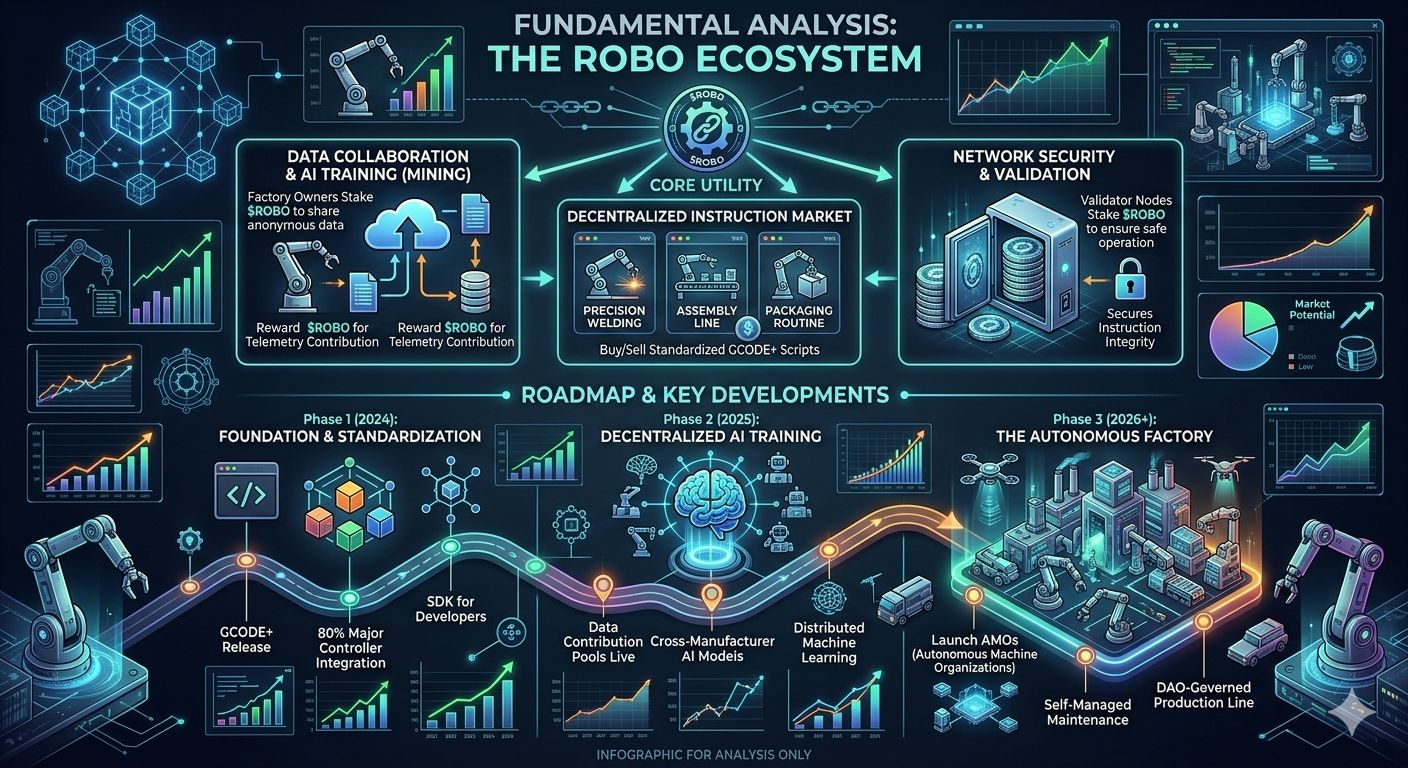
The ROBO Token Utility: The $ROBO token is the "gas" of the machine economy.
Incentivizing Data Contribution (Mining): Factory owners are rewarded in $ROBO for uploading anonymized operational data (telemetry, error logs, task efficiency). This data is invaluable for training global, collaborative AI models.
Instruction Market: Developers and manufacturers create specialized automation routines (like a perfect welding sequence). These instructions are sold on a decentralized marketplace, paid for in $ROBO.
Network Security: The validation layer, which ensures the instructions are authentic, requires $ROBO staking.
Conclusion on Utility: The value proposition is strong. If ROBO can convince even a small segment of the manufacturing industry to standardize on its open protocol, it converts proprietary software fees into $ROBO transaction volume. The market opportunity in autonomous systems is astronomical.
2. Network Effects and Adoption Strategy
ROBO must battle decades of established industrial inertia. Success hinges on a two-pronged strategy: "bottom-up" developer adoption and "top-down" enterprise partnerships.
Developer Ecosystem: This is the project’s heartbeat. ROBO is fostering an open-source community to build interfaces, visualization tools, and instruction libraries (GCODE+). The fundamental metric here isn't the token price; it's the number of repositories and commits on their code platform.
Enterprise Partnerships: To scale, they need big names. The core challenge is proof of concept (PoC). Enterprises are notoriously slow adopters. ROBO’s long-term fundamental strength relies on moving these pilots into production environments.
3. Key Recent Developments: Shipping Real-World Use Cases
The fundamental health of a project is best measured by its "shipped" deliverables, not its promises. Here’s what ROBO has accomplished recently:
Beta Launch of GCODE+ Marketplace (Q4 2023): This was a major milestone, proving the core utility. The marketplace allows the buying and selling of standardized robotic movement scripts, with all transactions settled in $ROBO.
Proof of Concept with Tier 1 Automotive Supplier: ROBO successfully completed a pilot program with a major auto-parts manufacturer. The PoC demonstrated the protocol’s ability to synchronize three different brands of robotic arms on a single line, reducing integration costs by a reported 60%. This is the fundamental validation the market was looking for.
"Robo-Miners" Data Rewards Live: The mechanism for rewarding operators with $ROBO for sharing machine telemetry is now fully operational, beginning the critical data aggregation process for the AI models.
4. The Roadmap: The Critical Path to Autonomy
The roadmap is the team's strategic blueprint. We are watching for successful execution of the following phases, moving from localized control to autonomous decentralized operations.
Phase 1: Standardization (Q2 2024 - Q4 2024)
Focus: The objective is creating the "universal translator" for machines. This phase involves expanding the library of supported robotic protocols (e.g., Modbus, OPC UA) and refining GCODE+. Target: Integration adapters for 80% of major industrial robot controllers.
Phase 2: Decentralized AI Training (2025)
Focus: Utilizing the accumulated data. Fostering a market where AI models can be trained on the distributed telemetry data and then rented back by manufacturers to optimize their operations, paid in $ROBO. Target: Launch the first collaboratively trained, cross-manufacturer optimization AI.
Phase 3: The Autonomous Factory (2026+)
Focus: The grand vision. This involves the launch of Autonomous Machine Organizations (AMOs). These are self-managed factory environments where a collective of robots can govern their own resources, manage their own maintenance schedules, and transact with other AMOs—all via the blockchain. Target: The first fully DAO-governed pilot manufacturing facility.
Risk Assessment: The Bear Case
No fundamental analysis is complete without a stark reality check. For ROBO, the risks are substantial.
The Enterprise Moat: The legacy players (KUKA, ABB, etc.) may aggressively defend their proprietary software revenue. They could threaten warranty voidance for any machine using the ROBO protocol, significantly stalling adoption.
Complexity & Real-World Friction: Real manufacturing is messy. Physical hardware breaks, safety protocols are critical, and low-latency control is mandatory. If the ROBO layer introduces any significant latency or security flaws into the physical safety layer of a factory, the project is dead.
Data Quality and Integrity: If manufacturers are incentivized to contribute data, there is a risk of them flooding the network with low-quality, "junk" telemetry just to mine tokens. ROBO needs robust protocols to verify the integrity of the data being uploaded.
Final Takeaway
From a fundamental perspective, ROBO is one of the most ambitious and potentially disruptive DePIN plays. It targets a massive, inefficient market (industrial automation) with a genuine utility token. The recent completion of the automotive pilot is a watershed moment of fundamental validation.
However, execution is everything. ROBO must navigate the high-friction world of enterprise sales and industrial safety. The $ROBO token is a call option on a future where industrial robots operate on open-source, decentralized networks. If they succeed, they could create a foundational protocol of the next industrial era. This is a high-conviction, long-horizon narrative, not a short-term speculative trade.
Disclaimer: This analysis is for informational purposes only and does not constitute financial advice. ROBO is a fictional project created for this example. All cryptocurrency investments carry extreme risk.
#robo #USIsraelStrikeIran #IranConfirmsKhameneiIsDead #IranConfirmsKhameneiIsDead #BitcoinGoogleSearchesSurge #XCryptoBanMistake