
In the history of technology, some of the most important innovations were not the loudest ones. They didn’t appear overnight with huge promises or flashy headlines. Instead, they started quietly with a simple idea that slowly changed how entire industries worked. Fabric Protocol feels like one of those ideas — a quiet but ambitious attempt to reshape the relationship between humans, machines, and the networks that connect them.
For decades, robotics has advanced at an incredible pace. Machines have learned to move, see, and even make decisions using artificial intelligence. Robots now help build cars, sort packages in warehouses, assist doctors in hospitals, and explore environments too dangerous for humans. Yet despite all this progress, there is still one major problem that the robotics industry has struggled with for years: robots rarely understand each other.
Most robots today live inside closed systems built by individual companies. A robot from one manufacturer usually cannot easily communicate or collaborate with a robot built by another. Each machine speaks its own digital language, follows its own rules, and operates inside its own software ecosystem. Billions of dollars have been invested in robotic hardware, but because the systems remain fragmented, their intelligence often remains isolated. Fabric Protocol was born from the belief that this fragmentation is the real bottleneck slowing down the evolution of robotics.
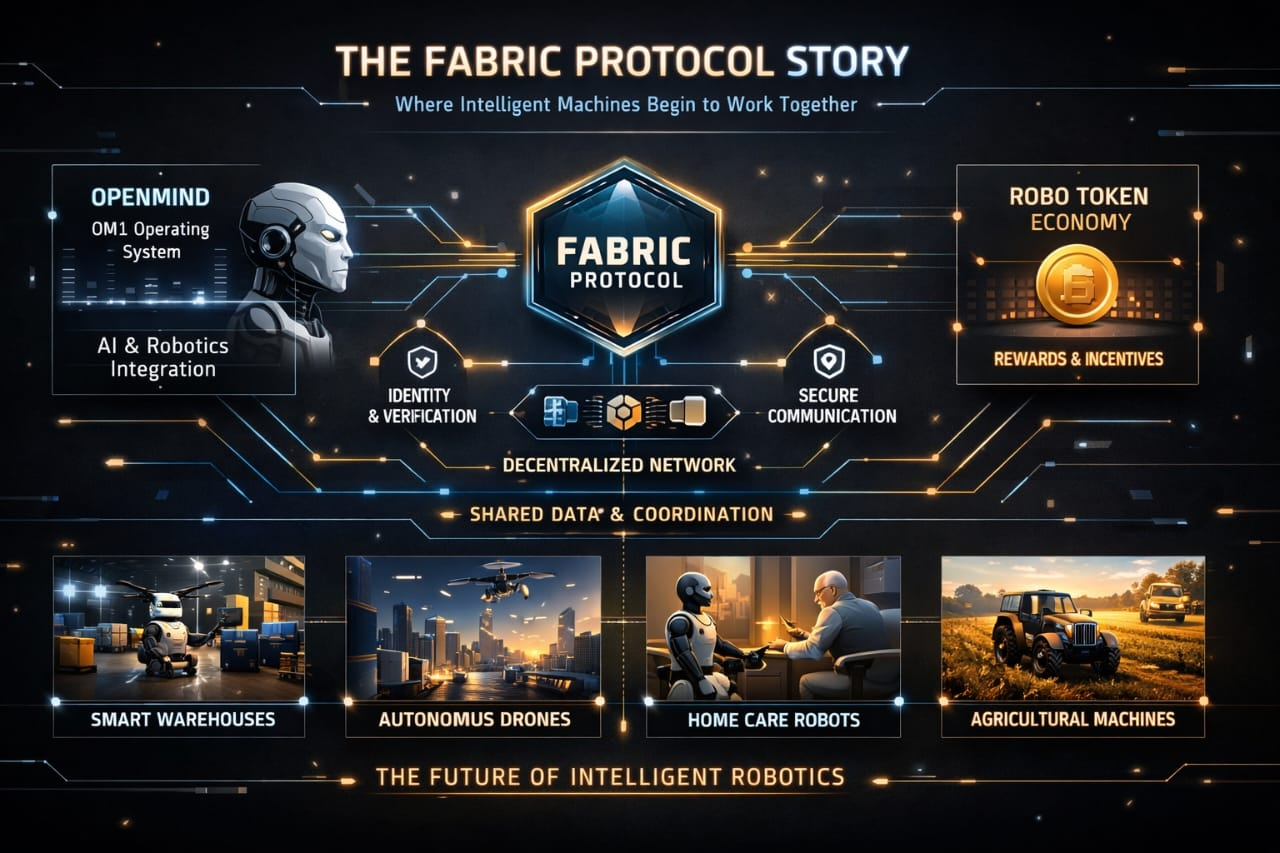
Fabric Protocol is designed as an open global network where intelligent machines can finally begin to cooperate. Instead of robots operating as isolated tools, the protocol creates a shared infrastructure where machines can identify themselves, exchange information, and coordinate actions safely. In simple terms, Fabric acts like a digital environment where robots, artificial intelligence agents, developers, and communities can interact through a system built on transparency and trust.
The project is closely connected to a robotics initiative called OpenMind, which focuses on building foundational technology for intelligent machines. OpenMind developed an operating system known as OM1, designed to work with many different types of robots regardless of manufacturer. This operating system allows machines to run advanced AI models while interacting with their surroundings in a flexible way. Fabric then acts as the decentralized coordination layer on top of this system, providing identity verification, communication rules, and a secure environment for collaboration between machines.
To understand the role of Fabric, it helps to imagine how humans interact in society. People rely on shared rules and systems to cooperate. We have identification systems, communication networks, and legal frameworks that allow strangers to work together. Fabric attempts to provide something similar for intelligent machines. It gives robots a verifiable identity, a shared set of rules, and a way to exchange trusted information across different environments.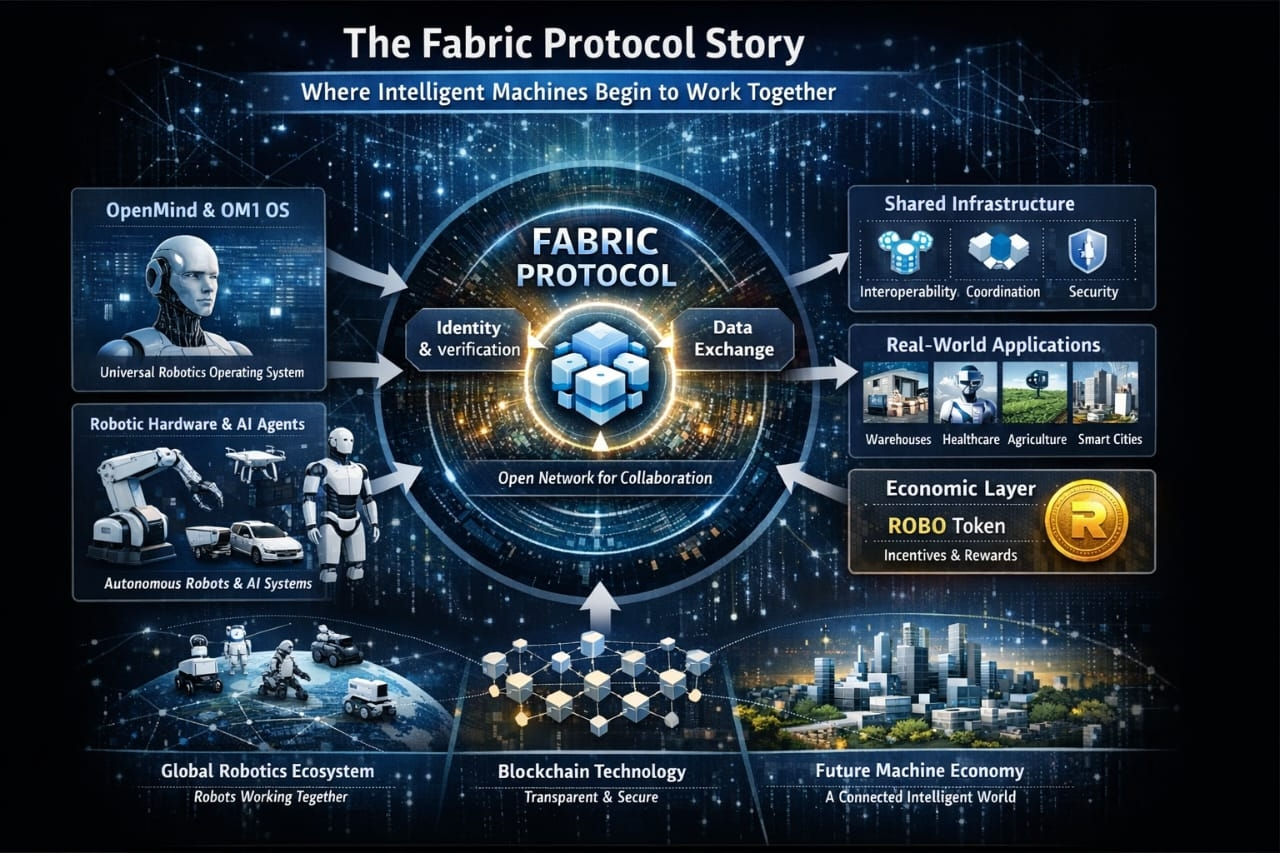
The protocol uses blockchain technology not as a control system but as a transparent record-keeping layer. Every robot connected to the network can have a unique identity that verifies who it is and how it behaves within the system. Actions, transactions, and interactions can be recorded in a decentralized ledger, making them auditable and trustworthy. This structure allows machines to share context, coordinate tasks, and verify data without relying on a single centralized authority.
In practical terms, this could transform how machines operate in the real world. Imagine autonomous robots working inside a large logistics warehouse. Instead of each robot acting independently with limited awareness of others, they could coordinate through Fabric’s network. Each machine would know the identity and location of nearby robots, share updates about tasks, and adapt its behavior accordingly. The result would be a more intelligent and cooperative environment where machines function more like members of a coordinated team.
Beyond warehouses, this type of coordination could eventually expand into many industries. Robots helping elderly people at home, autonomous delivery drones in cities, agricultural machines working across farms, or industrial robots inside factories could all interact through the same underlying network. Fabric is essentially trying to build the digital infrastructure that allows these machines to exist within a shared ecosystem.
Of course, every network also needs an economic layer that encourages participation. Fabric introduces the ROBO token as the native asset of the ecosystem. The token is designed to align incentives between developers, machine operators, and autonomous agents. Developers who build useful algorithms or robotic applications can be rewarded when their technology is used by machines across the network. Robots performing valuable tasks can also generate economic activity that flows through the system.
A major milestone for the project came when the ROBO token launched its public sale on the Kaito platform in January 2026. The sale valued the project at approximately $400 million fully diluted valuation and aimed to raise about $2 million by offering 0.5% of the total token supply. Participation limits ranged from $1,000 to $250,000 per address, while about 40% of the public allocation was reserved for partner communities connected to the ecosystem.
The sale generated strong attention within the crypto and AI sectors, reflecting the growing interest in technologies that combine artificial intelligence, robotics, and blockchain infrastructure. In fact, the round was reportedly oversubscribed within a few hours, showing that many early supporters see the project as a long-term bet on the future machine economy.
Still, the journey ahead will not be easy. Robotics is one of the most complex areas of technology because it deals directly with the physical world. Machines must operate safely in unpredictable environments, interact with humans, and function reliably over long periods of time. Building a decentralized coordination network for such systems is a challenge that will require years of development, testing, and collaboration.
But perhaps that challenge is exactly what makes Fabric interesting.
Instead of focusing only on short-term trends, the project is addressing a deep structural problem in the robotics industry. If intelligent machines are going to become part of everyday life, they will need a way to communicate, cooperate, and build trust with each other. Fabric Protocol attempts to create that foundation.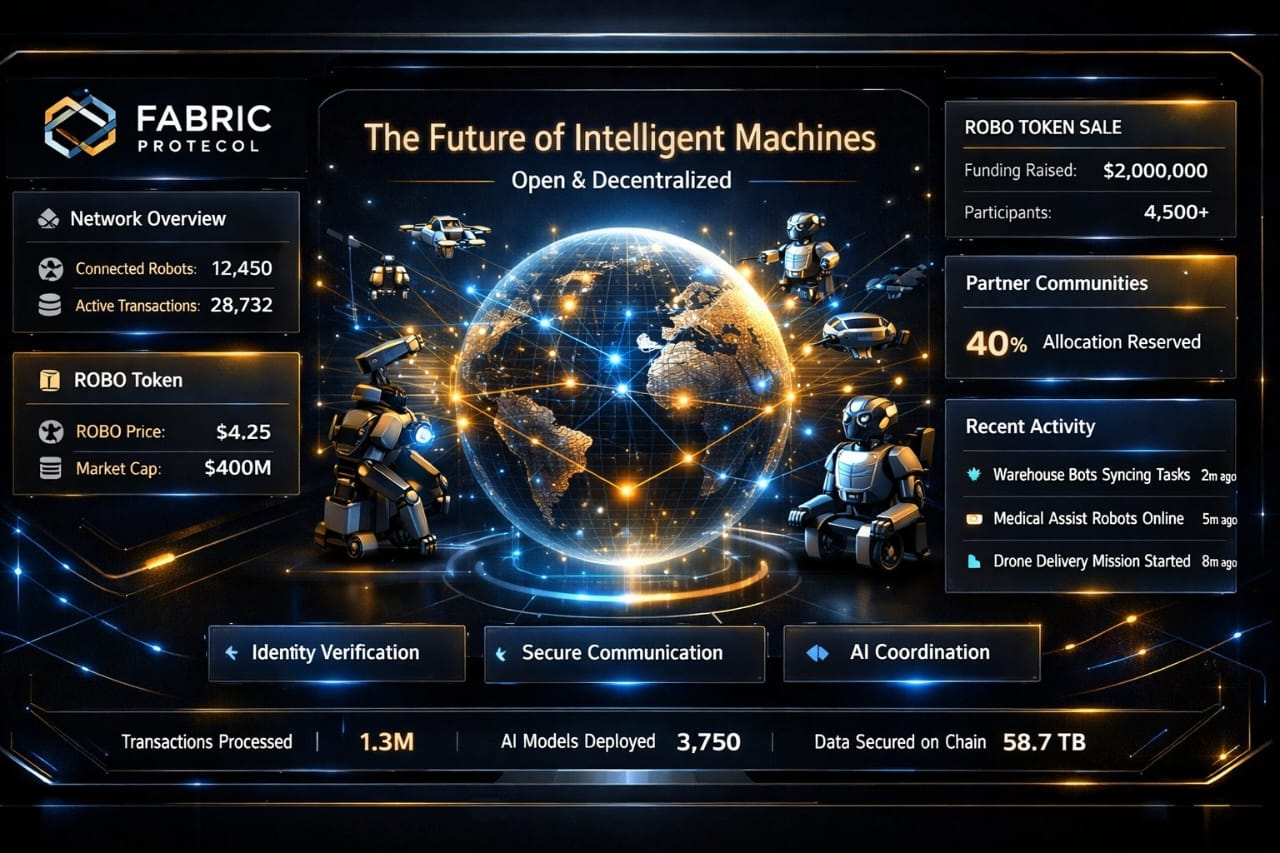
It imagines a future where machines are not isolated devices but participants in a shared digital ecosystem — one where intelligence flows freely between robots, developers, and communities. In that world, innovation would not be limited by company boundaries or incompatible systems. Instead, intelligence would grow collectively through an open network that connects machines across the globe.
And if that vision eventually becomes reality, Fabric Protocol may be remembered not just as another blockchain project, but as one of the early attempts to weave together the infrastructure of a new era — an era where humans and intelligent machines truly learn to work side by side.