

A few years ago, I sat through a post incident review after an automated trading system misrouted a series of orders. Nothing catastrophic happened, but the investigation uncovered something more interesting than the bug itself. The system had done exactly what it was told to do. The problem was that no one could confidently trace which machine had made the decision that triggered the cascade. Logs existed. Signatures existed. Yet identity in the system was abstract , processes, containers, rotating keys. Responsibility dissolved into infrastructure.
That experience reshaped how I think about machine coordination. Systems fail less often from malicious intent than from unclear identity and ambiguous authority.
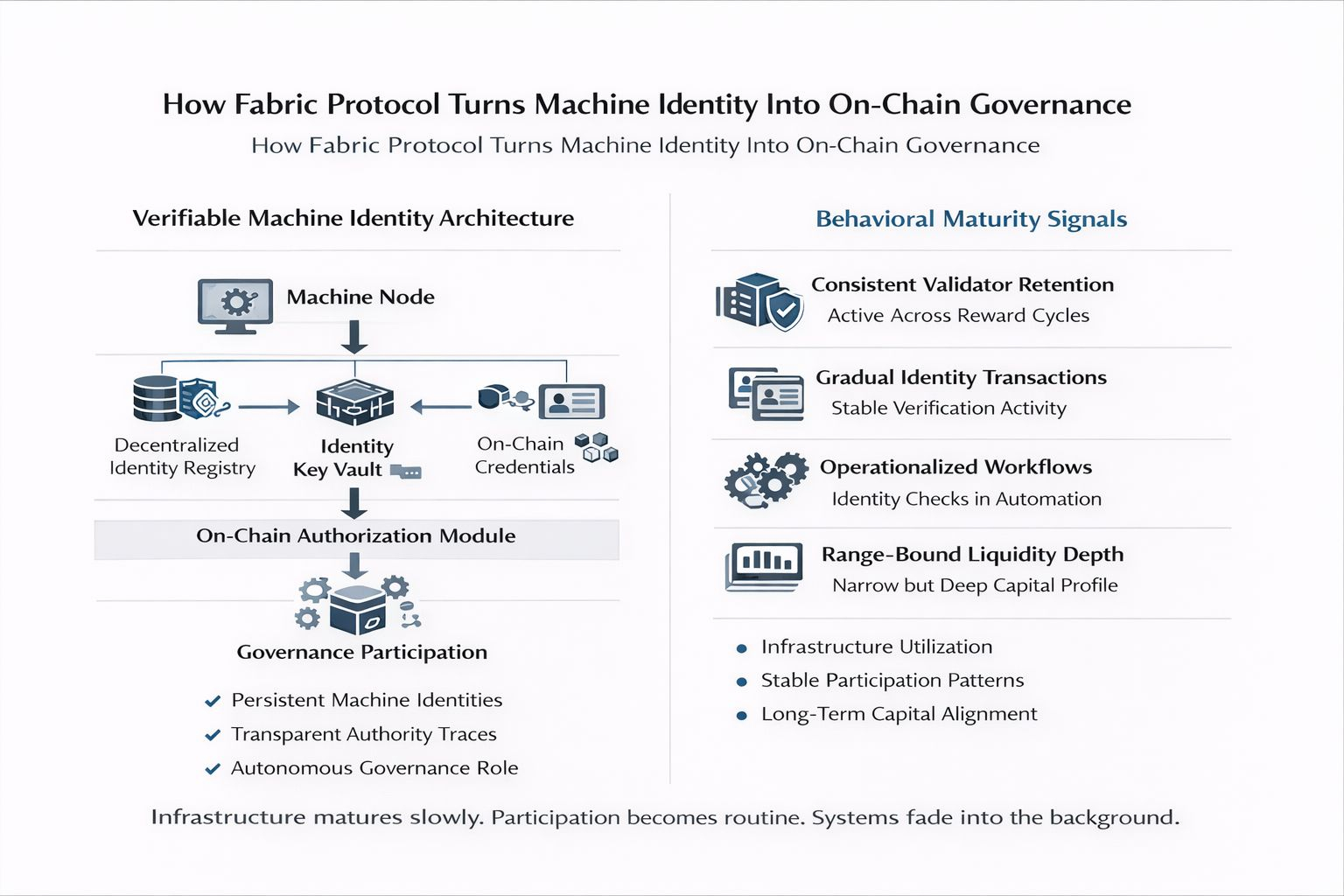
When I first examined @Fabric Foundation , the architectural idea that stood out was fairly modest on the surface: turning machine identity into something verifiable and persistent enough to participate in governance. Instead of treating machines as disposable compute units, Fabric introduces identity primitives that allow autonomous systems, agents, nodes, or services, to possess on chain identities capable of participating in coordination mechanisms.
It’s not a dramatic change in technology. But it is a structural one. Governance mechanisms historically assumed human participants. Fabric begins from a different assumption: that machines themselves will increasingly become actors in network coordination.
What matters more than the architecture, though, is how people behave around it.
Early behavioral signals often reveal whether infrastructure ideas are actually being integrated into workflows. In Fabric’s case, the activity pattern appears less narrative driven and more operational. Developer discussions increasingly revolve around identity registration and agent authorization frameworks rather than speculative governance features. Repositories referencing machine identity modules show integration attempts within automated service pipelines.
That shift is subtle but meaningful. When infrastructure starts appearing inside automation workflows rather than experimentation environments, it often indicates that reliability, not novelty, is becoming the priority.
Validator participation patterns offer another signal. Networks experimenting with new coordination primitives often see participation spike during incentive campaigns and decline afterward. In Fabric’s case, participation around identity verification tasks appears more evenly distributed across reward periods. That kind of consistency tends to emerge when operators view participation as part of maintaining network functionality rather than extracting temporary yield.
Usage patterns reinforce the same impression. On chain interactions tied to identity registration and verification tend to accumulate gradually rather than appearing in bursts around announcements. Systems that grow through routine interactions often reflect real operational use cases automated agents needing stable identity anchors rather than users responding to narrative momentum.
Infrastructure maturity often appears first as behavioral boredom.
When systems become reliable enough, activity stops looking reactive. Developers integrate identity checks because their workflows depend on it. Validators perform verification because it sustains network operation. Participation becomes habitual.
That’s usually when infrastructure begins to solidify.
Fabric’s design also places incentives in an interesting position. Governance participation tied to machine identity introduces a different incentive structure than typical token governance.
Machine identities could become ephemeral or manipulated. But if verification incentives reward long-term identity stability and accurate validation, the network begins to resemble a coordination layer rather than a voting mechanism.
The behavioral signals worth watching are therefore fairly specific.
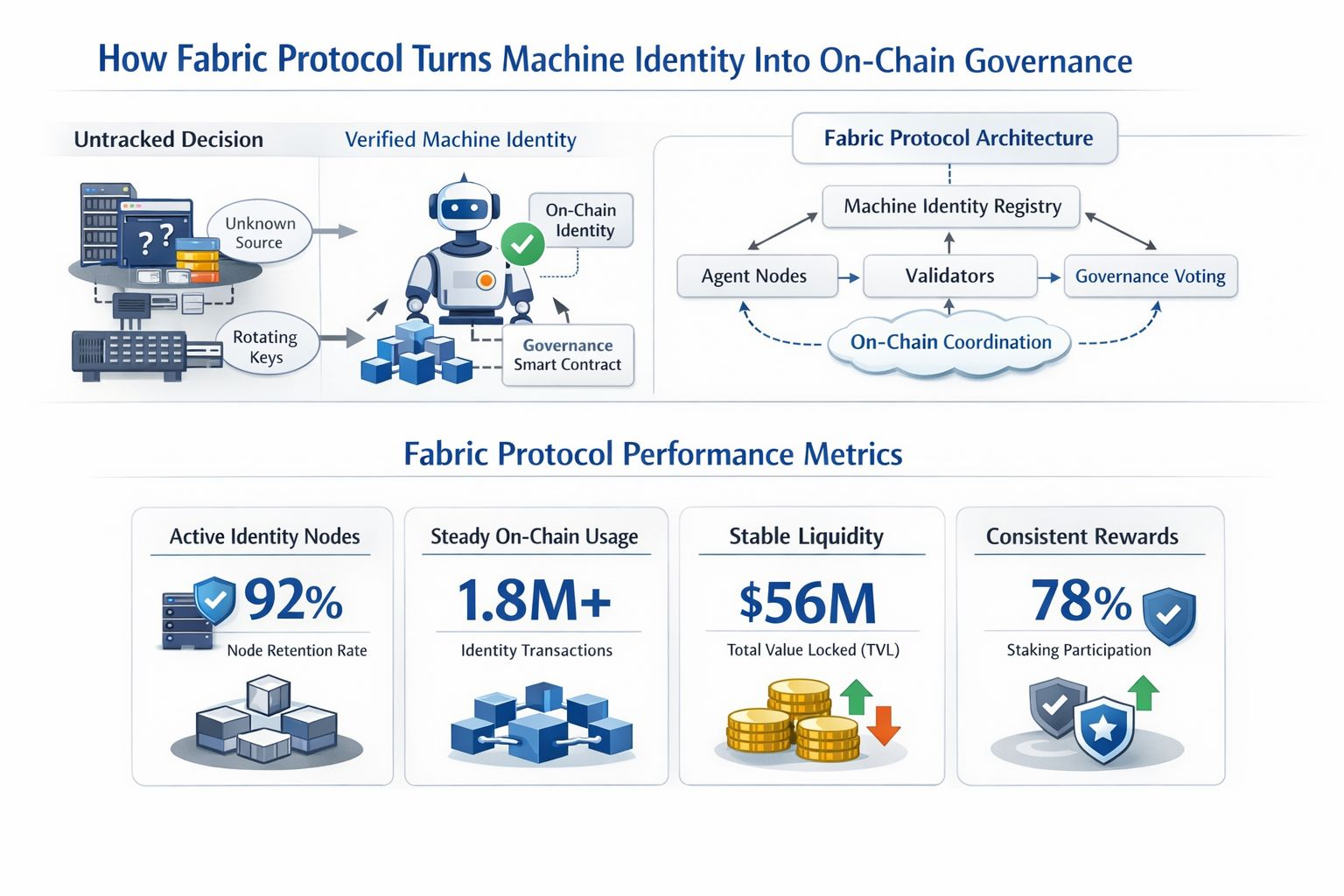
Validator retention across reward adjustments is one of them. If identity verification nodes remain active even when rewards compress, it suggests operators see value in maintaining the identity registry itself.
These signals rarely provide definitive answers. But together they help outline whether capital and participants are behaving opportunistically or structurally.
From a long term capital perspective, infrastructure networks often attract a different kind of liquidity. Instead of rapid inflows chasing narrative volatility, the capital tends to settle into narrower ranges, providing depth and continuity rather than explosive movement. Participants behave less like traders and more like service providers provisioning access to a system.
Machine identity networks may follow a similar trajectory.
If Robo succeeds in making machine identity verifiable and durable enough for governance, the protocol may gradually shift from an experimental governance model into a coordination layer embedded inside automated systems. Agents verifying other agents. Validators maintaining identity registries. Governance decisions influenced by entities that are themselves autonomous.
The interesting outcome is not spectacle. It’s normalization.
Developers might stop discussing machine identity protocols altogether because identity verification becomes a routine component of infrastructure much like TLS certificates or API authentication today.
That possibility raises a quieter question about the future of governance itself. If machines increasingly coordinate economic systems, should governance mechanisms continue to assume exclusively human participants?
#ROBO doesn’t answer that question outright. But by giving machines persistent identity within a governance framework, it nudges the infrastructure in that direction.
The durability of that idea will depend less on architectural elegance and more on whether incentives remain aligned long enough for behavior to stabilize.
Infrastructure matures slowly. Participation becomes routine. Systems fade into the background.
And the strongest coordination layers often become the ones we rarely notice anymore.
#USIranWarEscalation #StockMarketCrash #VitalikETHRoadmap #USIsraelStrikeIran



