Most revolutions do not look like revolutions in the beginning.
They look small, confusing, and sometimes even unnecessary.
When the internet first appeared, many people believed it was only useful for academics and hobbyists. When smartphones were introduced, critics said they were just expensive toys. Even Bitcoin, in its early years, was dismissed as an experiment that would never matter.
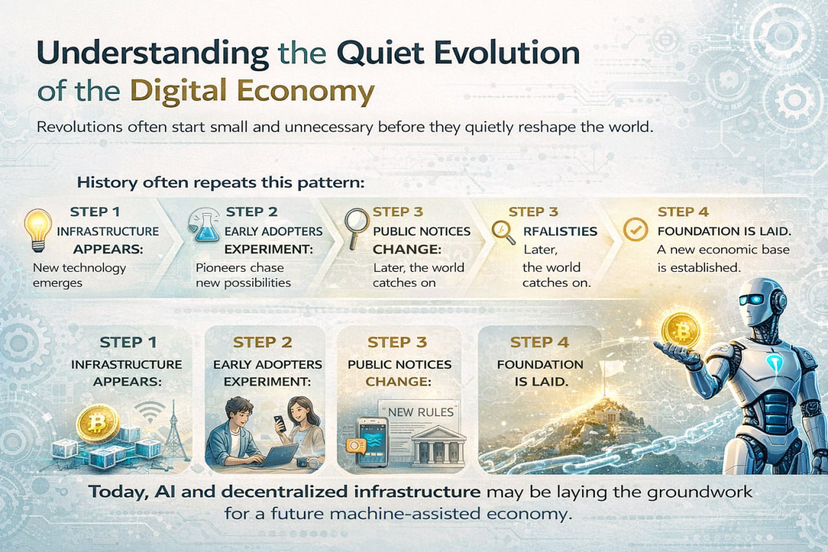
But history tends to repeat a simple pattern.
First, infrastructure appears.
Then, a few early adopters experiment with it.
Only later does the world realize something fundamental has changed.
Today, we may be witnessing a similar moment.
Artificial intelligence is no longer just a research topic. AI systems are writing code, analyzing markets, managing logistics, creating art, and assisting decision-making across industries. Machines are gradually moving from tools to participants in economic activity.
And that shift creates an interesting challenge.
If intelligent systems can create value, optimize resources, and interact with global networks, how should they participate in the economy?
Traditional systems were built entirely around humans. Banks require identity verification tied to people. Companies rely on legal ownership structures designed for human management. Financial transactions often depend on centralized institutions that approve or control access.
But machines do not fit neatly into these structures.
A global AI agent managing digital services might operate across multiple countries simultaneously. It might need to transact instantly, coordinate resources automatically, and verify data without relying on slow human intermediaries.
This is where decentralized infrastructure becomes relevant.
Blockchain technology introduced a powerful concept: economic coordination without central gatekeepers. Instead of trusting a single authority, participants rely on transparent rules and cryptographic verification.
Within that broader landscape, projects like ROBO are exploring what happens when intelligent systems and decentralized networks intersect.
Rather than viewing tokens only as speculative assets, it may be more useful to see them as components of a larger infrastructure experiment.
If machines increasingly participate in economic processes, they may require systems that allow them to interact, exchange value, and verify activity without traditional institutional friction.
Of course, not every project attempting this vision will succeed. Innovation rarely moves in a straight line. Many experiments fail before a workable model emerges.
However, the larger trend seems difficult to ignore.
Technology is steadily moving toward automation, autonomy, and global coordination. The economic systems supporting that world will likely evolve as well.
In that sense, the conversation around ROBO may not simply be about price movements or short-term market cycles.
It may represent an early attempt to imagine how a machine-assisted economy could function.
And if history teaches anything, it is that the systems built quietly in the background often become the foundations of the next era.