
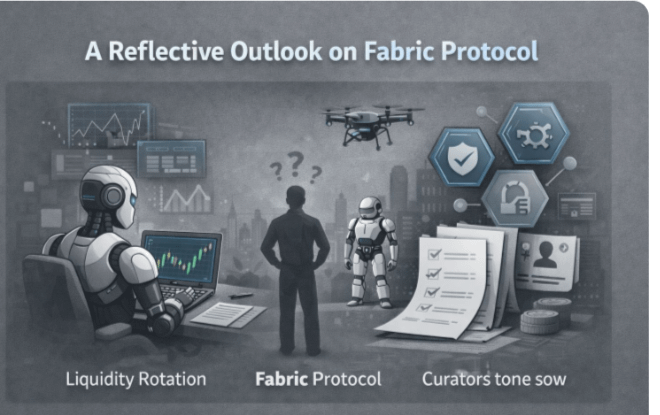
The AI and crypto segment of the market continues to evolve, with increasing attention shifting toward autonomous agents and machine-based economic activity. Fabric Protocol, backed by the Fabric Foundation, has entered this discussion with a focus on coordination infrastructure for robots and autonomous systems. Below is a clear breakdown of the key factors shaping analysis around the ROBO token and the broader thesis.
@Fabric Foundation #ROBO $ROBO
1. Core Thesis: Machine-Native Coordination
Fabric positions itself as infrastructure for autonomous machines rather than as a general AI token. Its framework centers on:
Verifiable compute
On-chain identity for agents
Payment routing for machine-executed tasks
Governance through a public ledger
The central concept is that increasingly autonomous robots may require standardized identity, settlement rails, and verifiable records of completed work.
2. Market Debut and Liquidity Structure
ROBO began spot trading on February 27, 2026, with multiple exchanges listing within a short timeframe. Aggregated listing activity was reflected on platforms such as CoinMarketCap, showing clustered liquidity during early price discovery.
Subsequent listings, including placement in innovation-focused categories on Bitget, extended visibility.
Listings increase access and attention, which influences short-term liquidity conditions, particularly in early trading phases.
3. Economic Model: Robots as On-Chain Actors
Fabric’s framework treats robots as potential economic participants capable of:
Holding wallets
Executing tasks
Receiving automated payments
Maintaining verifiable activity records
This differs from traditional models where machines operate solely under centralized ownership and accounting systems. The protocol proposes a neutral coordination layer that connects physical task execution with digital settlement.
4. Token Allocation and Supply Schedule
Public materials outline allocations across ecosystem funding, contributors, investors, reserves, and liquidity provisioning.
Market data summaries indicate that portions of total supply remain locked into later years, extending beyond 2026. Unlock schedules influence long-term liquidity expectations and often shape positioning well before release events occur.
Supply structure is a material factor in how the asset trades over time.
5. Sector Correlation and Narrative Cycles
ROBO may trade in correlation with broader AI and automation-related tokens. In thematic cycles, sector sentiment can influence price action independently of project-specific developments.
Longer-term differentiation typically depends on measurable network usage, integrations, or adoption metrics rather than narrative alignment alone.
6. Execution Timeline Considerations
Robotics development operates on longer timelines than software-only crypto projects. Factors include:
Regulatory frameworks
Hardware deployment cycles
Capital requirements
Verification of real-world task completion
The pace mismatch between crypto markets and physical-world infrastructure remains a key structural consideration.
7. Governance Structure
Operating under a foundation model introduces formal governance and funding mechanisms. Foundations can provide continuity and structured development oversight. However, execution efficiency and transparency determine long-term effectiveness.
Closing Perspective
Fabric Protocol is addressing a defined coordination question: if machines become increasingly autonomous economic actors, what infrastructure verifies and settles their activity?
Current observations include:
Early liquidity concentration
Structured token distribution
A multi-year development horizon
Exposure to broader AI sector sentiment
Future positioning will likely depend on measurable delivery, integration milestones, and how supply dynamics interact with market conditions.
ROBO currently sits at the intersection of infrastructure development, robotics adoption, and thematic capital rotation.