
A few months ago I was watching a small warehouse robot move boxes across a floor. Nothing dramatic about it. It rolled forward, paused, turned slightly, then continued. The kind of slow mechanical routine people stop noticing after a few minutes. What caught my attention wasn’t the robot itself. It was the screen next to it. Every movement was being logged somewhere—timestamps, location points, task IDs. Quiet little records stacking up in the background.
That moment stuck with me because robotics discussions usually focus on intelligence. Better AI models. Smarter navigation. Faster decision making. But in the warehouse, none of that looked like the real challenge. The real challenge seemed simpler and stranger at the same time: proving that the machine actually did the work.
Fabric’s approach to robotics makes more sense when you look at it from that angle.
Instead of trying to build the most advanced robot brain, Fabric seems more interested in the layer underneath everything. The part that records activity and allows different systems to agree on what happened. That may sound dull compared to futuristic AI narratives. Still, infrastructure tends to look dull right up until the moment it becomes essential.
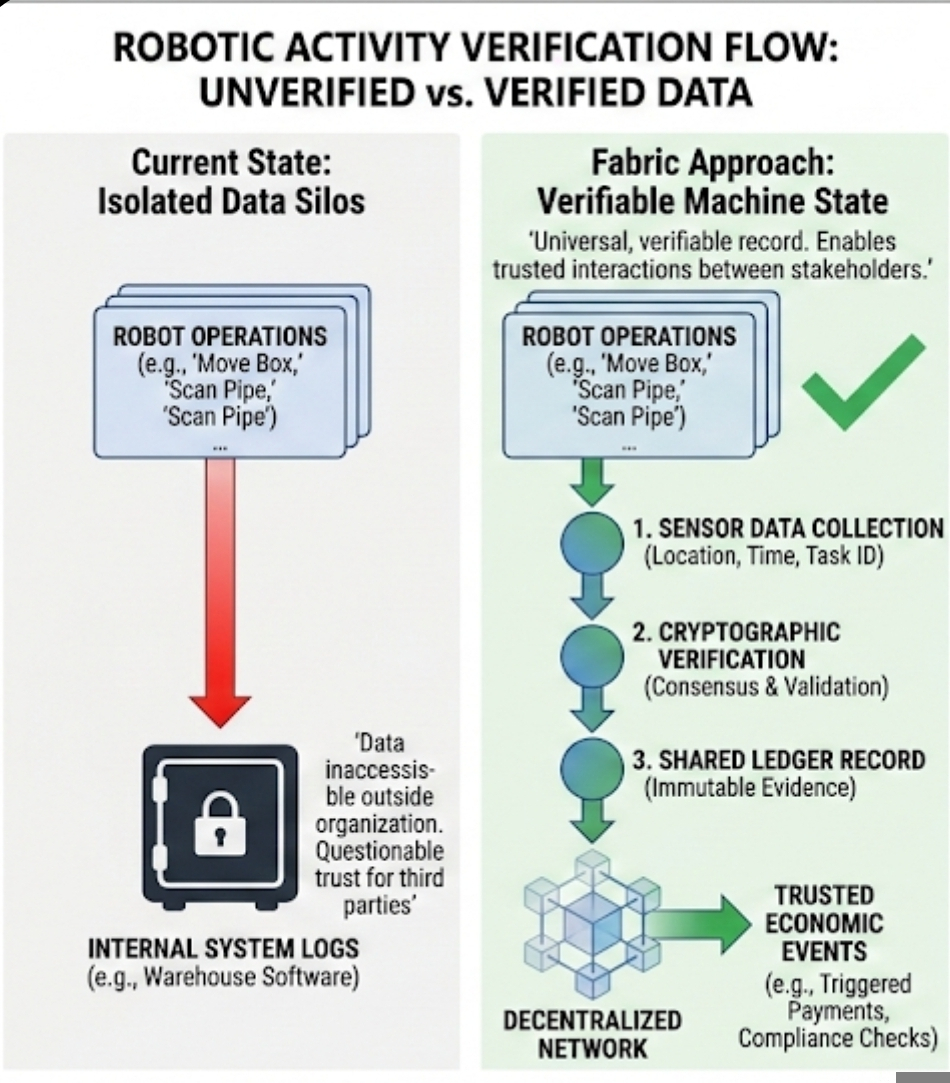
Think about how robotic work actually happens today. A robot might move packages in a logistics center, inspect pipes in an industrial facility, or scan farmland with cameras. Every one of those tasks produces data. Sensors report motion. Cameras capture images. Software logs task completion times. But most of that information stays locked inside the system that created it. The robot did the work, yes. But outside that company’s internal software, nobody really sees the evidence.
Fabric’s idea is basically about making those machine actions verifiable across networks. In simple terms, verification means confirming that something happened. Not just recording it internally, but producing a record other participants can check. It’s the same basic concept that financial systems rely on when confirming payments. Except here the thing being verified isn’t money. It’s physical activity.
Once you start thinking about it, that shift is bigger than it sounds.
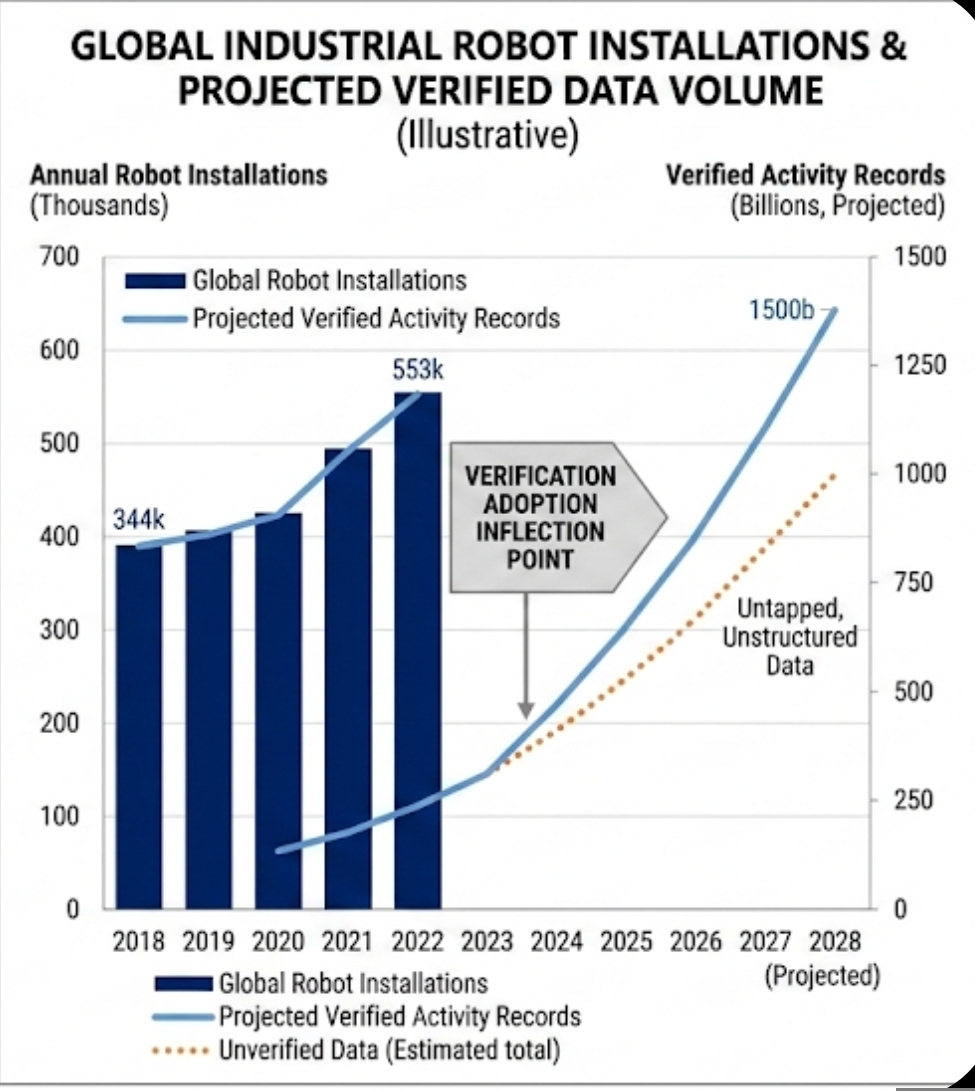
The robotics industry is already generating massive volumes of machine activity. The International Federation of Robotics reported that around 553,000 industrial robots were installed globally in 2022. That number only reflects new installations for that year. Many of those machines operate constantly, often running twenty hours a day inside factories and warehouses. Every movement they make generates operational data. Multiply that across thousands of facilities and the scale becomes hard to picture.
Yet most of that activity never becomes visible beyond the organization using the robots.
Fabric seems to be asking a quiet question: what if robot work could produce verifiable economic data the same way digital transactions do? Not flashy, not speculative. Just a record that says a machine completed a task at a specific time and location.
That possibility opens interesting doors. A robot delivering a package could automatically trigger a payment once the delivery event is verified. A maintenance drone inspecting infrastructure might produce a trusted record used for compliance checks. Even simple tasks like warehouse sorting could generate operational data that other systems rely on.
Of course, the real world rarely behaves as cleanly as diagrams suggest. Sensors fail. Networks drop packets. GPS signals drift by several meters sometimes. Anyone who has dealt with robotics hardware knows that physical systems are messy in ways software engineers don’t always expect.
So verification becomes tricky.
Fabric’s challenge isn’t simply collecting machine data. It’s deciding what counts as reliable evidence when machines interact with unpredictable environments. Multiple signals may need to agree. Independent systems might confirm each other’s observations. Sometimes verification requires economic incentives so participants actually spend time checking the data rather than ignoring it.
This is where things start to intersect with crypto infrastructure. Shared ledgers can record events in ways that different parties trust without relying on one central operator. But the idea only works if the recorded data is believable in the first place. Garbage inputs still produce garbage outputs. That part of the system requires careful design.
Interestingly, conversations about projects like Fabric often happen on platforms where attention behaves very differently from infrastructure development. On Binance Square, for example, visibility is strongly shaped by ranking algorithms. Engagement rates, reactions, reposts—those signals determine which posts appear in front of larger audiences.
The effect is subtle but noticeable. Quick market predictions travel fast through those ranking systems. Infrastructure explanations travel slower. They require context, patience, sometimes a bit of curiosity from readers. But over time I’ve noticed that audiences on the platform respond surprisingly well when someone actually breaks down how systems work. Not hype. Just clarity.
Maybe that says something about how people process technology once the noise settles.
Fabric, to me, feels like one of those projects that might look unimpressive for a long time. No dramatic demos. No grand claims about replacing entire industries overnight. Just the slow construction of systems that make robotic activity measurable and verifiable across networks.
Whether that vision succeeds is another question entirely. Infrastructure projects face a difficult path because adoption matters more than ideas. Robotics companies already have their own operational systems. Integrating with shared verification layers takes time, coordination, and trust.
There’s also the incentive problem. Some blockchain projects rely heavily on token rewards to encourage participation. Sometimes that works. Other times it attracts short-term speculation rather than long-term infrastructure building. The difference usually becomes obvious after a few years.
Still, the underlying question Fabric raises doesn’t disappear even if the project itself struggles.
Machines are beginning to perform real economic work in the physical world. Delivering goods. Inspecting structures. Monitoring environments. And as those activities expand, someone eventually needs reliable records proving what actually happened.
Maybe that’s the strange thing about robotics right now. Everyone is talking about artificial intelligence becoming more capable. But the quieter challenge might be something else entirely.
Not how smart machines become.
Just whether we can trust the records of what they did.