$ROBO I’ve been watching the crypto space for four years now, and if there’s one lesson I’ve learned the hard way, it’s this: Being popular doesn’t mean being necessary. Most people only realize this after the market turns and they’ve already paid the price.
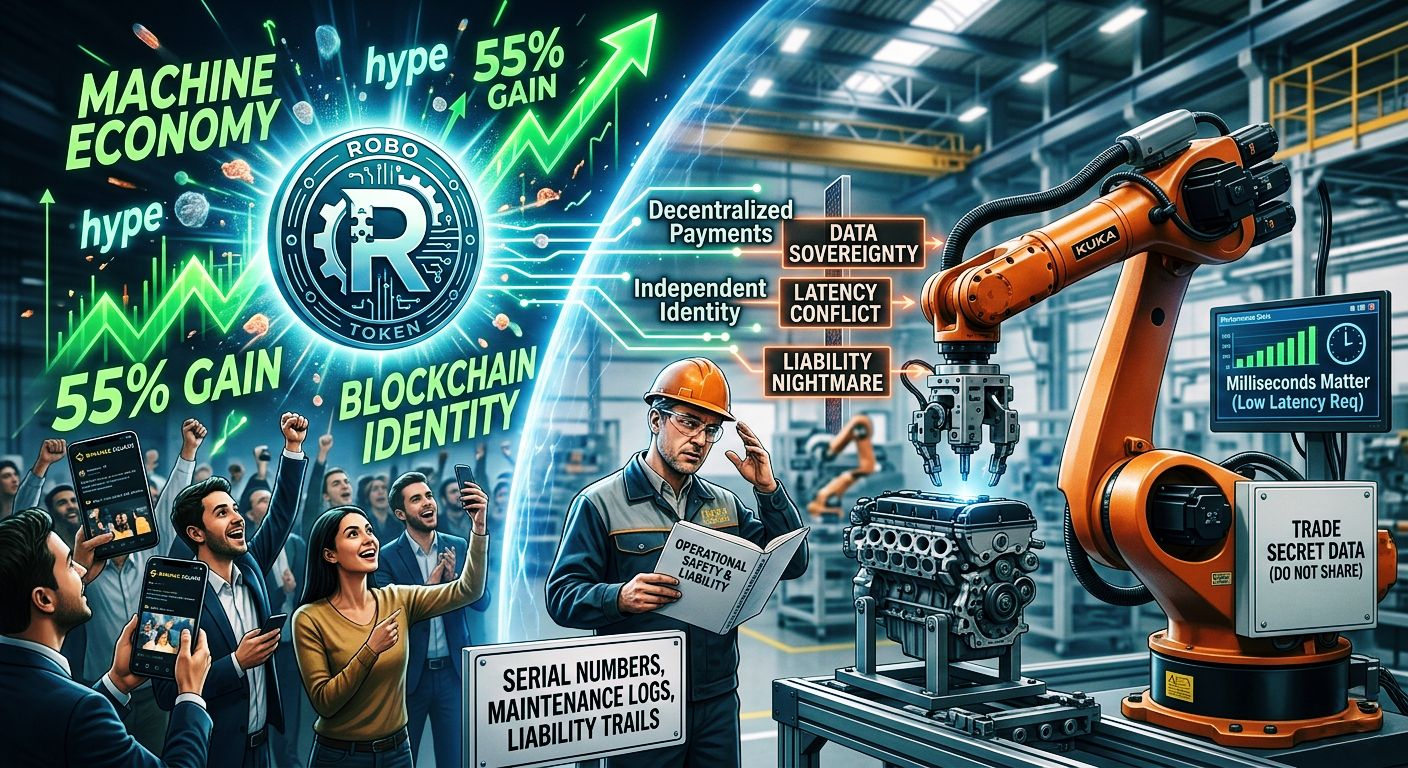
So, when ROBO shot up 55% recently and Binance Square exploded with hype, I didn't join the party. Instead, I did what experience has taught me—I stopped reading the hype posts and started talking to people who actually build robots for a living.I spoke with two experts outside the "crypto bubble"—one in industrial automation and another in service robotics. I asked them a simple question, stripped of any blockchain jargon: "Would your company use a system where machines have their own independent identities and can authorize their own payments?"
Their answer wasn't a "maybe" or a "someday." It was a flat no.
Their reasons were practical, grounded, and frankly, hard to argue with:
Data Sovereignty: Companies treat robot behavioral data as trade secrets. They aren't interested in putting that on a shared, transparent ledger.

Performance: In robotics, milliseconds matter. Current blockchain systems simply can't match the low-latency requirements of high-speed automation.
The Liability Nightmare: This is the big one. If a robot malfunctions and causes injury or damage, "decentralization" is a legal disaster. Companies need a clear, legal paper trail of who is in charge and who is liable. You can't sue a smart contract.
The team behind Fabric Protocol might be brilliant, but it feels like they’re solving problems they think the robotics industry has, rather than the ones that actually exist.
Crypto is great at solving its own problems. DeFi fixed issues for DeFi users; NFTs gave digital artists a new medium. But industrial robotics isn't a "broken" field waiting for a savior. It already has serial numbers, maintenance logs, and tracking systems that are recognized by insurance companies and the law. It’s not perfect, but it works.
For ROBO to be truly valuable, it needs to show—not just claim—that it solves a problem the current system can’t, and that the "fix" is worth the massive cost of switching. Right now, there is zero evidence of that.
Don't get me wrong: the price of ROBO can still go up. Market excitement and actual utility are two very different things. A token can moon because people love a good story, even if the project doesn't "do" anything yet. But the gap between the current price and real-world usage is filled entirely by belief. And belief is a volatile foundation.
When you buy ROBO today, you aren't buying a utility. You’re placing a bet that:
A "machine economy" will eventually emerge.
That economy will need Fabric’s specific architecture.
Fabric will be the one to win the market.
After four years in this game, I’ve stopped trusting complex "tokenomics" and started asking one simple question: What real-world problem does this solve for people outside of crypto today?
For ROBO, I don't have an answer yet.
Waiting for clarity isn’t being a "hater"—it’s how I avoid expensive mistakes. I'm not willing to pay a "future-success" price for a problem that might never be solved.