
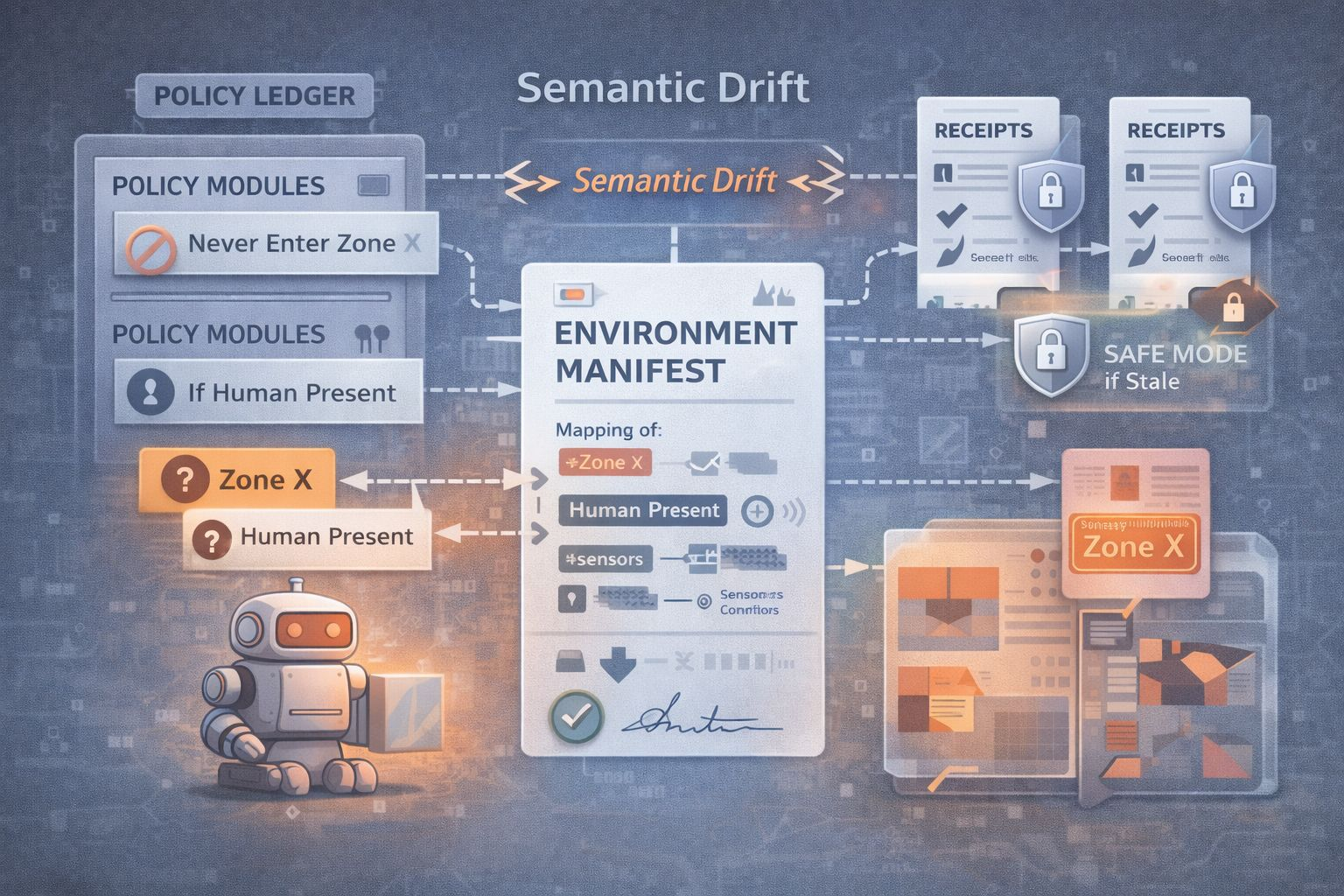
I’ve seen smart teams write “clear rules” that failed the moment they hit a real building, which is exactly why Fabric Protocol’s on-ledger policy vision lives or dies on semantics. The rule looked clean: never enter Zone X when humans are present. The robot obeyed it. The incident still happened. Later we discovered the boring truth. “Zone X” was drawn differently in two systems, and “human present” meant a camera model on one floor and a badge reader on another. The robot didn’t break the rule. The rule didn’t describe the world the robot actually lived in.
That is why I think Fabric’s real oracle is semantics. Fabric wants to coordinate regulation and robot behavior through on-ledger policy modules. The industry loves this idea because it feels like making safety programmable. But policy text is made of labels, and labels are not facts. “Zone X,” “Object Y,” “Human present,” “restricted,” “authorized,” all of these are names that have to be grounded in sensor reality. If you don’t bind them to a shared, signed mapping, you can compile rules perfectly and still enforce the wrong world.
People focus on Fabric’s policy compilation problem and assume the hard part is precedence. I think the hard part comes earlier. Before two policies conflict, they first have to refer to the same thing. If one authority’s “Zone X” is a polygon on a map and another authority’s “Zone X” is a set of RFID beacons, you don’t have a policy conflict. You have a semantic collision. The protocol can resolve it deterministically and still produce nonsense because it’s resolving symbols, not reality.
A ledger makes this both better and worse. Better because you can publish policy modules in a shared place. Worse because the ledger can give you the illusion of objectivity. People see an on-chain rule and assume it is grounded. But the grounding is always off-chain. A robot determines “zone” and “human” through sensors, calibration, and local infrastructure. If the mapping layer is messy, the most beautifully governed policy system becomes a compliance theater that fails quietly until it fails loudly.
So I would treat “environment manifests” as a first-class protocol object. A manifest is a signed, versioned description of what the policy labels mean in a specific site, and policies must reference a manifest identifier and version to be enforceable. It declares how Zone X is defined, which coordinate frame is used, which sensors are authoritative for “human present,” what object taxonomy is being used, and what confidence thresholds apply. It also declares who signed it and what scope it covers, so validity is not a vibe but a check: a recognized signer, a specific version, and a declared site context.
The key is versioning. Environments change. A hospital adds a temporary barrier. A warehouse moves shelving. A camera model gets replaced. If the manifest changes but the robot keeps enforcing policies against the old manifest, you get a dangerous form of correctness. The robot can be “compliant” with a map that no longer matches the building. That is why every receipt, every permissioned action, and every safety decision has to be bound to a manifest version, and why stale manifests need a hard rule: if the robot cannot confirm it is operating on the current version, it should downgrade to a restricted safe mode rather than continue claiming full compliance.
This is also where Fabric’s ledger coordination can become real infrastructure instead of ideology. The ledger can host the canonical manifest versions, record who signed them, and record which policy modules reference which manifest schema. Policy updates then become meaningful. They are not just text changes. They are changes over a shared semantic contract. When a regulator publishes “no entry during human presence,” the rule is only enforceable if the manifest defines what “human presence” is and how it is detected.
But this introduces a trade-off that I think is unavoidable. If you require signed manifests, you create a new authority layer. Someone has to be trusted to define the environment mapping. If you allow anyone to sign manifests, you invite manipulation. If you restrict who can sign, you introduce centralization. I don’t think there is a perfect answer. The best you can do is make the authority explicit and auditable, and make changing the manifest a governed act rather than a silent local tweak.
The risk surface is not hypothetical. A malicious operator could redefine Zone X to shrink restricted space and still claim compliance. A sloppy integrator could ship a manifest with the wrong coordinate frame and create phantom compliance. A sensor vendor could change detection thresholds through an update that silently shifts the meaning of “human present.” In all of these cases, the robot can produce receipts that look valid. The ledger will show the policy was followed. The world will show harm. That is exactly the failure mode Fabric has to prevent if it wants “regulation coordination” to mean anything.
There is also a scalability cost. Manifests turn policy into something closer to software deployment. You need schema compatibility, migration paths, and rollback plans. That sounds like overhead, but I have learned to distrust systems that promise safety without overhead. The overhead is the price of having rules that actually bind behavior. If Fabric tries to skip this layer to feel “simple,” it will push the complexity into ad-hoc integrator work. That is where semantics drift becomes invisible and unfixable.
Incentives matter here, but only in a very specific way. If Fabric uses $ROBO to reward participation, the most valuable behavior to reward is maintaining semantic integrity. Publishing accurate manifests, updating them when environments change, and being accountable for incorrect mappings should have economic weight, and repeated bad mappings should be costly rather than just embarrassing. If the protocol pays for task receipts but does not pay for the semantic layer that makes receipts meaningful, you will get a system that optimizes for outputs while the meaning of those outputs decays.
The second-order effect is that environment manifests could become Fabric’s real adoption wedge. Enterprises already live in a world of site-specific rules. What they lack is a way to make those rules portable across vendors without losing meaning. A shared manifest model, governed and versioned, is a way to make “Zone X” mean the same thing across systems, or at least make differences explicit. That is what procurement teams want, not ideology. They want fewer ambiguous interfaces between policy and reality.
The falsifiable part of this thesis is straightforward. If Fabric can coordinate on-ledger regulation across heterogeneous real sites without a shared manifest layer, while still preventing semantic drift and post-incident ambiguity, then I’m wrong. But if we see incidents where policies were “followed” on-chain and still violated safety intent because labels didn’t map to the same reality, that is the semantic oracle failing exactly as expected.
I don’t think the next decade of robotics is mainly a contest of models. I think it is a contest of who can turn messy environments into disciplined interfaces. Fabric is aiming to put regulation into code. That only works if the code points to a world model that everyone can name, sign, and version. Otherwise we will get a future where robots are compliant with words while humans pay the cost of what those words failed to mean.
@Fabric Foundation $ROBO #robo
