
There’s something uncomfortable about seeing a countdown next to a token you can’t claim.
Nine days left. Other wallets are collecting. Yours says “Not Eligible.”
It feels personal, even though it isn’t.
What’s happening with ROBO isn’t just about a missed airdrop. It’s about how crypto divides opportunity between people who were early and people who are paying attention now. The Fabric Foundation structured the ROBO distribution to reward prior participation. That means certain wallets qualified because they interacted with the ecosystem in specific ways. Others didn’t meet those criteria, so the system blocks them. No drama. Just logic written into the rules.
And that’s where the emotional part begins.
Airdrops have become symbols of being early, being connected, being ahead of the crowd. So when someone sees “Not Eligible,” it doesn’t just mean “you didn’t qualify.” It feels like “you weren’t part of the inner circle.” In reality, it’s simply a participation filter. Foundations do this to shape ownership. They want contributors, testers, builders, and early supporters to hold governance weight.
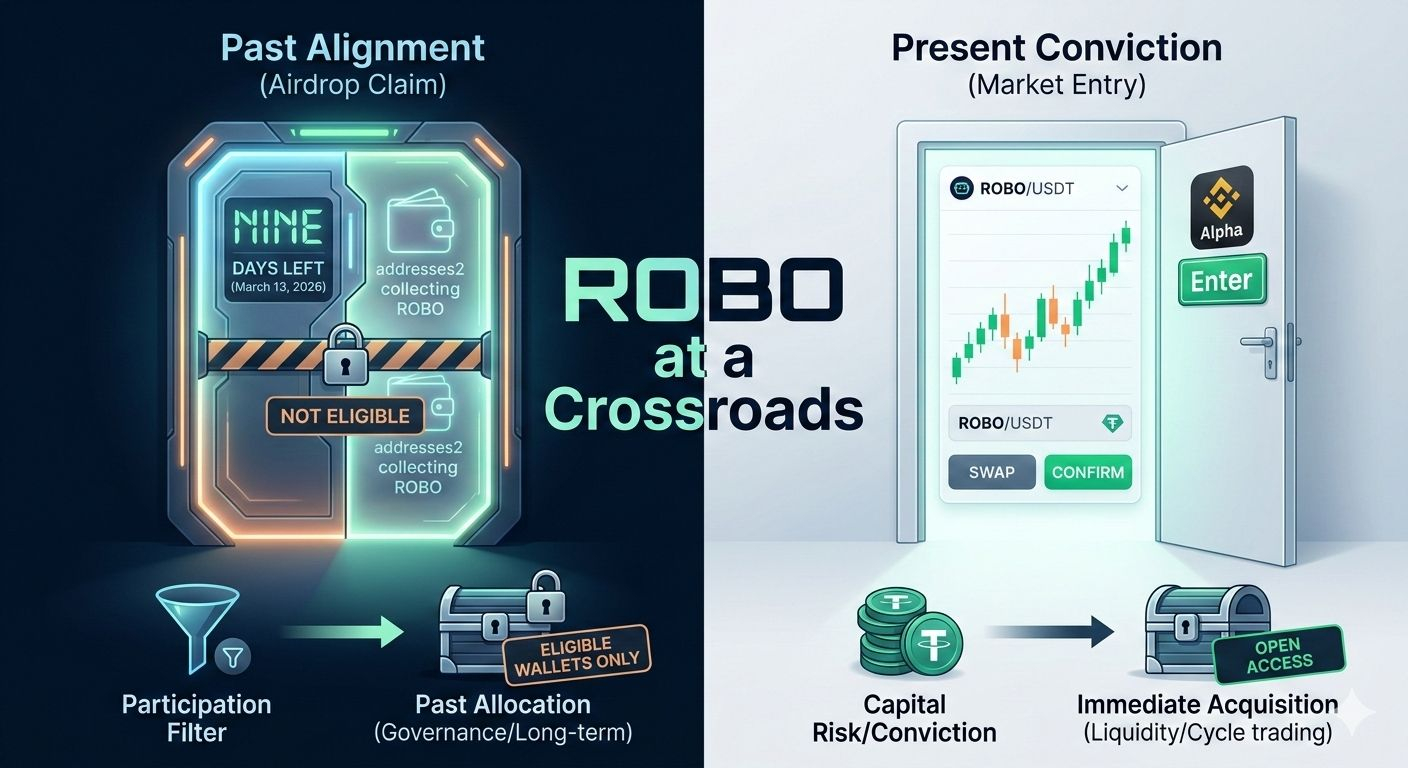
The claim window closes March 13, 2026. After that, it’s over. Deadlines in crypto aren’t decorative. They change supply math. Once unclaimed tokens are locked or redistributed, circulating supply becomes clearer, and markets adjust accordingly. So if someone is eligible, claiming before the deadline isn’t optional — it’s basic responsibility.
But here’s the important part: missing the airdrop does not mean missing the project.
There are always two doors in crypto. One door rewards past alignment. The other rewards present conviction.
That second door right now is market access through Binance. Specifically, its Alpha section, which acts like an early-access trading environment inside the exchange. It removes the eligibility filter entirely. You don’t need past participation. You just need USDT and a decision.
Open the app. Go to Alpha. Select ROBO. Swap. Confirm. The tokens appear.
It’s simple, and that simplicity changes everything. It turns exclusion into choice.
Of course, buying on the market is different from receiving an airdrop. Airdrops carry little capital risk but require history. Market purchases carry financial risk but require conviction. Neither path is superior — they serve different people.
The recent price movement adds another layer to the psychology. ROBO has shown upward momentum, moving from lower consolidation levels toward the mid-cent range with visible volume support. When a token starts moving like that, it creates urgency. RSI hovering below overbought territory suggests momentum without extreme exhaustion, but early-stage tokens are volatile by nature. Five cents can become six quickly — and it can also become four just as fast.
That volatility is normal. Early narratives move faster than fundamentals.
What makes this situation interesting isn’t just the price. It’s the split forming within the community. On one side are earners — people who received allocation because they participated early. On the other side are buyers — people entering through open markets.
Earners often think long-term because their entry cost was participation. Buyers often think in cycles because their entry cost was capital.
Healthy ecosystems need both. Without earners, there’s no foundation. Without buyers, there’s no liquidity.
And then there’s the deeper layer: governance. If ROBO plays a significant role inside the broader Fabric ecosystem, token ownership could eventually translate into voting power and influence. Early distribution shapes who speaks loudly in those rooms. Market buyers still gain that exposure — just through a different path.
The March 13 deadline matters for another reason too. Once the claim window closes, uncertainty reduces. Markets prefer clarity. If unclaimed tokens are burned or reallocated according to the tokenomics, that shifts expectations about future supply. Clarity can stabilize sentiment.
But none of this changes a basic truth: buying a new token is speculative. Momentum feels powerful while it’s happening. It feels inevitable. But markets don’t move in straight lines. Liquidity can thin out. Sentiment can flip. News can redirect narratives overnight.
So the real question isn’t “How do I get ROBO?” It’s “Why do I want it?”
If you believe in the long-term vision of the ecosystem, then market participation is a rational path. If you’re reacting to the pain of missing an airdrop, that’s a different emotional driver.
Crypto constantly tests this distinction.
The first opportunity usually rewards time.
The second opportunity rewards timing.
Most people miss the first. The second is always open — but it costs something.
Right now, the door is still open in both directions. Eligible users have a limited window to claim through the Fabric Foundation portal. Others can access ROBO through Binance Alpha without friction.
Neither path guarantees profit. Neither path guarantees loss.
Markets don’t care about regret. They respond to participation.
And participation, one way or another, is still possible.
