
When US and Israeli forces struck Iran over the first weekend of March 2026, traditional commodity exchanges were closed. COMEX wasn't open. The NYSE wasn't open. But Hyperliquid was - and traders noticed.
Key Takeaways:
Hyperliquid's HIP-3 hit $83.37B in cumulative volume since its October 2025 launch
During US-Israeli strikes on Iran (March 1-2), Hyperliquid became the primary real-time price discovery venue for oil and commodities
The protocol generated $71.88M in gross revenue in January 2026 alone
Analysts project HYPE could reach $120–$180 by late 2026/2027, though regulatory risks remain
The decentralized exchange's HIP-3 protocol, which allows permissionless deployment of perpetual contracts, became the de facto venue for real-time price discovery on crude oil, gold, and silver during the strikes. Bitwise CIO Matt Hougan flagged that Bloomberg itself cited Hyperliquid's crude oil contract as the most relevant price benchmark available that weekend. USOIL perpetuals surged between 5% and 20%, briefly touching $97.
It was a stress test nobody planned - and Hyperliquid passed it.
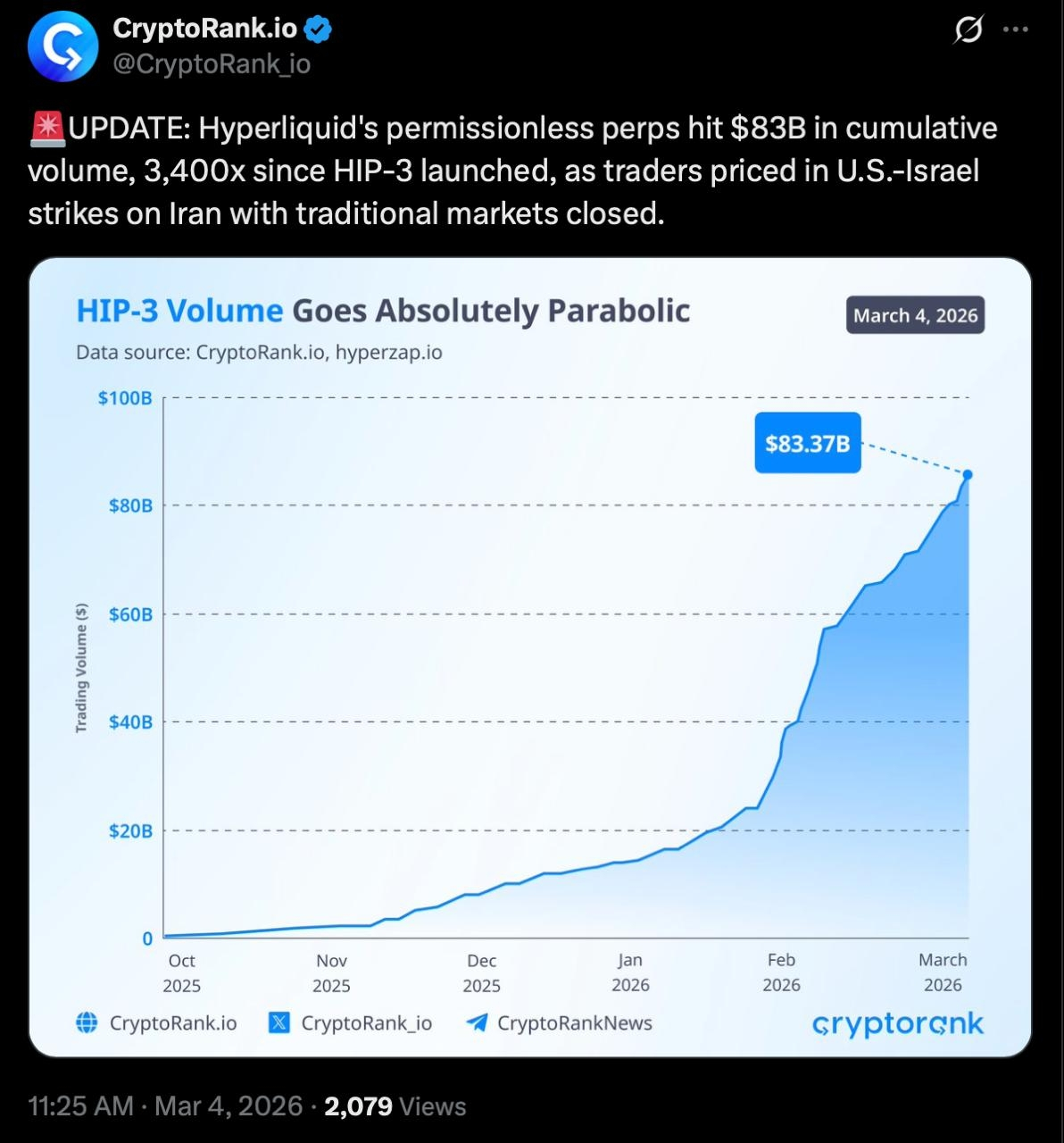
Volume That Wasn't Supposed to Exist Yet
HIP-3 launched in October 2025 with little fanfare. By February 2026, it was printing $5.2 billion in a single day. Silver perpetuals alone drove 68% of that record session - roughly $4.09 billion - as traders piled into safe-haven contracts amid broader macro uncertainty.
Cumulative volume across HIP-3 has now reached $83.37 billion. Open interest peaked above $1 billion in early 2026, with commodities contracts consistently setting new all-time highs through late January. Hyperliquid's gold and silver volume has climbed to approximately 1% of COMEX's total - a figure that would have seemed implausible eighteen months ago.
The Business Behind the Protocol
January 2026's financials were blunt in their message: this is no longer an experimental platform. Hyperliquid generated $71.88 million in gross income that month, with $63.86 million attributable to perpetual trading fees. Launching a HIP-3 market requires staking 500,000 HYPE tokens, which has created sustained demand pressure on the native token.
HYPE is currently trading in the $30–$34 range, having pulled back from earlier highs. Analysts covering the token project a potential run to $120–$180 by late 2026 or into 2027, contingent on continued market share capture from centralized exchanges.
What Could Go Wrong
The risks are real and not minor. Regulators have been circling decentralized derivatives platforms with increasing intent, and the absence of KYC requirements on Hyperliquid remains an obvious target. Additionally, daily token unlocks for core contributors - around 217,000 HYPE per day - create consistent selling pressure that bulls have to absorb.
The protocol's next development milestone is HIP-4, a prediction and outcome markets module expected later in 2026. If it launches on schedule, Hyperliquid will have moved from a crypto-native perps platform to something that looks considerably more like a full-spectrum financial exchange - one that, as March 2026 demonstrated, doesn't close on weekends.