

I remember the first time a “real-world” crypto thesis fooled me in a way that had nothing to do with charts. It was a logistics-automation deal I got excited about because the demo looked clean and the narrative sounded inevitable. Then I tried to track the thing that actually matters to me as a trader: proof of usage that doesn’t rely on the team’s tweets. On-chain, it was basically a desert. Wallets moved when incentives hit, then activity flatlined. Liquidity dried up, attention rotated, and the only people left were arguing about token emissions like it was a substitute for demand. That lesson stuck: if a project says it’s tied to real operations, I want to see whether the system keeps producing transactions after the incentives fade. Retention is the whole trade.
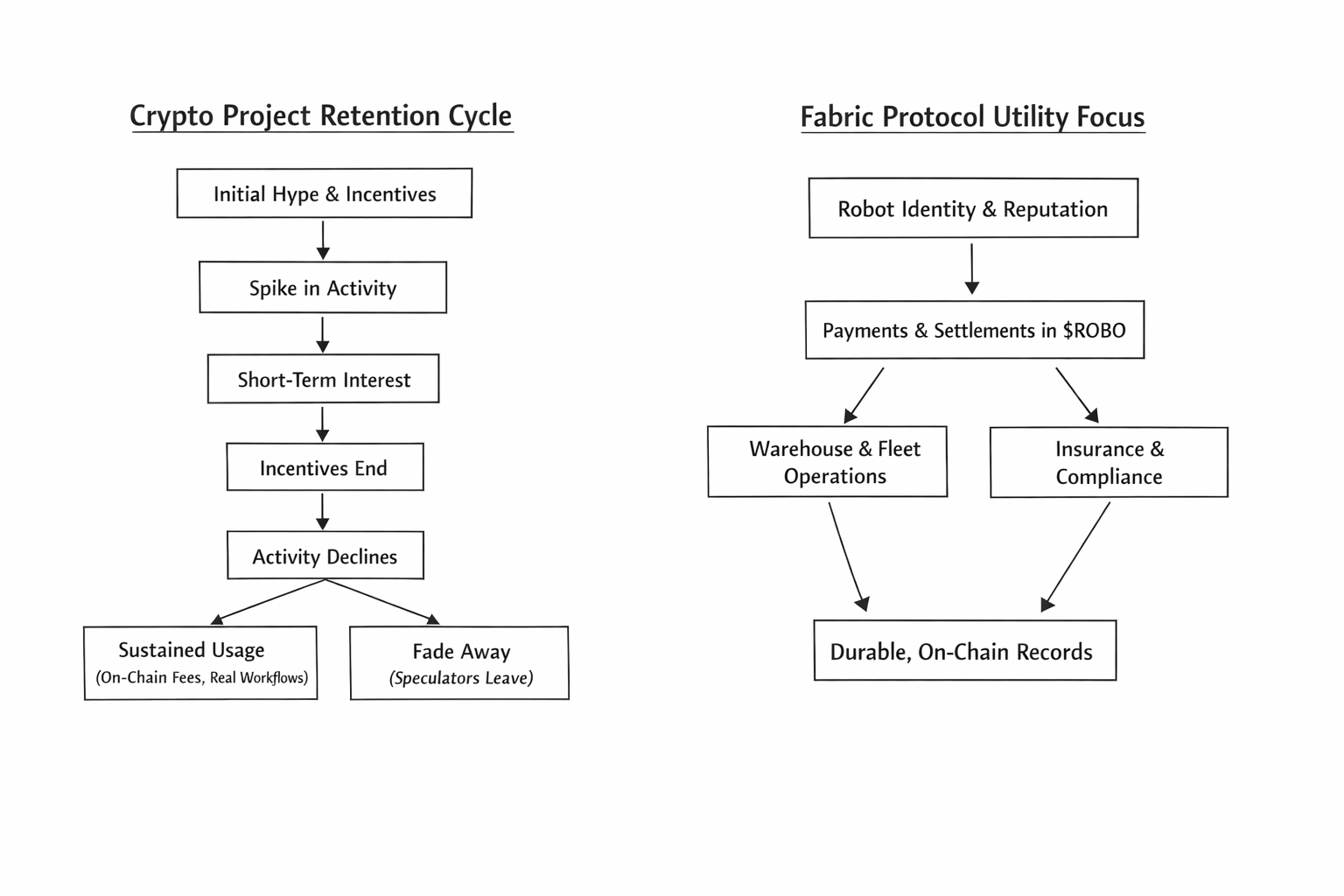
That’s why I’ve been watching Fabric Protocol with a more suspicious, practical lens. The pitch is not “robots plus AI,” it’s “robots plus agency,” and agency in markets usually means two boring things: identity and settlement. Robots can’t open bank accounts or carry passports, so Fabric frames the base layer as wallets, on-chain identity, and fees paid in $ROBO, with an initial deployment on Base and a stated path toward a dedicated chain later. If you’ve spent any time trading “infra” tokens, you know how often that becomes hand-wavy. Still, the structure is at least coherent: if robots are going to do work, get paid, post bonds, buy skills, and leave an auditable trail, you need a coordination fabric that doesn’t depend on one company’s database. But here’s the part I care about, and it’s where the retention problem shows up immediately. Most narratives in this lane assume adoption is a straight line. In practice, adoption is spiky and fickle. Traders show up for a listing, airdrop, or announcement, then vanish. Developers tinker for a weekend hack, then bounce. Even “users” disappear the moment the subsidy ends. If Fabric is real, it has to retain participants for the boring middle of the cycle, the months where nothing is trending. That retention can’t just be vibes. It has to be paid for by workflows that people do not want to unwind because the on-chain record is now part of how robots get permissioned, insured, paid, and trusted across operators. The idea of on-chain identity sounds abstract until you map it to something traders already understand: credit. If a robot is doing tasks in the physical world, it’s going to break stuff, miss deadlines, get spoofed, or get used by a bad operator. Fabric’s framing of a persistent identity registry with provenance and historical performance is basically credit history for machines. And once you treat it that way, retention becomes less about token holders and more about counterparties. Warehouses, fleet operators, and insurers do not want to re-underwrite the same machine every week. They want a durable identity trail. If the protocol actually becomes the place where that trail lives, the stickiness is structural. Still, the risk is right in your face. A public ledger for robot actions and decisions is an accountability feature, but it’s also a privacy and compliance headache. If sensitive operational data leaks, or if regulators decide that certain robot logs qualify as personal data, you can get adoption friction overnight. And if Fabric relies on “migration to its own L1” as a future capture mechanism, that introduces another trader-grade risk: bridges, security assumptions, and the usual mess when ecosystems split liquidity. I’ve seen too many projects promise “we’ll move later” and then spend a year dealing with the second-order consequences. So what do I watch instead of the narrative? I watch whether the token is being used for reasons other than speculation. CoinMarketCap currently shows meaningful reported 24-hour volume and a circulating supply figure, which tells you there’s attention and liquidity right now, but it doesn’t tell you retention. Retention shows up as consistent fee-paying behavior, repeat interactions, and a distribution of activity that isn’t just a handful of whales. If Fabric is truly about payments, identity, and verification fees paid in ROBO, then you should eventually see a baseline of transactions that persists through quiet weeks. If that baseline never forms, you’re back in the same old cycle: incentives spike, charts spike, then nothing. There’s another tradeoff that bugs me, too. Turning robot coordination into an on-chain process can add latency and cost. In physical systems, milliseconds and reliability matter. If the protocol is used for identity, bonding, settlement, and audit trails, fine. If anyone tries to shove real time control loops on-chain, I’d be skeptical. The value is in the parts of autonomy that need shared truth, not in over-blockchaining everything just because you can. If you’re eyeing this as a trader, treat it like a retention bet, not a story bet. Pull up the basics, then do the unsexy work: track on chain activity trends across time, watch whether usage survives after campaigns, and pay attention to whether integrations look like actual operations or just partnerships on a slide. If Fabric starts showing durable, repeat demand for identity and settlement, I’ll respect it even if price chops for months. If it doesn’t, I don’t care how clean the thesis sounds. Go verify the retention signals yourself, not the marketing. Watch the chain, watch the fees, watch who keeps showing up when nobody’s watching, then place your risk where the proof is.
@Fabric Foundation #ROBO $ROBO
