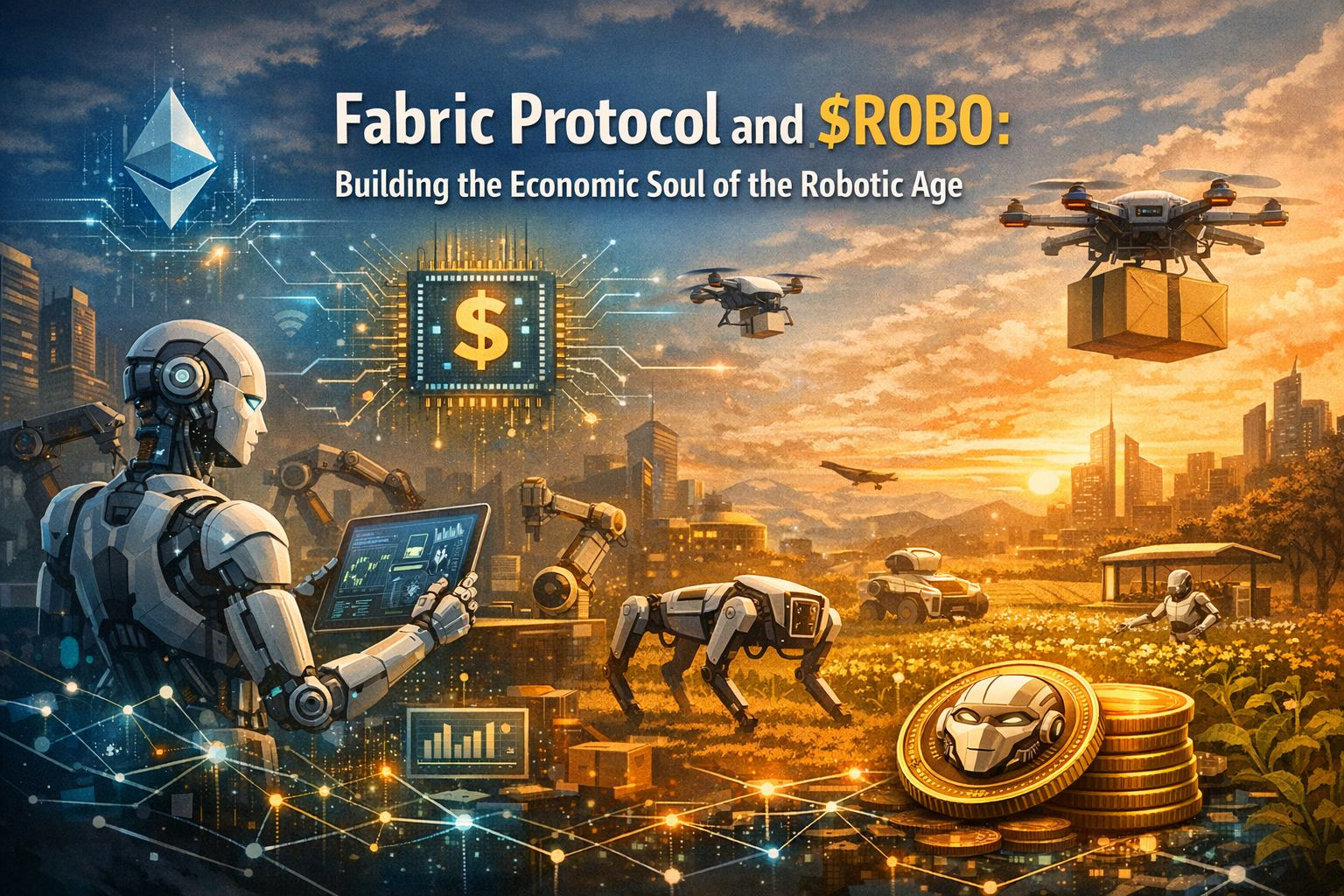
The first time you hear about a “blockchain for robots,” it sounds like something pulled from a futuristic pitch deck. But if you slow down and really look at the world around you, it doesn’t feel futuristic at all. It feels like the next logical step. Robots are already here. They move through warehouses, assist in surgeries, inspect dangerous infrastructure, and quietly power logistics networks. Companies like Boston Dynamics have shown us machines that can run and adapt with surprising balance, while Amazon has built entire fulfillment systems around robotic labor. The machines are working. The missing piece is the economic layer that connects them in an open way.
Fabric Protocol is trying to build that missing layer. Not in a dramatic, world-changing overnight sense, but in a structural sense. It is attempting to give robots identity, coordination, and a financial system that doesn’t depend entirely on centralized corporate databases. In simple terms, it wants robots to be able to prove who they are on-chain, accept payments, complete tasks, and interact with other participants through smart contracts. That sounds technical, but at its core it’s about independence and structure. It’s about building rails for a future where machines don’t just execute commands but participate in economic systems.
The project began on Base, which itself sits on top of Ethereum. From a practical perspective, that makes sense. Lower fees, compatibility with existing tools, and easier developer access. But the bigger vision stretches beyond simply being another application on someone else’s chain. The long-term ambition suggests a dedicated environment where robotic coordination is not just a feature, but the foundation.
Then there is $ROBO, the token that carries the economic weight of the system. On the surface, it follows the familiar ERC-20 structure. But when you look a little closer, you notice it isn’t rigidly fixed. There is a burn function that can reduce supply, and there is also a restoreSupply mechanism that allows tokens to be reintroduced under defined conditions. That detail matters. It means the supply is not locked forever in a single direction. There is flexibility built into the design.
Flexibility can be powerful. It allows a system to adapt. But it also raises emotional questions about trust. Who has the authority to restore supply? Under what rules? Is it automated by governance, or controlled by a limited group? These are not accusations; they are natural questions any thoughtful participant should ask. Because in decentralized systems, power is not just about code. It’s about who can change the code’s impact.
The total supply of 10 billion tokens is divided across community incentives, investors, team members, foundation reserves, airdrops, and liquidity. On-chain data visible through explorers like Etherscan shows that only a portion is circulating right now. That’s normal for early-stage projects, but it also means decentralization is still developing. A network does not become decentralized simply because it says so. It becomes decentralized when control, ownership, and influence are widely distributed over time.
What truly makes Fabric emotionally interesting is its idea of Proof of Robotic Work. Instead of rewarding only financial staking or computational mining, it tries to reward actual robotic productivity. If a robot completes a task and that task can be verified, the network distributes incentives accordingly. In theory, that aligns token rewards with real-world value. It connects digital assets to physical contribution.
There is something beautiful about that concept. It suggests a world where tokens are earned because something tangible was done — a delivery completed, a repair executed, a crop monitored. It moves away from pure speculation and toward measurable work. But the real world is complicated. Verifying that a robot truly completed a task is not simple. Data feeds can be manipulated. Oracles can be centralized. Reputation systems can be gamed. The bridge between blockchain certainty and physical-world uncertainty is fragile.
This is where governance becomes more than a technical feature. It becomes the heart of the experiment. If decisions about supply, rewards, and system upgrades are transparent and meaningfully controlled by the community, Fabric could evolve into a genuinely decentralized coordination layer. If those decisions concentrate in a small circle, then the narrative of decentralization weakens. The technology might still function, but the philosophy changes.
Right now, the network shows early adoption. There are holders. There is activity. There is visible contract code. But early adoption is not the same as maturity. The true test will come during stress — during moments when difficult decisions must be made, when incentives are tested, when governance proposals challenge existing power structures.
Still, there is something quietly powerful about what Fabric is attempting. It is looking at a world where autonomous systems will only increase, and asking a simple but profound question: how do we coordinate them fairly? Not just within a single corporation, but across an open network. Not just as tools, but as programmable economic agents.
If the vision unfolds successfully, you could imagine fleets of robots negotiating tasks automatically, receiving payment the moment work is verified, and interacting across borders without friction. You could imagine agricultural drones, logistics bots, and maintenance machines participating in a shared settlement layer that no single company controls. That future does not feel absurd. It feels like a natural extension of trends already in motion.
Whether Fabric Protocol becomes the backbone of that future or simply one of the early experiments will depend on execution, transparency, and community vigilance. The idea is bold, but bold ideas are only the beginning. What matters is whether the system can stay open, accountable, and resilient as it grows.
In the end, Fabric is not just building code. It is testing whether machines can be integrated into an open economic framework without losing human oversight and fairness. That is not just a technical challenge. It is a social one. And that is why this project feels less like a token launch and more like the start of a long, uncertain, but fascinating journey.
@Fabric Foundation #ROBO $ROBO