
I call it latency shadow the invisible spread you pay not in fees but in time#mira $MIRA
Every serious trader eventually discovers it You see the quote you hit execute the block confirms and yet the fill reflects a price that existed half a heartbeat ago That half heartbeat is the shadow It is not slippage in the UI It is structural delay embedded in validator gossip mempool ordering block propagation and physical fiber routes Most crypto networks pretend this does not exist Mira is one of the few that appears designed around it
Project Mira is not trying to win with slogans about throughput It is optimizing for observability and execution determinism two properties that directly shape how capital behaves under stress I say that as someone who watches on chain liquidity fragmentation and validator dashboards every single day What stands out is not marketing language It is architectural intent
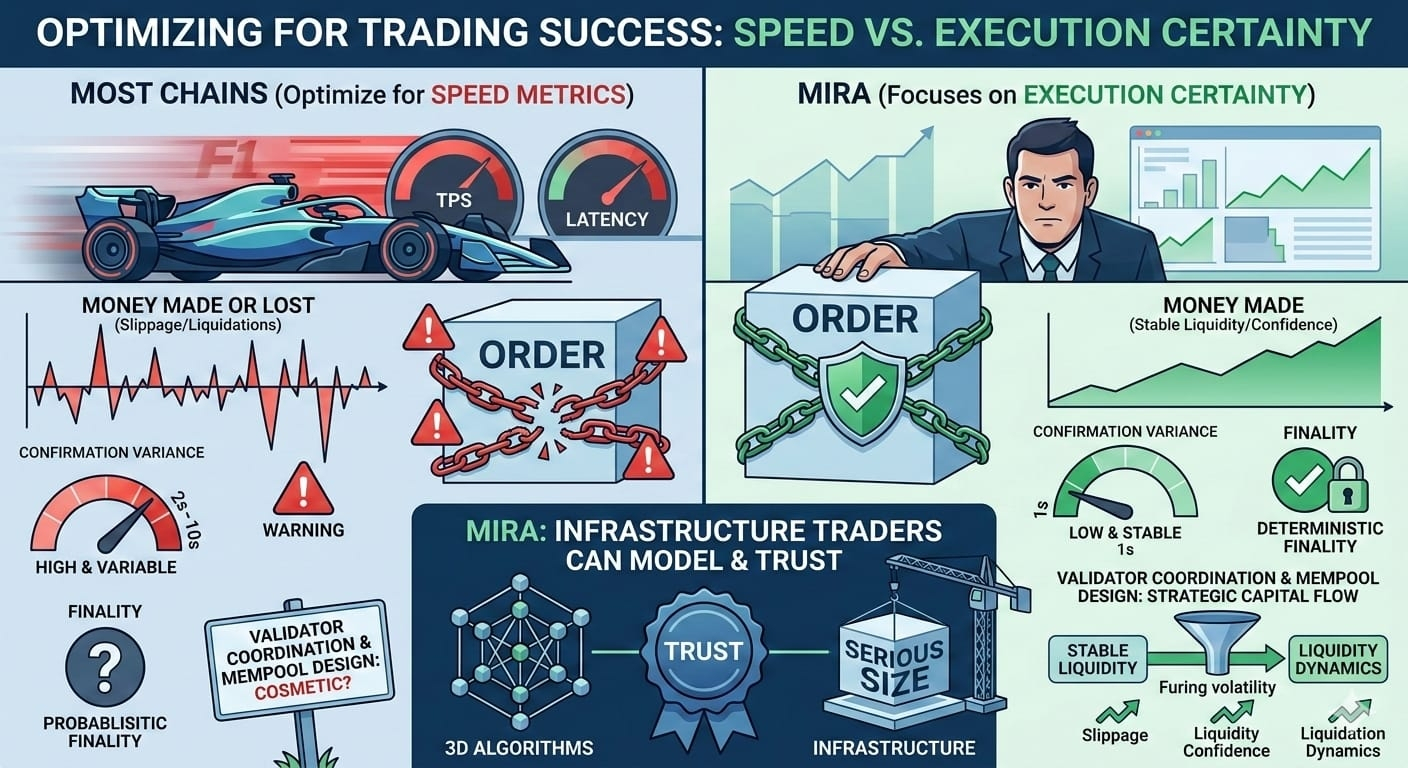
Mira leans toward a low variance confirmation model That matters more than raw TPS Traders do not fear moderate latency They fear unpredictable latency When block times oscillate when validator leaders stall when mempools split under congestion market makers widen spreads defensively Liquidity thins not because of volume but because of uncertainty Mira appears structured to minimize confirmation variance rather than chase theoretical speed That trade off signals seriousness
The validator topology reflects that bias Instead of maximizing geographic sprawl at any cost Mira seems to balance distribution with propagation reliability That introduces real tension Concentrated validator clusters reduce network latency and improve finalization predictability but they increase correlated infrastructure risk A routing failure or data center outage could distort block production cadence In trading terms that becomes volatility in execution quality The challenge is not simply being fast It is remaining stable under adversarial conditions
The mempool layer is where things become personal for traders Public mempools are breeding grounds for extractive behavior sandwiching priority gas auctions latency arbitrage If Mira incorporates private relay pathways or encrypted propagation it directly changes market microstructure Reduced pre trade visibility compresses MEV bandwidth which can tighten effective spreads for organic flow But opacity shifts power Whoever controls the relays influences inclusion Infrastructure always moves leverage somewhere even when it claims neutrality
Execution quality also depends on how confirmation depth behaves statistically Finality design that minimizes reorg probability beyond shallow depths is not academic It shapes liquidation logic and leverage tolerance I have watched cascading liquidations accelerate because reorg uncertainty forced risk engines to overreact If Mira can maintain tight finality guarantees without excessive validator concentration that becomes structural edge But that only works with disciplined staking distribution and meaningful slashing enforcement Symbolic penalties do not protect markets
The user experience layer tells a deeper story Account abstraction and flexible gas models are not cosmetic upgrades They are execution routing tools If Mira supports programmable fee sponsorship through paymasters then applications can internalize gas volatility and offer consistent execution pathways From a trader perspective stable transaction cost modeling reduces hesitation during high volatility moments Decision pressure intensifies when you are unsure whether a transaction will stall or spike in cost Cleaner gas abstraction reduces that psychological friction and that changes behavior
Oracle integrations and bridge design are where infrastructure meets capital flow If price feeds are sourced from high frequency aggregators with tight update intervals liquidation engines and AMMs reflect reality more closely Slow oracle updates create arbitrage windows that extract from passive liquidity providers Faster updates narrow spreads but increase sensitivity to manipulation It is always a balance
Bridges matter even more A network can optimize internally but if cross chain ingress is slow or liquidity routing is fragmented capital hesitates Traders follow liquidity gravity not ideology Mira must reduce bridge friction through low latency verification and efficient liquidity abstraction Otherwise it risks becoming an island dependent on external sequencing layers for meaningful depth
Physical infrastructure bleeds into market outcome Validator hardware bandwidth capacity colocation density all determine propagation time During volatility spikes microseconds compound If validators operate on standardized high performance hardware with strict uptime requirements block production variance tightens But that narrows participation to operators with resources Decentralization becomes a spectrum rather than a slogan
There is honest tension in all of this Optimizing for low latency often means fewer validators with tighter coordination Optimizing for maximal decentralization can inflate propagation delay and confirmation variance As someone who has traded through congestion events I prefer predictable performance over ideological purity But systemic resilience requires both speed and distribution
The real question is not whether Mira is fast today It is whether validator incentives governance controls and infrastructure assumptions remain stable as economic density increases Networks behave differently at ten million in daily settlement than at ten billion Latency shadow widens when demand saturates capacity MEV intensifies Validator collusion incentives grow Paymaster systems become attack surfaces
The long term structural test for Mira is simple in theory and difficult in practice Can it maintain low execution variance fair transaction ordering and stable finality while validator participation scales and liquidity deepens without drifting toward operational concentration that erodes neutrality If it can compress latency shadow without centralizing trust then it becomes more than a performant chain It becomes infrastructure traders can build real risk models around and that is when a network stops being experimental and starts becoming dependable@Mira - Trust Layer of AI