

As of March 5, 2026, it is getting harder to pretend that robotics and advanced AI will stay confined to demos. Machines are starting to act in the physical world and that creates a coordination problem that feels bigger than any single lab. When many people build a robot together, who can prove what the robot did, who can audit it, and who is accountable when something goes wrong?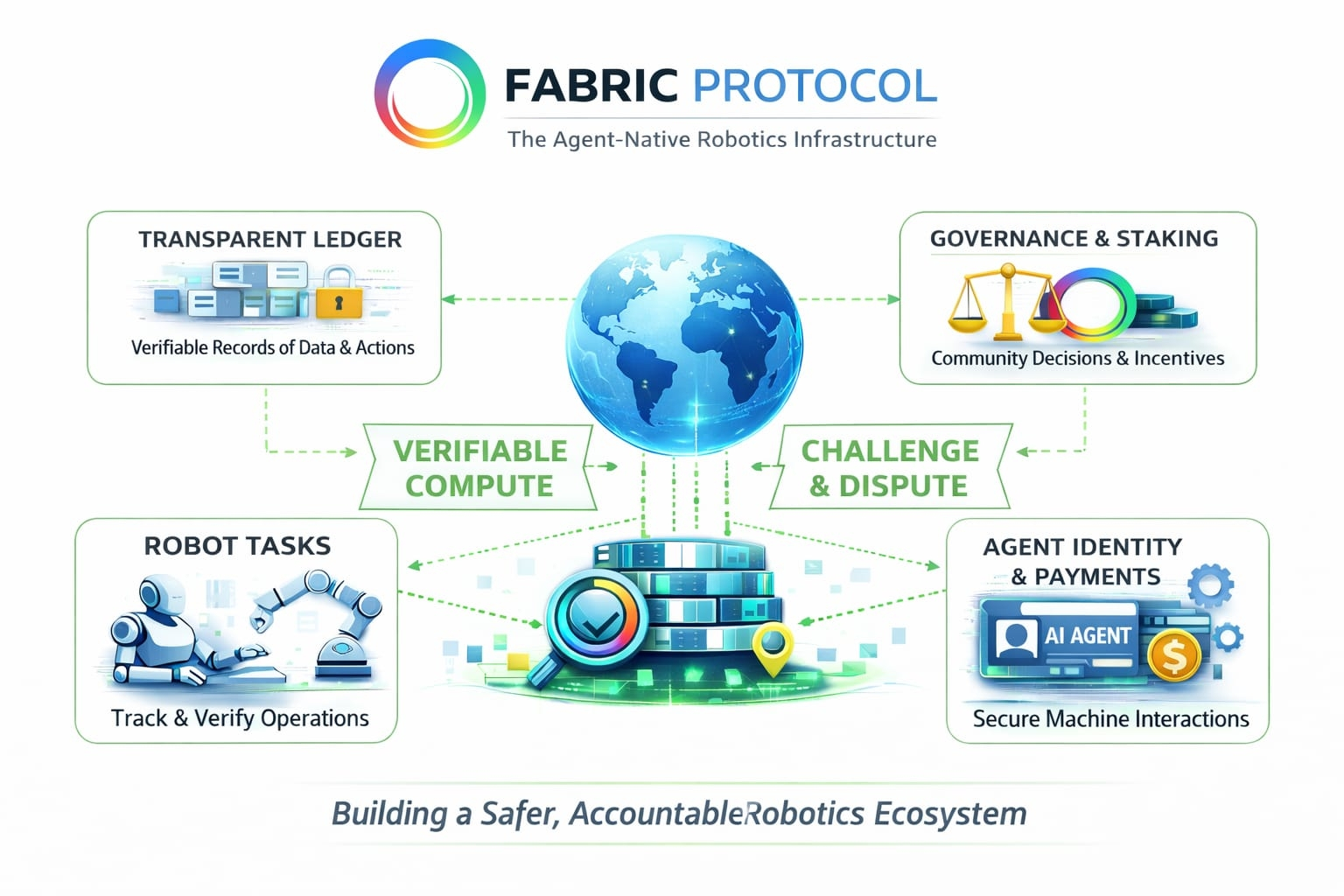
I read Fabric Protocol as an attempt to answer that with an open network supported by the Fabric Foundation. The Foundation positions itself as a nonprofit steward for long term governance and coordination rather than a single owner of the full stack. That matters because robotics infrastructure tends to centralize fast, especially when safety and compliance pressures rise.
In the design, a public ledger becomes the shared record for data, computation, and oversight. Instead of trusting private logs, the network treats key events as verifiable statements: a dataset was contributed, compute was delivered, a task was completed, or a safety check failed. If those statements can be validated by anyone, collaboration can scale beyond small teams without relying on personal trust.
Verifiable computing is the piece I watch most closely. The whitepaper describes contribution and rewards as tied to completed work that can be checked, not to passive holding. Compute can be attested, data can be measured in standardized units, and robot tasks can be challenged when results look suspicious. A challenge and dispute process, backed by staked bonds and penalties, is meant to make fraud uneconomical even if it is not technically impossible.
This is also where agent native infrastructure starts to feel practical. Robots and autonomous software agents need identities, permissions, and payment rails that fit machine behavior. The Foundation describes building systems for machine and human identity, accountable task allocation, gated payments, and machine to machine communication conduits. I interpret that as infrastructure that lets agents coordinate work, exchange value, and leave an auditable trail, even though they are not legal persons.
Modularity is the other lever that makes an open robotics network plausible. The protocol centers on a general purpose robot concept that can evolve through many specialized modules. Skills can be added, updated, or removed in a controlled way, like swapping software components while keeping clear version history. Different hardware platforms can plug in through drivers and configuration layers, which helps developers and researchers collaborate on interoperable systems without rebuilding everything.
Governance decides whether this stays open over time. In Fabric, the token is framed as functional tooling: paying network fees, posting operational bonds, and participating in protocol decisions through time locked voting weight. Governance can tune quality thresholds, verification rules, and slashing conditions. Transparent records also help with regulatory alignment because audits can focus on data provenance, validation outcomes, and who signed off on what.
When I imagine the long term impact, I do not think first about a single robot. I think about shared infrastructure for smart industries and cooperative AI environments where humans can observe and critique machine behavior at scale. Still, real world robotics is messy. The strongest test will be whether verification stays affordable and whether governance remains responsive as the ecosystem grows.
In the end, the vision I take from Fabric is simple: a public, verifiable coordination layer so robotics progress can be collaborative, accountable, and safer for everyone.
@Fabric Foundation #ROBO #robo
