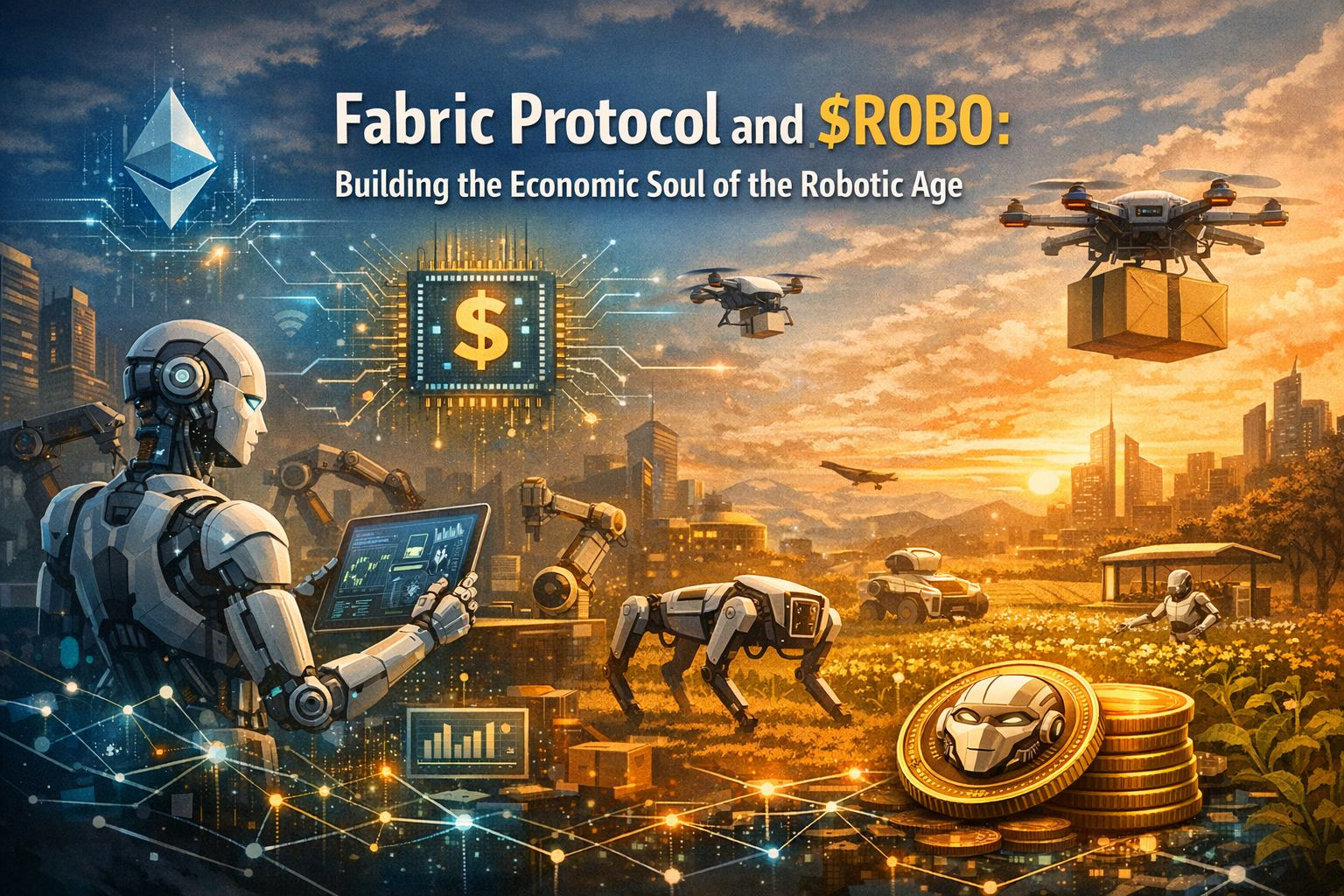
When I think about Fabric Protocol and ROBO, I don’t immediately think about charts or token prices. I think about something much more basic and much more human — trust. We are slowly handing more responsibility to machines. We let AI suggest medical insights. We let algorithms influence hiring decisions. We let robots manage warehouses and assist in surgeries. And most of the time, we don’t really know what’s happening behind the scenes. We just hope it’s working correctly.
That quiet hope is where Fabric Protocol steps in.
Fabric is built around a simple but powerful idea: if machines are going to act in the real world, their actions should be verifiable. Not hidden inside private company servers. Not locked away in systems that only a few engineers understand. Verifiable in a way that creates a permanent, tamper-resistant record. Instead of saying “trust our AI,” the system says, “here’s the proof of what it did.”
At its core, Fabric uses blockchain infrastructure to log and validate AI and robotic activity. Imagine a robot completing tasks in a warehouse or a model processing sensitive data. Each meaningful action can be recorded and confirmed by independent validators on a decentralized network. Once recorded, that information can’t quietly disappear or be altered later. It becomes part of a shared ledger.
There’s something emotionally reassuring about that. Not because it makes machines perfect — it doesn’t — but because it removes secrecy. It introduces accountability.
The ROBO token plays a practical role in this system. Validators who help confirm and secure the network are rewarded in ROBO. Operators who want their AI systems verified use ROBO to access the infrastructure. It creates an incentive structure where maintaining honesty and accuracy supports the network’s health. In theory, everyone benefits when the system remains transparent and decentralized.
But let’s be real. Verification is not the same thing as wisdom.
A blockchain can prove that an AI model produced a certain output at a certain time. It can confirm that data was processed according to a specific set of rules. What it cannot do is automatically decide whether that output was fair, ethical, or contextually safe. If an AI makes a flawed decision, recording that mistake permanently doesn’t fix it — it simply makes it visible.
And maybe that visibility is still progress.
Another concern that naturally comes up is decentralization itself. It sounds powerful, but it only works if participation is truly distributed. If too much verification power ends up concentrated in a small group, the system becomes fragile. Incentives must be carefully designed so that honesty is more profitable than coordination or manipulation. Real decentralization is not just about open-source code — it’s about who actually holds influence.
Then there’s sustainability. Many token ecosystems struggle because they reward participation faster than real demand grows. If ROBO tokens are issued at a pace that exceeds genuine utility, long-term stability becomes difficult. For Fabric to thrive, its infrastructure needs to be used in meaningful ways — by real companies, real robotic systems, real AI platforms. Utility has to outpace speculation.
Compliance also quietly sits in the background of this conversation. Around the world, governments are building new frameworks to regulate artificial intelligence. Transparency and auditability are becoming serious requirements. Fabric’s verification model could potentially support that shift by providing immutable records of AI actions. But regulatory trust requires more than cryptographic proofs. It requires governance, dispute resolution, and institutional clarity.
What makes Fabric interesting isn’t that it claims to solve every problem in AI. It doesn’t. What makes it interesting is that it recognizes something we all feel: as machines become more capable, blind trust becomes uncomfortable. We want visibility. We want accountability. We want systems that can be questioned and audited.
If Fabric succeeds, it could quietly become infrastructure for a machine-driven world. Robots coordinating supply chains could leave transparent records. AI systems interacting across platforms could verify each other’s outputs. Autonomous systems could transact with built-in proof layers. It’s a future where trust is embedded, not assumed.
Of course, the real test isn’t the vision. It’s execution. Can the network stay decentralized as it grows? Can the economics remain balanced? Can it attract real-world integration instead of just theoretical support? These are difficult questions, and the answers will take time.
But at the heart of it all, Fabric Protocol is trying to answer one deeply human concern: if we are going to rely on intelligent machines, how do we make sure they remain accountable to us?
It doesn’t promise perfection. It doesn’t claim machines will suddenly become morally aware. What it offers is something more grounded — a system where actions leave proof, where records can’t be quietly erased, and where trust is strengthened through transparency.
@Fabric Foundation #ROBO $ROBO