
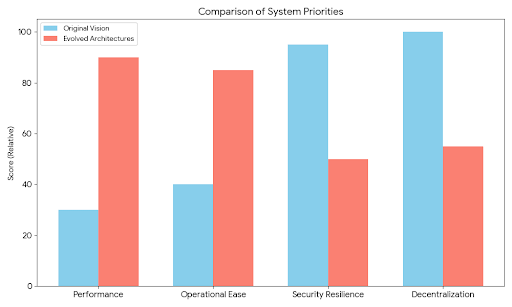
The original vision of blockchain systems was built on a simple but powerful assumption: trust should not be concentrated. By distributing authority across independent participants, blockchains aimed to create systems where no single actor or small group could manipulate outcomes. Over time, however, many blockchain networks evolved into architectures that quietly reintroduced predictability into the system. Validators became relatively fixed, communication channels stabilized, and coordination patterns repeated over long periods. While this stability helped performance and reduced operational complexity, it also introduced subtle security risks that early blockchain designers sought to avoid.
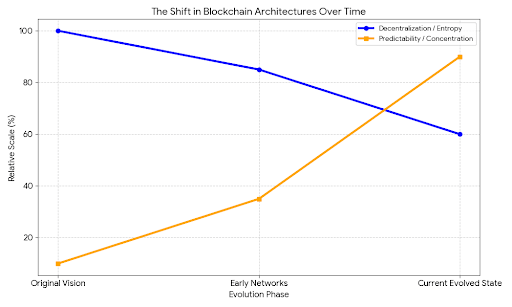
The challenge becomes even more significant when blockchain moves beyond financial applications into physical infrastructure such as robotics. When a network begins coordinating real-world machines, data, and computation, reliability and safety become more than technical concerns. They become structural requirements. This is the context in which Fabric Protocol proposes a different approach to validator architecture—one that prioritizes dynamic coordination instead of static participation.
At the heart of the protocol is the idea that validators should never remain fixed for extended periods of time. Traditional proof-of-stake networks often rely on a semi-static set of validators who process transactions and maintain the ledger. Although stake distribution theoretically ensures decentralization, the same validators frequently remain active for long cycles. Over time, they develop predictable communication patterns, stable peer relationships, and known operational behaviors. These patterns can unintentionally create attack surfaces. If an adversary understands which validators are likely to interact repeatedly, they can target infrastructure, influence coordination paths, or attempt network manipulation through timing and network-level attacks.
Fabric’s architecture addresses this issue by treating validator participation as a constantly shifting system rather than a stable committee. Validators are rotated continuously through a verifiable selection process that changes communication partners, coordination roles, and validation responsibilities. Instead of relying on a predictable set of participants, the protocol ensures that every round of computation and consensus introduces new combinations of validators.
This rotation does more than distribute workload. It removes the structural predictability that attackers rely on. In a static system, repeated validator interactions create patterns that can be analyzed and exploited. In a rotating system, these patterns disappear. Validators cannot assume they will interact with the same peers, and adversaries cannot reliably anticipate the network’s coordination structure.
The philosophy behind this design is rooted in the belief that decentralization is not only about how many participants exist, but about how they interact over time. A network with hundreds of validators can still develop centralized dynamics if the same participants repeatedly coordinate with each other. True decentralization therefore requires dynamic interaction patterns, not merely distributed ownership.
Within Fabric’s infrastructure, this principle extends beyond consensus into how computation and data validation are performed. The protocol coordinates robotics-related tasks through verifiable computing, where machine-generated data and AI-driven actions must be validated by independent network participants. Because robots operate in physical environments, the consequences of incorrect computation or malicious data are far more serious than simple ledger discrepancies. An error could translate into a real-world malfunction or unsafe machine behavior.
To mitigate these risks, Fabric uses validator rotation to ensure that verification responsibilities are constantly reassigned across the network. Each validation cycle draws from a changing pool of participants, preventing long-term dependency on specific validators. This design creates a layered defense: even if a subset of validators behaves incorrectly, their influence is limited by the system’s constantly shifting structure.
Another important element of the design is the separation of coordination, computation verification, and regulatory enforcement. Rather than concentrating these responsibilities in a single group of nodes, Fabric distributes them across modular infrastructure layers. Validators participate in different roles depending on the cycle, further reducing the likelihood that any participant can build long-term influence within the system.
This approach reflects a broader shift in blockchain design philosophy. Early blockchain systems prioritized immutability and censorship resistance above all else. Modern infrastructure networks must balance these goals with operational resilience and real-world safety. When blockchains begin coordinating robots, autonomous agents, and machine data, the cost of failure increases dramatically. A system designed only for financial settlement may tolerate occasional inefficiencies. A system coordinating machines cannot.
Dynamic validator rotation therefore becomes a security primitive rather than an optional feature. By ensuring that validator relationships constantly change, the network resists both technical attacks and social coordination risks. It becomes significantly harder for malicious actors to predict the structure of the network or influence its operations.
This design also has an important cultural implication for decentralized systems. In many blockchain ecosystems, long-term validators gradually become entrenched infrastructure providers. While this stability can be beneficial, it can also lead to informal hierarchies that contradict the original principles of decentralized governance. By continuously reshuffling validator participation, Fabric ensures that influence remains fluid rather than fixed.
The result is a network architecture that behaves more like an evolving ecosystem than a static infrastructure layer. Participants enter different roles, collaborate with different peers, and validate different computations over time. The network never settles into predictable routines, and this constant motion becomes a form of protection.
As decentralized technologies expand into robotics and autonomous systems, the assumptions that shaped early blockchain design must evolve as well. Static validator models were sufficient when blockchains primarily secured financial transactions. But when these networks begin coordinating machines and real-world processes, security must be approached as a dynamic system.
Fabric’s rotating validator architecture represents one possible answer to this challenge. Instead of treating validator stability as a virtue, the protocol treats it as a potential vulnerability. By designing for constant change new peers, new roles, new coordination paths the network creates an environment where trust emerges not from fixed relationships, but from continuously verified interaction.
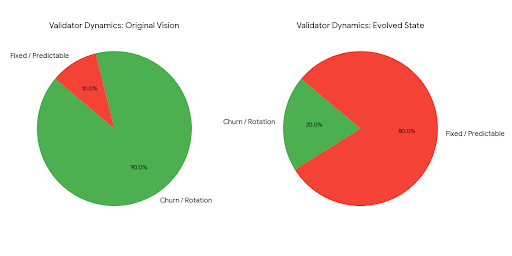
In this sense, Fabric’s design reflects a deeper principle about decentralized infrastructure. Security does not come only from cryptography or stake distribution. It also comes from unpredictability in how a network organizes itself. When the structure of participation is always shifting, manipulation becomes significantly more difficult.
For networks that aim to coordinate the future of robotics and machine intelligence, this principle may prove essential. Decentralized systems must not only distribute authority; they must also prevent authority from becoming structurally predictable. Fabric’s validator rotation model suggests that the next generation of blockchain infrastructure may be defined less by static consensus and more by adaptive coordination.
#ROBO @Fabric Foundation $ROBO
