
My day usually starts the same way: phone alarm, a quick scroll, and a mental checklist of everything I have to get done—work, errands, family stuff, messages I forgot to reply to, and that one task I keep postponing. Some days feel like I’m juggling five lives at once, and I’m doing it with nothing but apps, payment screenshots, and a little patience.
Now here’s the wild thought that actually changes how I see my routine: what if the “apps” weren’t just connecting humans to humans—but humans to robots that can earn, pay, and prove what they did?That’s the kind of future Fabric Foundation is building. Fabric Foundation describes itself as an independent, non-profit organization focused on creating the governance, economic, and coordination infrastructure that helps humans and intelligent machines work together safely and productively. Their mission is basically about making sure intelligent machines expand human opportunity, stay aligned with human intent, and benefit people everywhere. And the part that hits different is this: AI is no longer just living inside screens—it’s entering the physical world, where mistakes can break real things. Fabric Foundation argues that robots and autonomous agents bring new challenges like physical safety, real-time decision-making, and operating in human environments. When you think about it like that, “robot economy” stops sounding like sci-fi and starts sounding like the next layer of daily life.Here’s where ROBO comes in. Fabric Foundation positions $ROBO as the core utility and governance asset for its ecosystem, meant to support the mission of “Own the Robot Economy.” The big idea is that as robots become more capable, society needs open and verifiable infrastructure for human–machine alignment—and $ROBO is designed to align incentives and let people participate in that network. In normal-person terms: $ROBO is trying to be the fuel and the voting power for a system where robots can operate like economic actors.
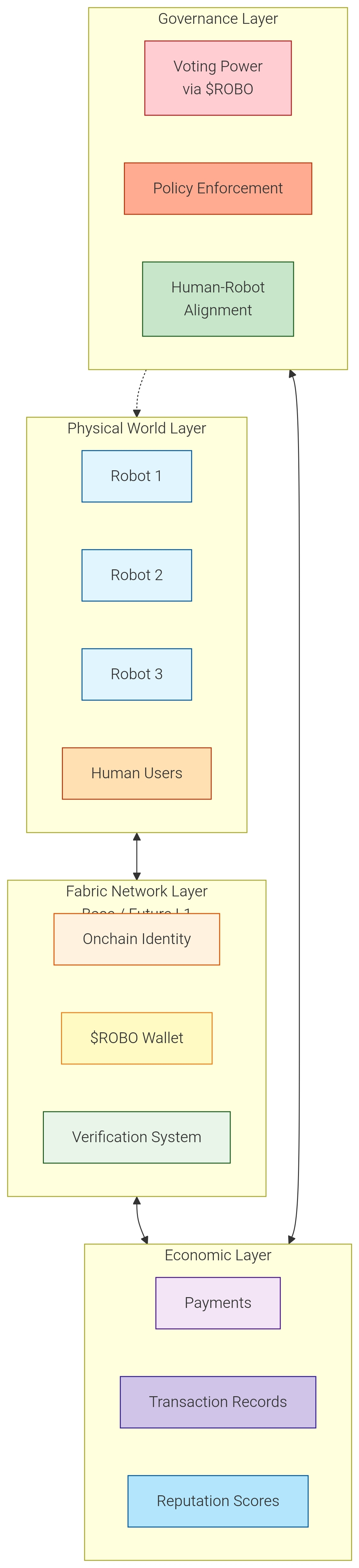
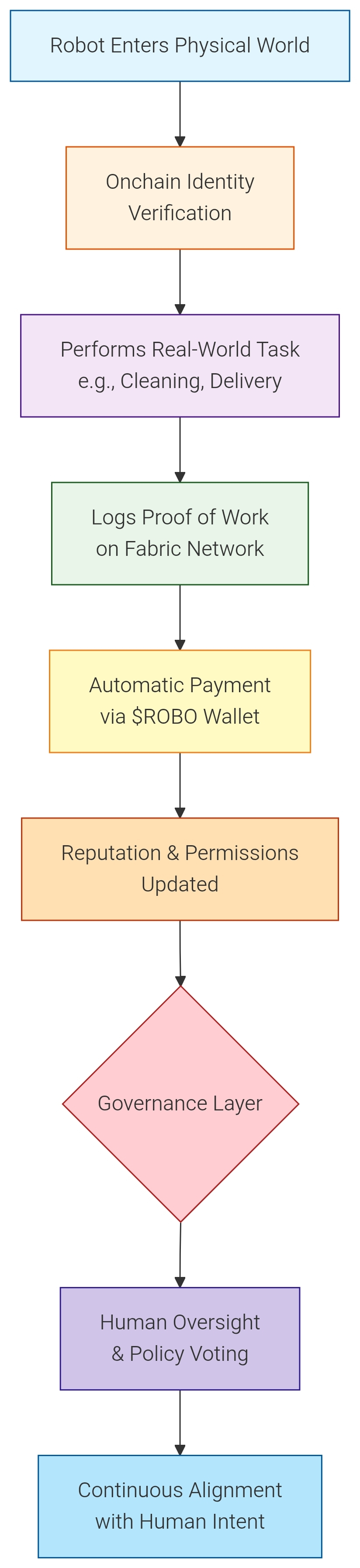
So when I’m thinking about my own day—commuting, ordering something, paying bills, coordinating work—I imagine the same friction points showing up for robots. Robots can’t open bank accounts or hold passports, so Fabric’s framing is that they’ll need wallets funded with crypto and onchain identities to handle payments and track activity. Fabric Foundation also says $ROBO is intended to cover network fees tied to payments, identity, and verification in the Fabric network. And the infrastructure has a roadmap, not just vibes. Fabric Foundation says the network is initially deployed on Base (an Ethereum Layer 2), with a plan to later migrate and become its own Layer 1 chain as adoption grows. What blows my mind is how this maps onto ordinary life. If I can send money instantly, verify a transaction, and keep receipts, then a robot doing real-world tasks also needs a way to: (1) identify itself, (2) get paid, (3) prove what it did, and (4) be governed so it doesn’t go rogue or get exploited. Fabric’s public messaging describes its goal as building an open network for general-purpose robots where anyone can participate and contribute. So imagine a future version of a normal day: a cleaning robot completes a job, logs the proof, gets paid automatically, and its reputation (or permissions) updates without me chasing support chats. I don’t need to “trust” a random operator; the system itself can be designed to verify activity and enforce rules. That’s the promise behind governance too—Fabric Foundation frames $ROBO as part of how policies, fees, and operational decisions get shaped over time. I’m not saying tomorrow morning I’ll wake up to robots running my whole schedule. But Fabric Foundation (and ROBO) is one of those ideas that makes you realize something bigger: the future isn’t only smarter apps—it’s smarter actors in the world, and they’ll need economic rails as real as the streets we walk on.