

The next technological revolution is forming at the intersection of artificial intelligence, robotics, and blockchain. While crypto has already transformed finance through decentralized systems, the next frontier is the machine economy — a world where intelligent machines interact, transact, and evolve autonomously.
At the center of this emerging narrative is ROBO, a token designed to power decentralized coordination between humans, AI agents, and robots. Instead of relying on centralized corporations to control intelligent machines,ROBO introduces an open blockchain infrastructure where robotics networks can operate transparently and economically on-chain.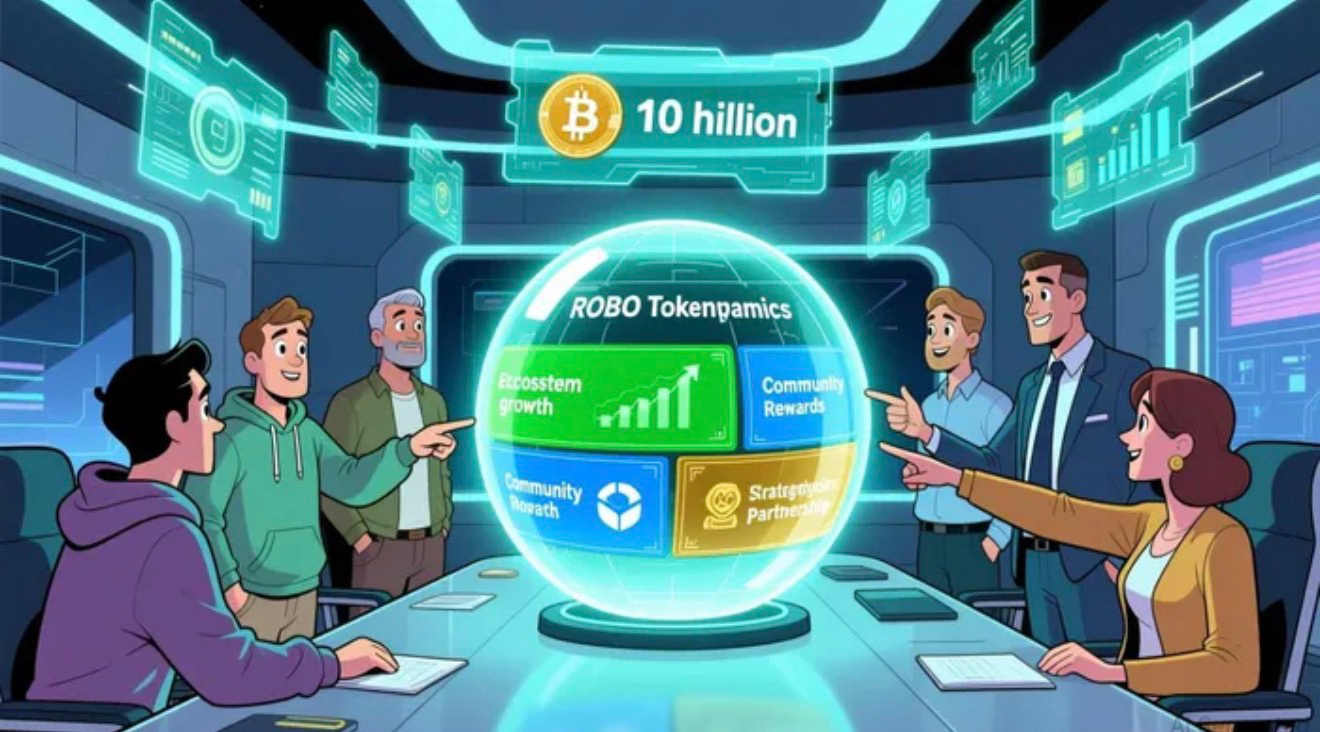
This vision is not just theoretical. It represents a shift toward programmable intelligence ecosystems, where machines become economic participants rather than passive tools.
The Vision Behind ROBO
The ROBO token is part of the Fabric Protocol, a decentralized network designed to coordinate robots, data, compute resources, and human oversight through blockchain technology.
In simple terms, Fabric aims to answer a critical question:
Who will control the robots in an AI-driven future?
Without decentralized frameworks, intelligent machines could become concentrated in the hands of a few powerful corporations. Fabric proposes a different model — one where robotics infrastructure is open, collaborative, and governed by a global community.
Within this network, ROBO functions as the economic engine that aligns incentives between developers, operators, and autonomous machines.
Why Robotics Needs Blockchain
As AI becomes more powerful and robotics advances rapidly, three major challenges emerge:
The first is ownership and control. Without decentralized systems, robotics ecosystems risk becoming monopolized by large tech companies.
The second challenge is machine identity and accountability. Robots interacting with the real world need verifiable identities, transparent activity logs, and secure coordination.
 The third issue is economic coordination. Autonomous systems require trusted mechanisms for payments, rewards, and work validation.
Fabric Protocol addresses these issues by integrating robotics infrastructure with blockchain, enabling machines to securely communicate, coordinate, and transact on a decentralized ledger.
In this architecture, robots are no longer isolated machines. Instead, they become nodes within a global machine network.
The Role of the ROBO Token
Within the Fabric ecosystem, ROBO acts as the utility and governance token that powers the entire network.
Its core functions include:
• Paying network fees for robotic services and computational tasks
• Enabling governance decisions for protocol upgrades
• Coordinating incentives for developers, operators, and contributors
• Securing work bonds that ensure reliable machine performance
One of the most interesting design choices is that token emissions are tied to real work rather than passive holding. This means participants earn rewards by contributing resources or services to the network, reinforcing a productive digital economy instead of speculative inflation.
The project also uses a fixed supply of 10 billion tokens, creating a predictable long-term token model.
AI, Automation, and the Machine Economy
The concept behind ROBO extends far beyond a single blockchain project. It represents a broader movement toward what many technologists call the machine economy.
In this future ecosystem:
Autonomous delivery robots could pay charging stations automatically.
Industrial robots could negotiate supply chain tasks through smart contracts.
AI systems could purchase compute power and data services without human intervention.
Blockchain enables these interactions by providing trustless infrastructure where machines can exchange value securely.
In such a world, tokens like ROBO function as the native currency of intelligent systems.
Market Momentum and Ecosystem Growth
The growing interest around ROBO reflects the increasing convergence between AI and Web3 infrastructure. Recently, the token has expanded its exchange presence and trading activity, highlighting rising market attention toward AI-focused crypto assets.
The token has also seen exchange listings and integrations that increase accessibility and liquidity, including trading pairs on major crypto platforms.
This trend mirrors a broader narrative in crypto markets: AI-powered infrastructure is rapidly becoming one of the most watched sectors in Web3.
Projects that combine machine learning, automation, and decentralized networks are increasingly attracting both developers and investors.
Why ROBO Is a Narrative to Watch
Crypto markets move in cycles driven by technology narratives. In the past we saw waves around:
• DeFi in 2020
• NFTs in 2021
• Layer-2 scaling in 2023
• Real-World Assets and DePIN in 2024-2025
The next major narrative may revolve around AI-native blockchain infrastructure.
ROBO sits directly in that intersection.
By building a decentralized framework for robotics coordination, it introduces a concept that could fundamentally reshape how intelligent machines interact with digital economies.
If AI agents and autonomous systems become widespread in the coming decade, networks like Fabric could become the underlying coordination layer for the global machine economy.