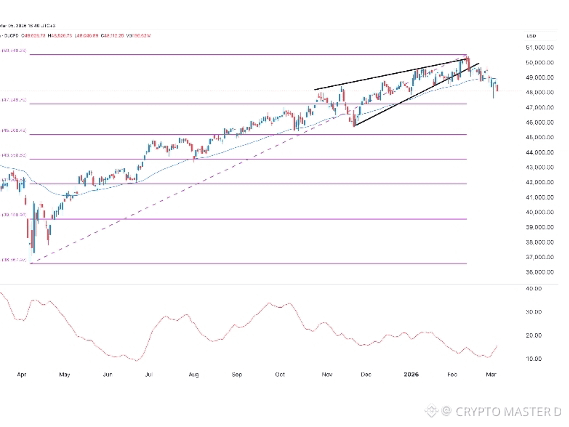
The Dow Jones Index resumed its downward trend today, March 5, as the war in the Middle East continued and odds of a ceasefire happening between Iran and the United States fell on Polymarket.
Summary
The Dow Jones Index retreated by over 500 points on Thursday.
Traders on Polymarket believe that there will be no ceasefire any time soon.
The index has formed a rising wedge pattern, pointing to more downside.
crypto.news

eToro
SearchSearchClose search

Bitcoin (BTC)
$71,269.00-1.99%
Bitcoin price

Ethereum (ETH)
$2,086.22-1.89%
Ethereum price

BNB (BNB)
$650.40-0.75%
BNB price

Solana (SOL)
$88.49-2.12%
Solana price

XRP (XRP)
$1.41-1%
XRP price

Shiba Inu (SHIB)
$0.0000056-1.42%
Shiba Inu price

Pepe (PEPE)
$0.0000035-3.45%
Pepe price

Bonk (BONK)
$0.0000062-1.13%
Bonk price

dogwifhat (WIF)
$0.221.96%
dogwifhat price

Popcat (POPCAT)
$0.05334.99%
Popcat price

Bitcoin (BTC)
$71,269.00-1.99%
Bitcoin price

Ethereum (ETH)
$2,086.22-1.89%
Ethereum price

BNB (BNB)
$650.40-0.75%
BNB price

Solana (SOL)
$88.49-2.12%
Solana price

XRP (XRP)
$1.41-1%
XRP price

Shiba Inu (SHIB)
$0.0000056-1.42%
Shiba Inu price

Pepe (PEPE)
$0.0000035-3.45%
Pepe price

Bonk (BONK)
$0.0000062-1.13%
Bonk price

dogwifhat (WIF)
$0.221.96%
dogwifhat price

Popcat (POPCAT)
$0.05334.99%
Popcat price
Russia drafts stablecoin bill to weaponize cross‑border crypto rails

By Andrew Folkler
Mar 5, 2026 at 10:19 PM GMT+5:45

Edited by Dorian Batycka
News

Ledger’s Black Friday 2025 is live — get $70–$80 in BTC with Ledger Flex™ or Stax™ and up to 50% off selected devices and accessories.
Share
Russia is fast‑tracking a dedicated stablecoin law to turn fiat‑pegged tokens into sanctioned‑resistant payment infrastructure.
Summary
Russia will table a standalone stablecoin bill in the State Duma, separate from its broader crypto trading framework, with core regulations potentially in force as early as Jul. 1, 2026.
The Central Bank of Russia already treats stablecoins as “foreign digital rights,” with the ruble‑pegged A7A5 approved for overseas trade settlements in Oct. 2025.
Analysts say Moscow aims to use state‑aligned stablecoins to bypass Western sanctions and support cross‑border payments as pressure on its traditional banking channels grows.
The Russian Ministry of Finance is preparing an independent stablecoin bill that would formally regulate digital assets pegged to fiat currencies, rather than folding them into a generic cryptocurrency law.
Alexey Yakovlev, head of the ministry’s Financial Policy Department, has described the potential of these instruments as “enormous, even astonishing,” signaling that policymakers see stablecoins less as speculative assets and more as strategic financial infrastructure.
According to local reports, the ministry plans to advance the stablecoin bill on a separate legislative track from its upcoming framework for cryptocurrency trading. The broader crypto regulation package is expected to be submitted to the State Duma in the spring and could come into effect as early as Jul. 1, 2026, while technical work around stablecoin rules is being accelerated in parallel. This two‑lane approach allows regulators to prioritize instruments that directly touch trade and settlement, even as they remain cautious over retail speculative activity in Bitcoin (BTC) and other volatile assets.
Regulators: “foreign digital rights” and A7A5
The Central Bank of Russia (CBR) has already laid the legal groundwork by classifying stablecoins within a special category it calls “foreign digital rights.” This designation allows certain approved tokens to be used in cross‑border trade settlements without fully opening the door to domestic crypto trading or broad on‑ramp access. In practice, the CBR can selectively license stablecoins that align with state interests while keeping the perimeter tight for retail users and offshore issuers.
A key test case is A7A5, a ruble‑pegged stablecoin that won regulatory approval for overseas trade in Oct. 2025. By green‑lighting A7A5 for cross‑border settlements, authorities effectively created a programmable ruble proxy that can move through blockchain rails instead of traditional correspondent banks. Market analysts cited around the initiative argue that, under mounting Western sanctions, stablecoins like A7A5 could allow Russian exporters and importers to maintain flows even as access to conventional dollar and euro channels is squeezed.
The timing of the push is not accidental: Western sanctions have increasingly targeted Russian banks, payment providers and even individual cross‑border channels, forcing Moscow to look for alternative infrastructure. Against that backdrop, the Ministry of Finance’s enthusiasm for stablecoins reflects a broader shift toward using crypto‑adjacent tools not for speculation, but for trade finance and settlement. Policymakers appear to be betting that tightly controlled, state‑aligned stablecoins can form the backbone of new payment routes with friendly jurisdictions, even as exposure to Ethereum (ETH) and other open crypto networks remains constrained.
Analysts suggest that if the framework succeeds and more ruble‑pegged or Russia‑approved stablecoins are cleared for use, it could create a parallel, sanctions‑resistant liquidity pool for cross‑border payments. Such a system would sit largely outside Western banking oversight and complicate enforcement, especially if commodity or energy trades begin to settle in these instruments rather than in dollars or euros. While this model diverges from rules‑heavy regimes such as MiCA in Europe, it underscores how states can use stablecoin design and licensing as a geopolitical tool, not just a prudential one. For crypto markets, Russia’s move adds another front to the ongoing contest over who controls stablecoin issuance, distribution, and the rails that underpin global value transfer.
Read more:Stock market today: here’s why the Dow Jones is crashing
btc-2.19%Bitcoineth-2.03%Ethereum
Read more about
CryptocurrencyDeFiRussia
Stock market today: here’s why the Dow Jones is crashing

By Crispus Nyaga
Mar 5, 2026 at 09:35 PM GMT+5:45

Edited by Anthony Patrick
Markets

Share
The Dow Jones Index resumed its downward trend today, March 5, as the war in the Middle East continued and odds of a ceasefire happening between Iran and the United States fell on Polymarket.
Summary
The Dow Jones Index retreated by over 500 points on Thursday.
Traders on Polymarket believe that there will be no ceasefire any time soon.
The index has formed a rising wedge pattern, pointing to more downside.
The Dow Jones Index, which tracks the performance of 30 large American companies, retreated by over 500 points. Similarly, the other top blue-chip indices like the S&P 500 and Nasdaq 100 fell by over 0.10%.
This retreat happened as Iran denied reports that it had reached out to the United States for talks on how to end the ongoing war. As a result, odds of a ceasefire happening this month tumbled to 27%. Similarly, the odds of a ceasefire happening in April fell by 23% to 48%.
As a result, the Fear and Greed Index continued falling, moving to the fear zone of 39. At the same time, the price of crude oil continued rising, with Brent moving to $85 and the West Texas Intermediate moving to $78.
A prolonged war in the Middle East is risky for the stock market because of the fresh supply chain shocks that will happen. It also risks stoking inflation, which will make it hard for the Federal Reserve and other central banks to cut interest rates soon.
Most companies in the Dow Jones Index were in the red, with Walmart falling by 3.90%. Merck shares fell by 3.2%, while Sherwin-Williams, Procter & Gamble, Johnson & Johnson,and Amen falling by over 2.50%.
Only four companies in the index rose today. Salesforce stock jumped by 4.46%, while IBM, Chevron, and Microsoft rose by 1.90%, 1.01%, and 0.60%. Chevron is benefiting from the ongoing crude oil and natural gas prices surge.
Dow Jones Index is at risk of falling further
The blue-chip Dow Jones Index has retreated substantially in the past few weeks. This retreat started after it moved to the psychological level of $50,000. It is common for an asset to retreat after testing such a significant level.
The stock retreated after the two lines of the rising wedge pattern neared their confluence. A rising wedge is a highly accurate reversal chart pattern.
It is now nearing the 23.6% Fibonacci Retracement level. Also, it has already moved below the 50-period moving average. Whenever an asset drops below that average, it is usually a sign that bears have prevailed.
The Average Directional Index has rebounded to 15, a sign that the sell-off is gaining momentum. Therefore, the most likely Dow Jones Index forecast is bearish, with the next key target being the 23.6% retracement level at $47,250.