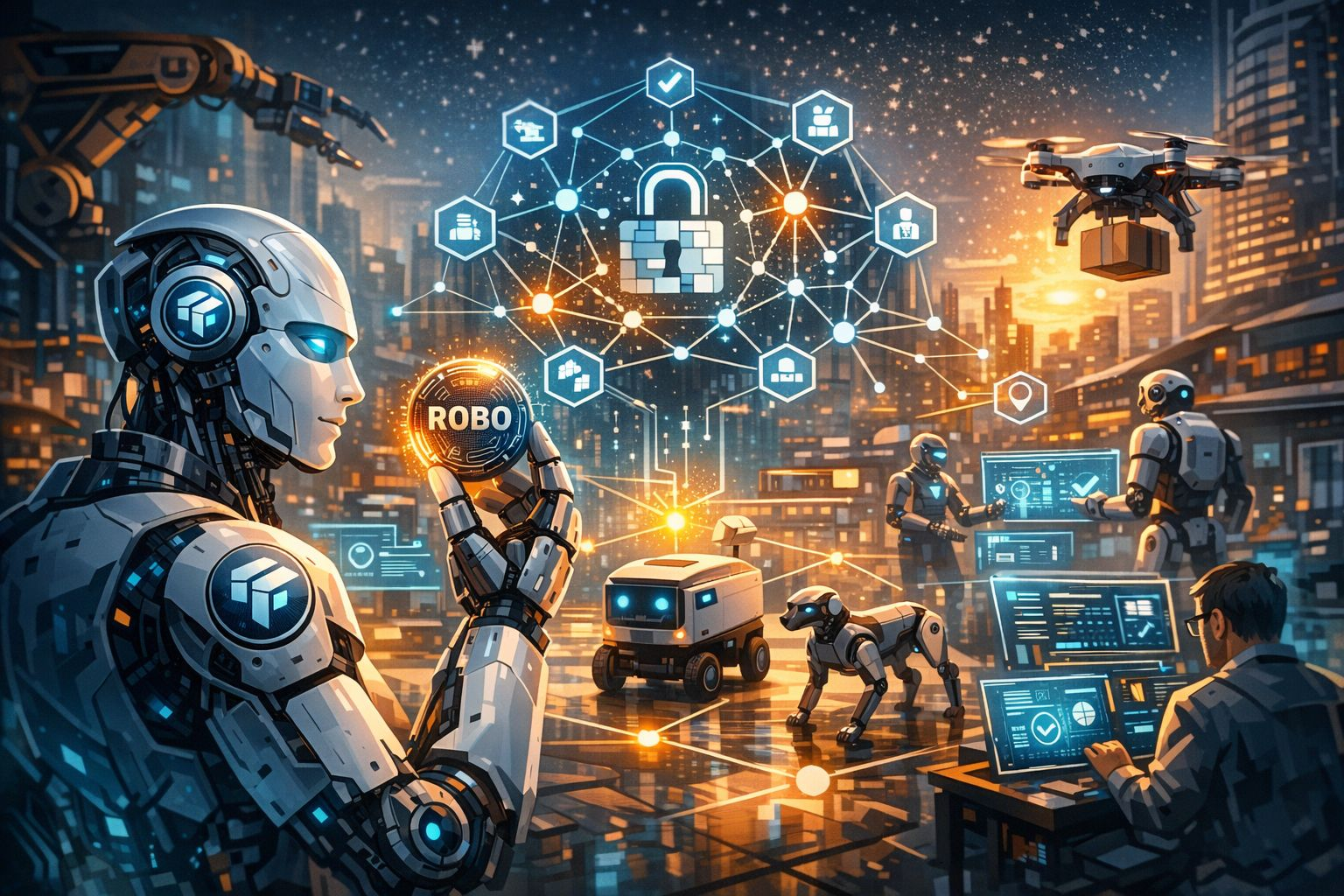
When people talk about artificial intelligence today, the conversation often stays focused on software—chatbots that write text, algorithms that recommend videos, or models that analyze data faster than any human ever could. But outside the screens we look at every day, another quiet revolution is happening. Robots are slowly entering the real world in ways that many people barely notice. In warehouses they organize inventory, in hospitals they assist with cleaning and logistics, in factories they work alongside humans, and in some cities they are even starting to deliver packages. Machines are becoming more intelligent, more capable, and more present in everyday life.
Yet despite this progress, there is something missing in the way these machines exist today. Most robots and AI systems live inside closed ecosystems. A warehouse robot from one company cannot easily communicate with a delivery drone built by another. Machines operate in isolated environments controlled by centralized software, which means even though they are intelligent, they are not truly connected to each other. If you think about it, the situation is a bit like having millions of skilled workers scattered around the world but unable to cooperate because they all use completely different systems.
This is where Fabric Protocol enters the conversation. The idea behind the project is surprisingly simple when you strip away all the technical language. What if robots and AI systems could exist on a shared decentralized network where they can identify themselves, communicate with each other, perform tasks, and even exchange value? Instead of being locked inside isolated corporate systems, machines could become part of a broader ecosystem where collaboration is possible.
To understand why this idea matters, it helps to think about how human economies function. People can work with strangers because we have systems that establish trust. We have identification documents, contracts, banks, payment networks, and legal frameworks. These systems allow someone to complete work for another person and receive compensation, even if they have never met before. Without these layers of trust and coordination, modern economies simply would not function.
Machines do not yet have an equivalent infrastructure. Robots cannot easily prove who they are on a global network, they cannot independently verify the work of other machines, and they cannot participate in financial exchanges without human-controlled systems managing everything. As robotics and AI become more advanced, this gap becomes increasingly obvious. If the world eventually contains millions of autonomous machines performing tasks across industries, those machines will need a system that allows them to cooperate safely and transparently.
Fabric Protocol is essentially trying to build that system from the ground up. The project uses blockchain technology as a foundation for creating a decentralized environment where robots and AI services can interact. In this environment, machines can have unique cryptographic identities recorded on a blockchain. That identity works like a digital fingerprint that proves the machine exists and allows its actions to be logged transparently. When a robot performs a task or provides data, the network can record that activity in a way that cannot easily be altered.
Once machines have identities, a whole new set of possibilities begins to appear. Robots could request assistance from other machines. Autonomous systems could offer services on decentralized marketplaces. Tasks could be posted, accepted, and verified through smart contracts that automatically handle agreements between participants. Instead of relying on a single company’s servers to coordinate everything, the network itself becomes the infrastructure that allows machines to collaborate.
The economic side of the system revolves around the project’s native token, ROBO. This token acts as the primary medium of exchange within the network. If a robot performs a service, helps validate tasks, or contributes useful data, it can earn ROBO tokens as a reward. In the same way that human workers are paid for their labor, machines in this ecosystem could receive digital compensation for the work they perform.
What makes this idea fascinating is the possibility that machines could eventually become productive participants in an economic system. Imagine robots that maintain infrastructure, monitor environmental conditions, or manage logistics networks. Instead of simply operating as tools owned by a single organization, they could contribute services to a broader network and receive rewards that sustain their operation. It is a concept that begins to blur the line between software systems and economic actors.
Of course, ideas like this also raise difficult questions. One of the biggest challenges is verification. Blockchain networks are excellent at recording that something happened, but they cannot automatically determine whether the outcome was correct or useful. If a robot claims it completed a task, the network can confirm the claim was submitted, but verifying the quality of the work requires additional mechanisms. Sensors, reputation systems, independent validators, and AI analysis may all play roles in determining whether tasks were genuinely completed.
Another challenge is maintaining decentralization. Many blockchain projects start with the intention of distributing power widely but gradually become dominated by a small group of participants. If validation responsibilities concentrate in the hands of a few actors, the system could become vulnerable to manipulation or collusion. For Fabric Protocol to succeed, it will need a strong ecosystem of independent validators and contributors who keep the network balanced.
Regulation is another reality that cannot be ignored. As robots and AI systems become more autonomous, governments and institutions will want oversight. Systems that coordinate machine activity may eventually need to provide transparency, auditing tools, and compliance mechanisms. The relationship between decentralized technology and regulatory frameworks will likely shape how projects like Fabric evolve in the coming years.
Despite these challenges, the vision behind Fabric Protocol touches on something bigger than a single project. Technology has always advanced by building new layers of infrastructure that connect systems together. Roads connected cities and allowed commerce to expand. The internet connected computers and allowed information to move freely across the globe. Blockchain technology introduced new ways to coordinate trust without central authorities.
If intelligent machines continue to grow in number and capability, they too will need infrastructure that allows them to cooperate. A world filled with autonomous drones, service robots, sensors, and AI systems cannot rely entirely on isolated networks controlled by individual companies. At some point, shared coordination systems may become necessary.
Fabric Protocol is one attempt to imagine how that infrastructure might look. It explores the possibility of a future where machines are not just isolated tools but participants in a connected ecosystem. Robots could collaborate across industries, AI services could verify each other’s outputs, and machines could contribute real work to decentralized economic networks.
Whether this specific project ultimately succeeds is something only time will reveal. Technology evolves through experimentation, and many ideas must be tested before the most useful systems emerge. But the questions being asked by projects like Fabric Protocol are deeply important. They force us to think about how society will function when intelligent machines are no longer rare or experimental but everywhere.
The future may involve cities where robots maintain infrastructure, drones monitor environmental conditions, and autonomous systems manage logistics networks with minimal human oversight. If that world arrives, the machines performing those tasks will need ways to identify themselves, cooperate with each other, and exchange value.
And the infrastructure being explored today could quietly become the foundation that allows that world to exist.
@Fabric Foundation #ROBO $ROBO