
I keep a note on my desk that reads: "The map is not the territory." I put it there after losing a chunk of money on a project that had a "revolutionary" whitepaper but zero execution.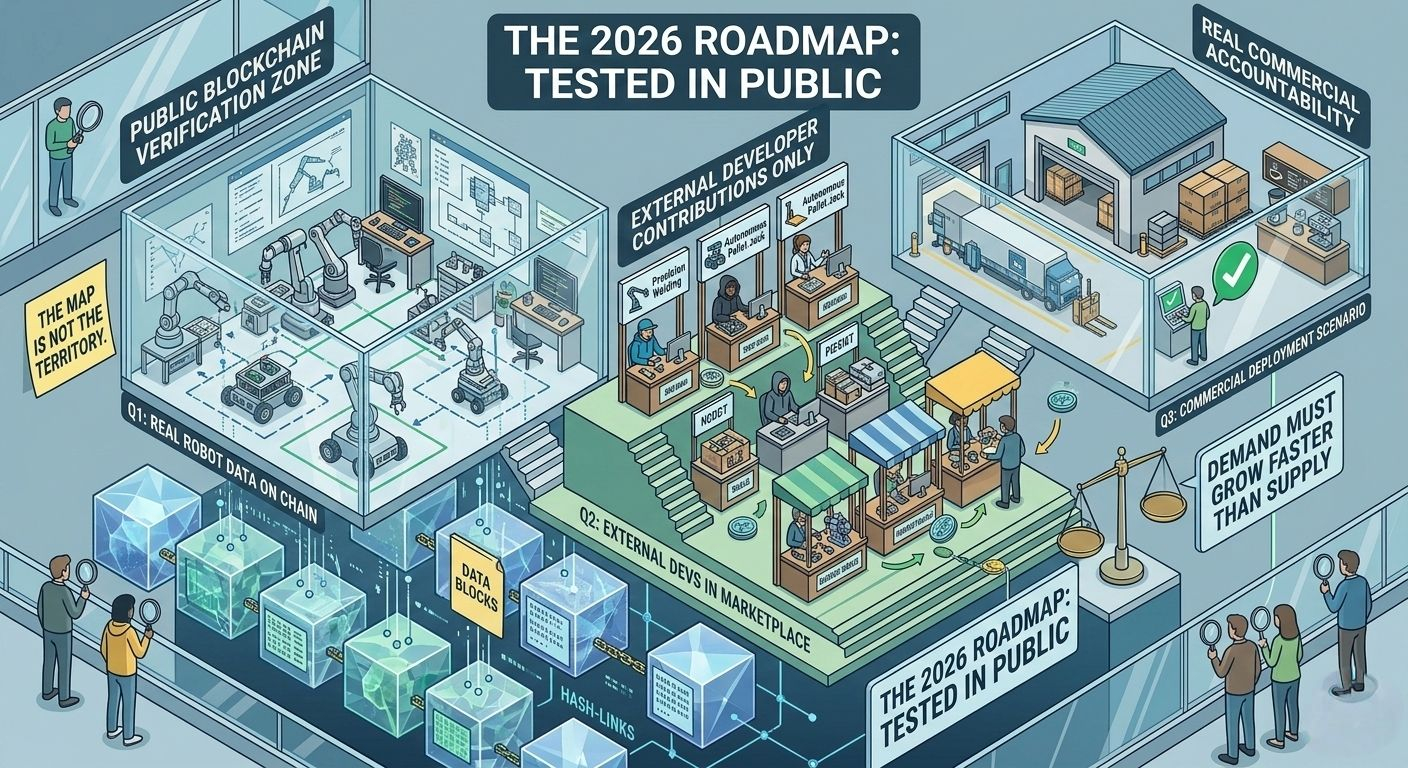
Lately, I’ve been digging into the Fabric Protocol. On paper, their 2026 plan is compelling. It reads less like a hype-filled pitch and more like an engineering commitment.
Focuses on the basics—robot registration, task execution, and data harvesting.
Introduces "proof of completion" (robots only get paid when the job is done) and a skill marketplace for third-party devs.
The big leap—multiple robots working together in actual commercial settings.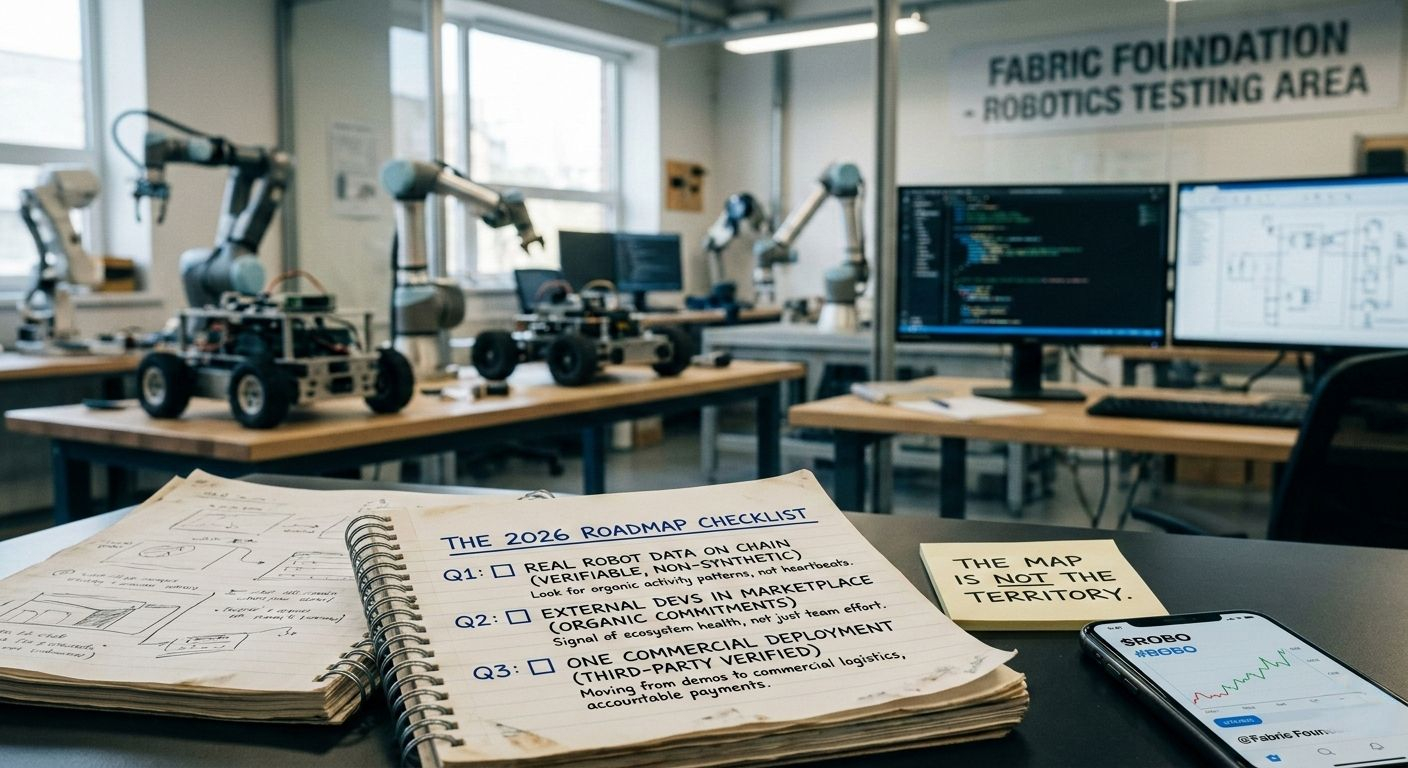
The plan isn't vague. It’s a schedule with testable goals. But here’s the reality check: the crypto market doesn't wait for schedules. It prices in the "future" before a single brick is laid, then gets impatient when reality hits a snag. By the time real progress happens, the original believers are usually gone.
So, I’m not looking at this plan as a promise to believe in. I’m looking at it as a checklist to compare against reality.
The first quarter claims the basics will be ready. Specifically, they need to start collecting real data from robots. This is binary: either the data exists on-chain and is verifiable, or it doesn’t. No "vision," no "working towards."
I’ll be looking for a dashboard showing robot IDs with organic activity patterns. I don't want to see "heartbeat" transactions firing at perfect 60-second intervals (the hallmark of fake activity). I want to see the messy, irregular timestamps of real robots doing real work.
Paying robots for tasks sounds great until you realize people will try to spoof task completion for easy money. Every gig-economy platform faces this. Fabric needs a system strong enough to distinguish a silicon-and-steel robot from a script running in a basement.
But the real signal in Q2 isn't just their anti-cheat code—it’s the Marketplace. If outside developers are actually building skills there without being subsidized by the foundation, the ecosystem is breathing. That’s a much louder signal than anything the core team says.
A robot pouring coffee in a controlled demo is cool for Twitter. A logistics system that handles vendors, accountability, and payment flows in a warehouse is a business. Q3 demands commercial settings. This is where "crypto-speed" meets "hardware-reality."
Deploying hardware is expensive, slow, and legally murky. Smart contracts can't fix a broken actuator or a local zoning law. The timeline is inherently uncertain, and the current price rarely reflects that friction.
I appreciate the honesty in the documentation. Describing $ROBO as a utility token that "may become worthless" isn't a legal disclaimer—it’s an accurate description of a project at this stage.
With only 22% of tokens in circulation, there is a massive 78% supply overhang waiting to drop. To absorb that, we need demand from operators who need the token to run robots, not just speculators betting on the next pump.
I appreciate the honesty in the documentation. Describing $ROBO as a utility token that "may become worthless" isn't a legal disclaimer—it’s an accurate description of a project at this stage.
With only 22% of tokens in circulation, there is a massive 78% supply overhang waiting to drop. To absorb that, we need demand from operators who need the token to run robots, not just speculators betting on the next pump.
My checklist is simple:
End of Q1: Verifiable, non-synthetic robot data on the blockchain.
End of Q2: External developers committing to the marketplace.
End of Q3: One commercial scenario verified by a third party, not the Fabric team.
If these three boxes get checked, the plan becomes reality. Until then, I’m holding the checklist, not the token.
#robo #AltcoinSeasonTalkTwoYearLow #SolvProtocolHacked $ROBO @Fabric Foundation