
Most conversations about robotics stay close to the surface. People talk about arms, sensors, mobility, and how machines might replace certain kinds of work. Those things matter, but they sit on top of a deeper layer. Underneath the hardware, there is a quieter question about how robotic knowledge actually spreads.
For most of robotics history, learning has been local. A robot is trained for a task inside one factory line or warehouse system. The improvement stays there because moving that knowledge somewhere else takes time, testing, and careful validation.
That slow movement of knowledge creates friction. Even if a useful robotic behavior exists, it does not automatically travel to other machines. Someone has to rebuild the setup, retrain the system, and check safety again in a new environment.
Fabric Protocol seems to be looking at this problem from the infrastructure side. Instead of starting with the robot itself, it starts with the layer that manages how skills move between machines. The idea feels closer to building a foundation than launching a product.
If robotic skills become shareable artifacts, the system changes shape. A trained behavior is not just something stored inside one device. It becomes a package that includes training data, constraints, and the conditions where the behavior has already been tested.
In that structure, the scarce thing is not only the robot. It is the validated skill - the piece of knowledge that has already proven it can work safely somewhere in the real world. That difference may sound small, but it changes how scaling happens.
Consider a simple case. Imagine a robot that learns a narrow electrical inspection routine inside one facility that operates 200 electrical panels in a controlled layout. In the traditional approach, another site might need weeks of engineering time to adapt that routine to a new system.
With a shared skill layer, the process might look different. The trained behavior could move as a module that already includes the safety checks and operating boundaries. A second facility running 150 similar panels could test and deploy it without starting from zero.
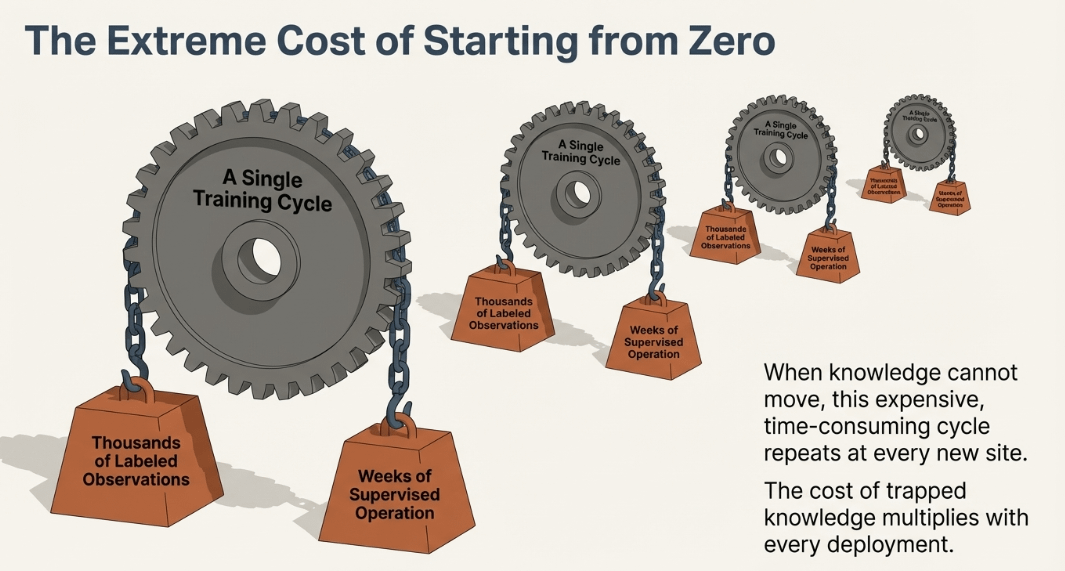
The speed difference matters because learning in robotics is expensive. A single training cycle might require thousands of labeled observations collected during weeks of supervised operation. When that knowledge stays trapped inside one system, the cost repeats again and again.
Infrastructure changes that rhythm. When the learning event happens once and the result spreads, the value of the original work multiplies. Software ecosystems moved in this direction years ago, but robotics has been slower to build the same kind of base layer.
Fabric introduces another piece that feels quietly important - economic coordination. If robotic skills become portable, someone still needs a way to track ownership, contributions, and usage. A protocol layer can record those relationships and distribute rewards when a capability is reused.
That kind of structure might encourage more people to contribute. A researcher who trains a useful inspection model could see that work deployed across multiple sites that operate 300 machines or more. In theory, the system could return value to the people who produced the knowledge in the first place.
Still, some uncertainty sits here. Robotics operates in messy physical environments where edge cases appear without warning. A skill that works inside one building with 50 identical devices might behave differently when moved somewhere else.
Governance questions also sit quietly underneath the architecture. Someone has to decide when a robotic skill is safe enough to share widely. The process for approving those decisions could shape how fast the network grows.
That is why the infrastructure layer matters as much as the robotics itself. The machines are visible, but the coordination system underneath determines how quickly learning spreads. If the foundation is steady, knowledge can move faster without losing control.
Fabric Protocol appears to be exploring that lower layer. Instead of competing only on hardware or models, it is experimenting with the texture of the system that connects them. Whether it works will depend less on promises and more on how the network behaves once real machines start using it.
For now, the idea remains a careful one. Robotics still moves slowly in many places, and physical work carries real risk. But if shared skill layers do take hold, the quiet infrastructure beneath robotics could end up shaping how the entire field grows.
#RoboticsInfrastructure #FabricProtocol #ROBO #AutomationNetworks #MachineLearningSystems @Fabric Foundation $ROBO #robo