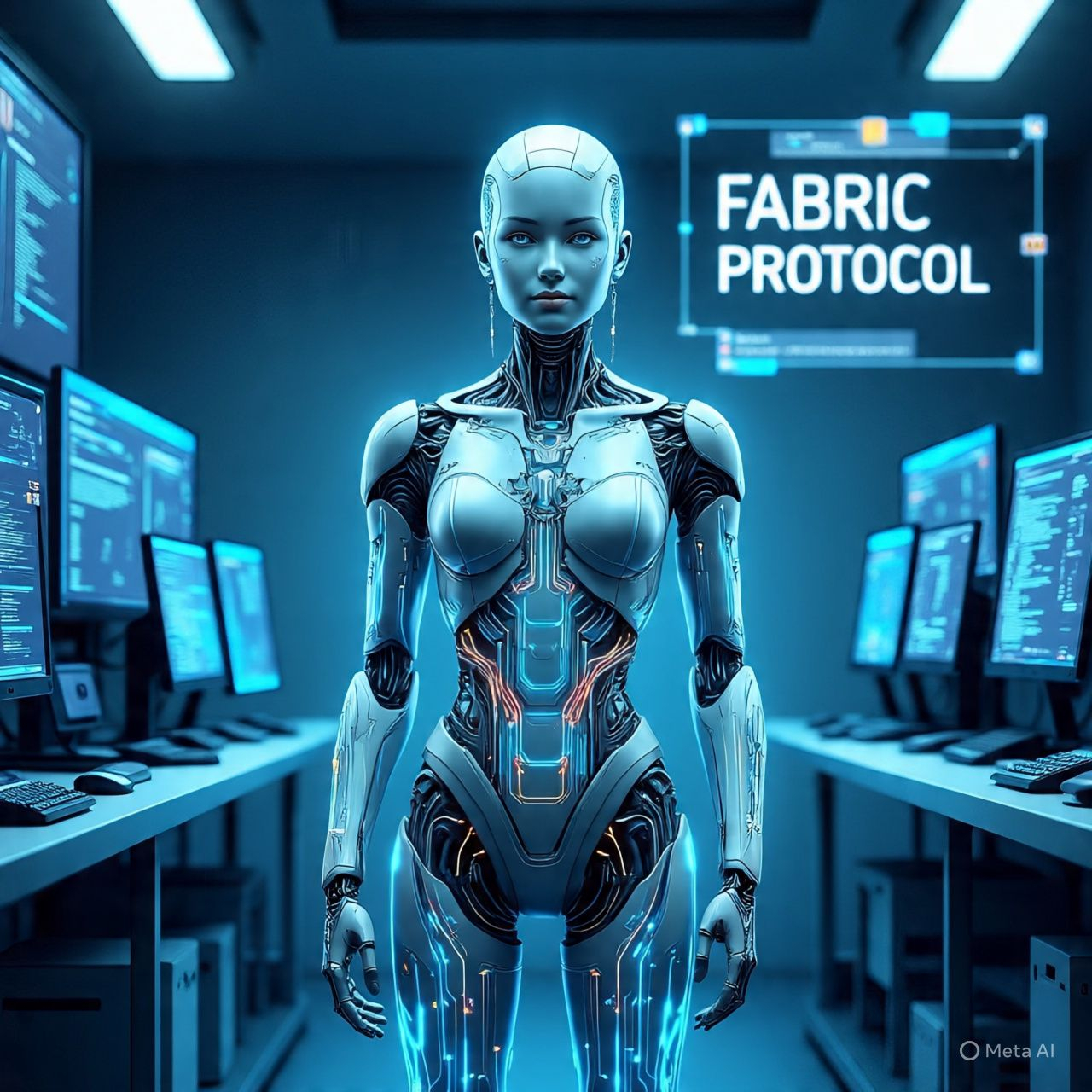
ROBO becomes interesting only when you look beyond the token itself and focus on the project behind it. In crypto, this difference is important. Tokens can attract attention quickly, but attention alone does not create long-term value. Real infrastructure does.
Fabric is attempting something far more complex than launching another asset tied to a popular narrative. The project is trying to answer a deeper question: if robots and autonomous systems are going to exist inside an open digital economy, what kind of infrastructure would they actually need?
This is where the idea becomes more meaningful.
Many AI and robotics projects in crypto sound impressive at first. The language is polished and the ambitions are big, but once you examine the details, the foundation often feels weak. Fabric does not completely escape that risk, but it approaches the problem from a more thoughtful angle.
The project begins with a simple observation. Machines today can already perform tasks. They can process information, make decisions, and execute actions. However, what they cannot naturally do is participate in an open economic system. They do not have native identity, built-in trust, or a clear way to interact within shared incentive structures the way humans do in digital networks.
This is the gap Fabric is trying to solve.
And it is not a marketing idea. It is a real structural problem.
Fabric is not mainly about showcasing futuristic robots or promoting abstract discussions about artificial intelligence. Instead, it focuses on the invisible systems that allow machines to operate within an economy. These include identity systems, coordination frameworks, access permissions, verification processes, payment mechanisms, and accountability.
These problems are not exciting at first glance, but they are the kinds of problems that determine whether a technology becomes useful or remains theoretical.
That is why ROBO only makes sense when viewed as part of the larger Fabric ecosystem.
By itself, a token is simply a symbol. Inside the Fabric network, however, ROBO is intended to function as part of the system’s economic layer. It represents participation in the network rather than existing as a detached asset created only for speculation. Many crypto projects design a narrative first and then attach a token later. Fabric’s design attempts to integrate the token into the network’s internal mechanics from the beginning.
Of course, this does not guarantee success. Execution is always the real test.
Still, the idea behind Fabric shows a more serious approach than many trend-driven projects.
Another interesting aspect of the project is how it views robotic capability. Instead of treating machines as fixed tools with one permanent function, Fabric imagines them as modular participants within a larger system. In this framework, a machine can access different capabilities, operate under defined rules, and interact with a network of tasks and services.
This perspective is much closer to how the internet itself works—flexible, composable, and interconnected.
If robotics ever becomes economically significant, it will likely depend on the systems built around machines, not just the machines themselves.
And that is where the real challenge lies.
People often focus entirely on machine intelligence, but intelligence alone is not enough. Intelligence without coordination creates confusion. Intelligence without identity creates risk. Intelligence without trust limits usefulness.
A machine might be extremely capable, but if there is no reliable framework for integrating its actions into a larger economic system, its value remains limited.
Fabric seems to recognize this issue.
Rather than simply celebrating what machines might become in the future, the project is trying to define the conditions that would allow machines to function within real economic networks. This is a far more difficult task, but it is also a more meaningful one.
At its core, Fabric raises an important question: can machines evolve from being tools inside closed environments to becoming recognized participants in open systems of value?
That shift would change everything.
Tools are controlled and execute tasks. Participants, on the other hand, must be identified, coordinated, evaluated, and governed within a shared system. Once machines reach that stage, the conversation moves beyond robotics and into the realms of governance, incentives, and digital trust infrastructure.
Many projects struggle when they reach this point.
Fabric has not solved this challenge yet, and it would be unrealistic to claim that it has. The gap between a well-designed concept and real-world adoption is very large. Crypto history is filled with projects that sounded convincing until implementation revealed their weaknesses.
Fabric still needs to prove that its ideas are not only elegant but also practical.
However, dismissing ROBO as just another trend token would be an oversimplification. The project is addressing a layer that many others either ignore or misunderstand. It is trying to think about the requirements for machine participation before pretending that the future has already arrived.
That alone gives the project more depth than many narrative-driven launches.
The importance of Fabric lies in the question it is asking.
If autonomous machines are going to become part of digital economies, they will need more than hardware and software. They will require systems that allow them to be identified, trusted, coordinated, and integrated into networks where value is created and exchanged.
Without that infrastructure, the vision of autonomous economic machines will remain incomplete.
That is the strongest argument for Fabric.
ROBO by itself is not the full story. Fabric is. The project is attempting to build the underlying framework for machine participation before that participation becomes common. It is difficult work, slow work, and often invisible work.