
Nobody is asking the obvious question about humanoid robots.
When manufacturers ship commercial humanoids at scale — and that wave is already beginning — what happens when those robots change owners? How does the new owner verify operational history? Safety record? Maintenance logs? Training data?
They cannot. Not independently. Not today.
Traditional robotics stores everything in proprietary databases controlled by the original manufacturer or operator. When a hospital sells a used rehabilitation robot to a factory, the buyer trusts whatever data the seller chooses to share. Or they do not buy used robots at all. That dynamic kills the secondary market before it has a chance to exist.
Fabric Foundation identified this structural gap early and built the solution the rest of the industry is not working on: persistent on-chain robot identities powered by Fabric Protocol and the ROBO token.
Here is why this matters more than the current market pricing suggests.
The Secondary Market Problem Nobody Is Solving
Robots are capital assets. Commercial humanoids carry price tags ranging from tens of thousands to hundreds of thousands of dollars per unit. Enterprises deploying them expect multi-year operational lifespans. But hardware technology evolves fast. A hospital might upgrade its rehabilitation fleet after 18 months. What happens to the previous generation of units?
The traditional options are poor. Sell back to the manufacturer at steep depreciation. Scrap equipment that still has operational value. Both outcomes are economically wasteful.
The better option is a functioning secondary market. Facilities that cannot afford new commercial humanoids purchase verified used units from enterprises that have upgraded. Capital efficiency improves across the entire ecosystem. But this only works if buyers can independently verify what they are purchasing.
Consider how the used vehicle market functions. Independent third-party verification systems exist specifically because buyers cannot trust seller-reported data alone. Mileage, accident history, service records — all tracked through neutral systems not controlled by the seller.
Commercial robots need equivalent infrastructure. Fabric Foundation built it.
How Fabric Protocol Creates Persistent Robot Provenance
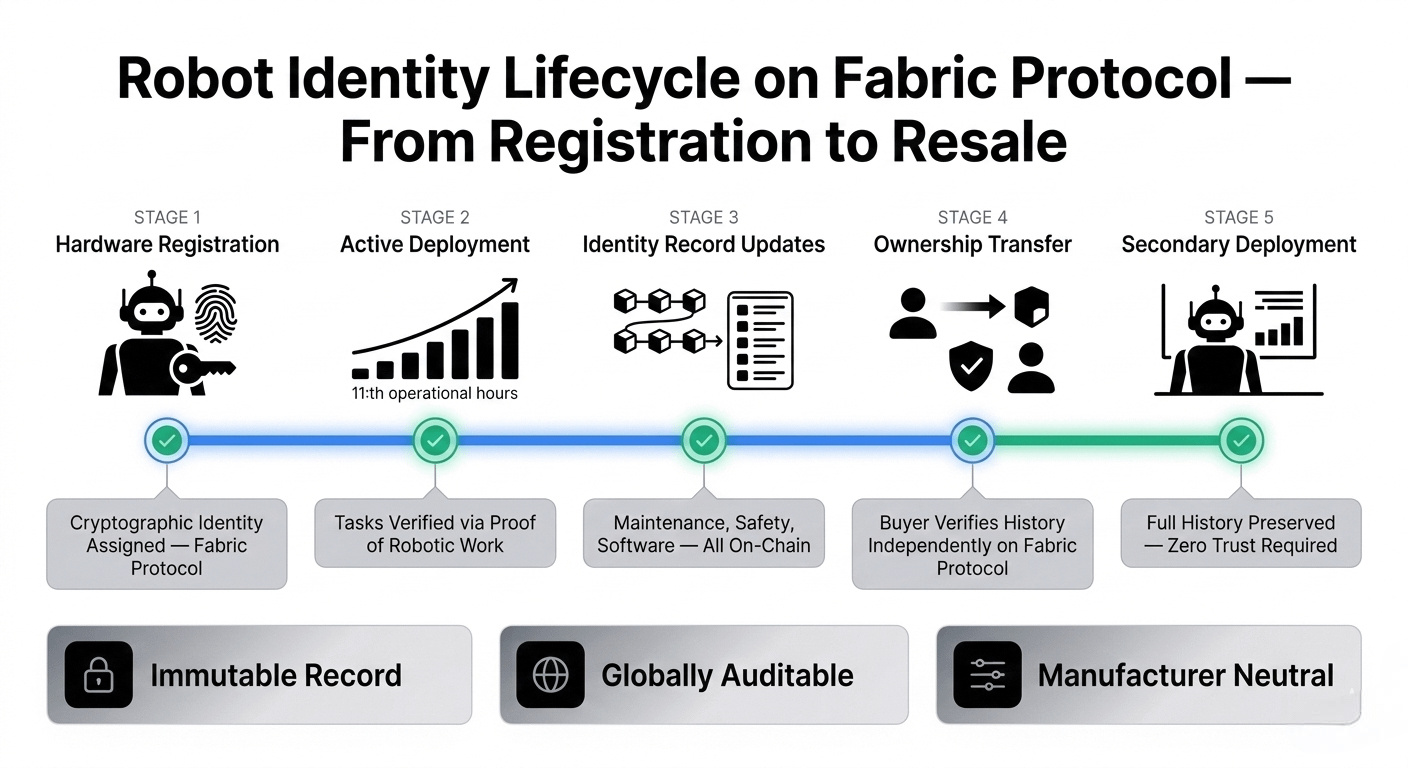
Every robot running the OM1 operating system gets registered on Fabric Protocol with a cryptographic identity. That identity functions as a permanent, tamper-proof operational passport.
The on-chain record captures the full lifecycle of each unit:
Manufacturing date and hardware model
Total verified operational hours
Tasks completed and validated through Proof of Robotic Work
Safety incidents, if any
Maintenance performed and software updates applied
Current ownership and transfer history
Insurance status and regulatory compliance certifications
Every entry is immutable. Every entry is globally auditable. No single party controls the record.
When a manufacturing facility considers purchasing a used rehabilitation robot from a hospital, they do not rely on the hospital's internal spreadsheets or verbal assurances. They verify directly on Fabric Protocol. The robot's complete operational history — every verified task, every ownership transfer, every logged maintenance event — is on-chain and independently accessible.
The February 18, 2026 launch of the x402 protocol integration extended this infrastructure further. Robots can now prove their verified history AND execute autonomous payments using USDC. The identity layer and the payment layer are converging into unified operational infrastructure.
Why No Single Manufacturer Will Build This
Large robotics manufacturers could theoretically build identity systems for their own hardware lines. Several have the engineering capability. None will build neutral shared infrastructure. The structural reasons are straightforward.
Competitive positioning prevents cooperation. A neutral identity system benefits all manufacturers equally. No single company has incentive to build infrastructure that helps its direct competitors.
Proprietary ecosystems generate lock-in value. Manufacturers profit from keeping operators dependent on their specific software, services, and upgrade paths. Open interoperability works against that model.
Immutable safety records create permanent liability exposure. Publishing unalterable on-chain safety incident data creates legal evidence that manufacturers cannot retract or modify. Proprietary systems give manufacturers control over what gets disclosed and when.
Fabric Foundation sidesteps all three constraints by being manufacturer-neutral. Fabric Foundation is not building robots. It is building infrastructure that all robots can use regardless of hardware origin. Hardware partners including commercial humanoid manufacturers are already integrated with OM1, writing to the same Fabric Protocol ledger, using the same verification mechanism.
The strategic positioning is clear: be the neutral coordination layer nobody controls but every serious deployment needs.
The ROBO Token's Functional Role in the Identity System
ROBO is not a governance token. It is not a passive speculative asset. It is a functional requirement embedded in how Fabric Protocol's identity system operates.
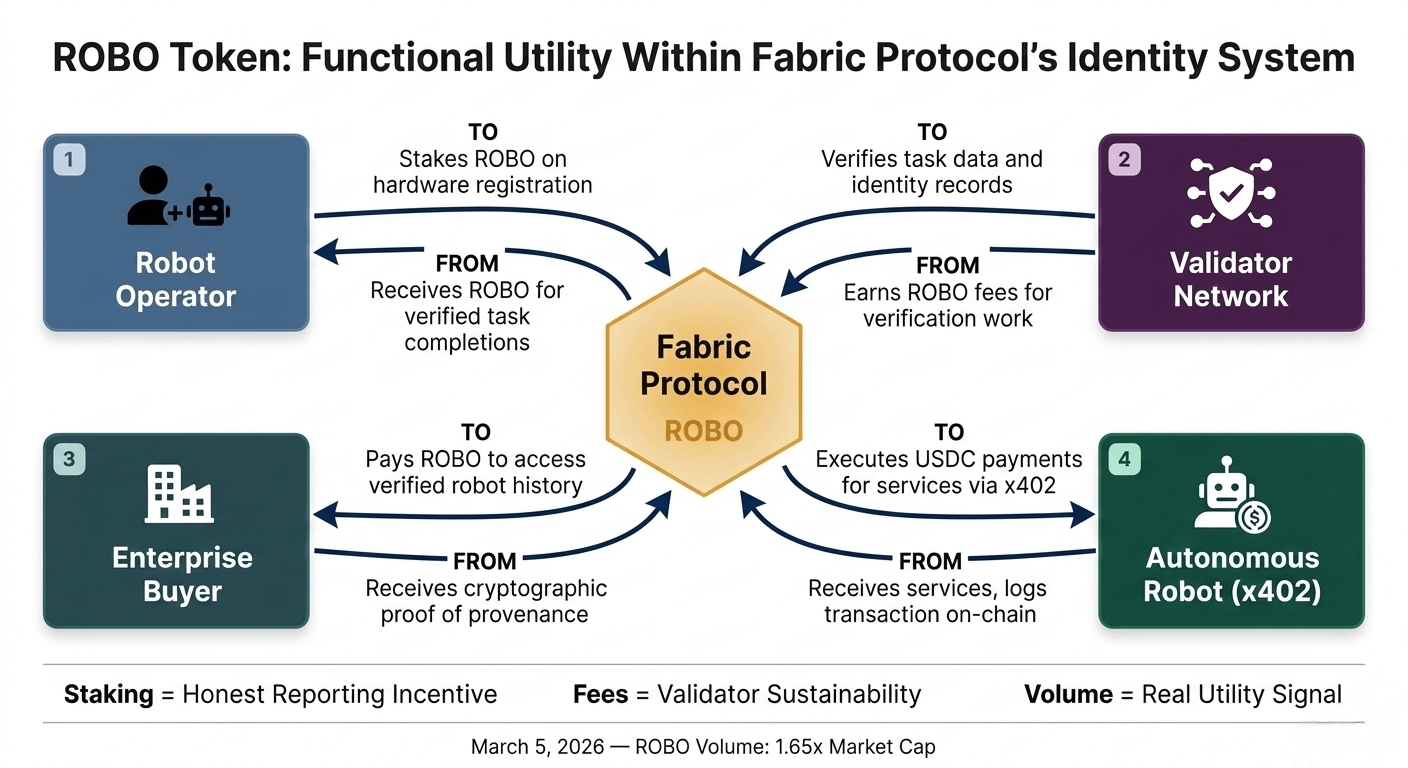
Robot operators stake ROBO when registering hardware on Fabric Foundation. That stake is refundable under normal operation but subject to slashing if operators submit fraudulent performance data. This creates a direct economic cost for dishonest reporting — the incentive structure that makes the verification meaningful rather than performative.
Buyers verifying robot history pay ROBO fees to validators who confirm that on-chain records are accurate and have not been tampered with. Robots updating their identity records after task completion incur ROBO transaction costs. The entire identity and verification system runs on ROBO as its coordination mechanism.
The token utility scales directly with network adoption. More robots registered means more ROBO staked. More history verification requests means more ROBO flowing to validators. More task completions means more ROBO transaction volume. The relationship between network growth and token utility is direct not speculative.
March 5, 2026 data showed ROBO trading volume at 1.65x its market cap — a ratio that indicates active network participation rather than passive holding. Something is driving that volume. The x402 autonomous payment system processing real USDC transactions generates ROBO activity. Validator operations generate ROBO fees. Neither requires speculative positioning to explain elevated volume.
The Metric That Will Confirm the Thesis
The single most important data point Fabric Foundation has not yet published publicly is registered robot count.
OpenMind delivered its first OM1-powered hardware in September 2025. The Robot App Store launched January 2026. The x402 integration went live February 18, 2026. The infrastructure timeline is clear. What remains unconfirmed is how many robots currently hold verified on-chain identities on Fabric Protocol.
That number determines everything about the adoption narrative.
If hundreds of commercial robots carry verified Fabric Protocol identities today, the infrastructure thesis is validating in real time. If the number is still in the early dozens, the technology is solid but the adoption curve has not yet inflected.
Real deployment at scale gets publicized. Fabric Foundation publishing registration metrics would be the clearest possible signal that the identity system has moved from infrastructure launch to genuine industry adoption.
Why This Infrastructure Determines Robotics Scaling
Industries with serious compliance obligations will not deploy robots at scale without independent verification systems. Healthcare requires auditable safety records that survive ownership changes and regulatory review. Industrial manufacturing needs verifiable operational histories for insurance underwriting and supply chain compliance. Logistics operators need documented reliability records before committing to autonomous fleet deployments.
Fabric Foundation built the verification layer that makes large-scale multi-operator robot deployment viable. Not through corporate trust agreements. Through cryptographic proof recorded on a neutral public ledger.
Hardware manufacturers can continue building better robots. But neutral identity infrastructure — the layer that lets robots prove their history, change owners, and operate across organizational boundaries — requires exactly the kind of manufacturer-neutral network that Fabric Foundation built.
The bet is structural. Fragmented proprietary identity systems do not scale across an industry where robots move between owners, cross borders, and operate in regulated environments. Neutral infrastructure that any manufacturer can integrate with, and that no single company controls, is what the robotics economy actually requires.
Fabric Foundation built that layer. ROBO is the token that makes it function.
The technology is operational. The partnerships are real. The volume data is interesting. Adoption metrics at scale will confirm whether the infrastructure has found its market.
@Fabric Foundation #ROBO $ROBO
