
When I started watching ROBO this week, the first thing that stood out was how quickly most traders ignored the boring part of the story. The price was moving fast after new listings, volume was strong, and like many AI-related tokens, the market focused mainly on accessibility and hype.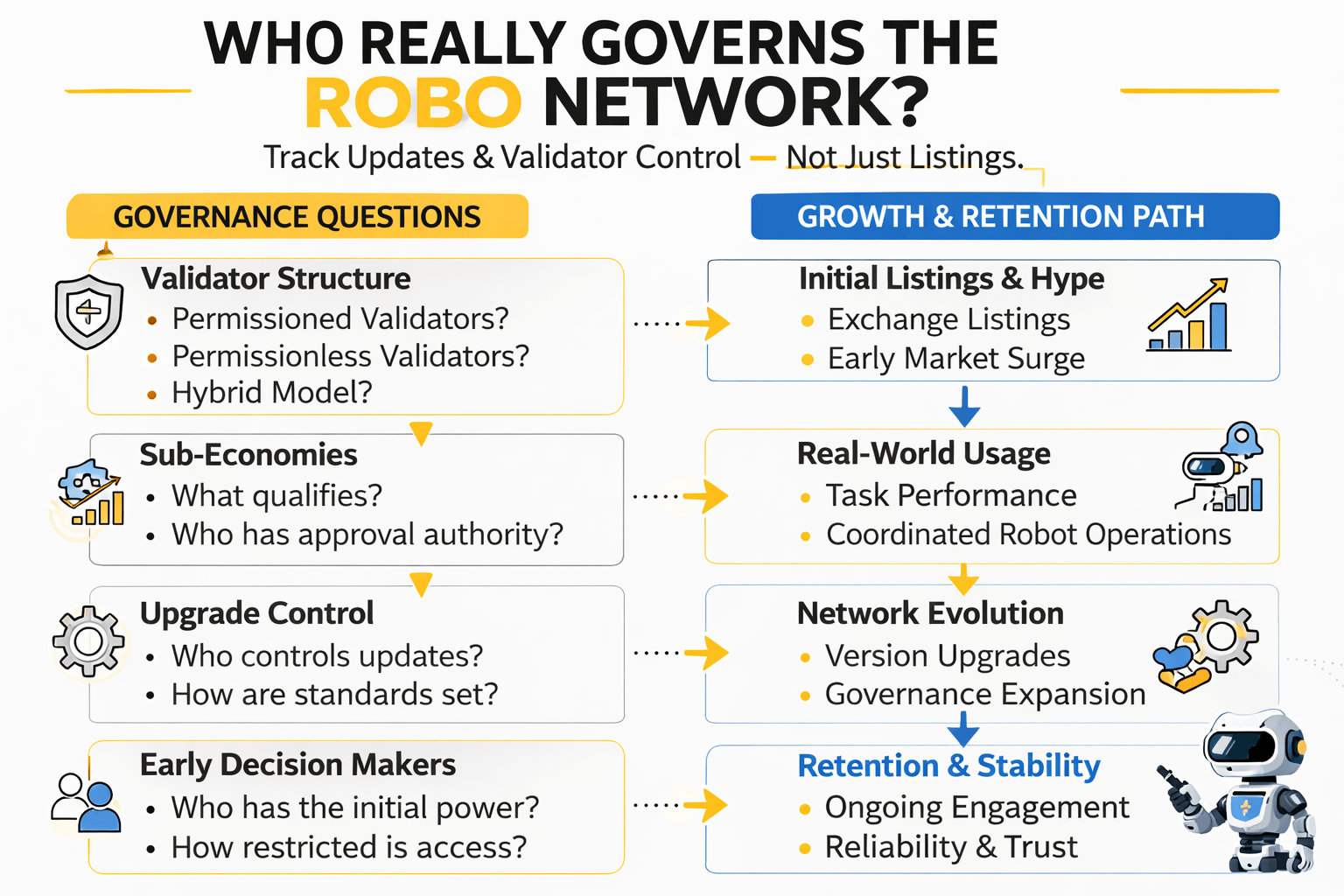
But when I actually looked deeper into the Fabric documentation, a different idea caught my attention. In this system, governance is not only about holding tokens. The real influence comes from deciding upgrades, validator rules, quality limits, and other operational parameters of the network. Those decisions might look technical, but they actually determine how the system behaves in practice. In a network designed to build and manage autonomous robots, controlling the update process can quietly become real power.
Fabric describes ROBO as a modular framework where different skill modules can be added or removed almost like apps. Over time, successful sub-economies inside the system could spread their pricing models, validation standards, and other parameters across the wider network.
In simple terms, traders watch the token price, but the real control layer is the upgrade pathway. Whoever decides which model version, validation rule, or configuration becomes the standard is shaping the environment that the ROBO economy will run on.
Another point that deserves attention is that some structural questions are still open. The documentation itself mentions that areas like sub-economy definitions and the design of the initial validator set are still being finalized. The validator network could begin as permissioned, permissionless, or a hybrid structure. It also states that governance frameworks may evolve gradually and that early decisions could involve a limited group of participants.
This is the dynamic I’m paying attention to. Not necessarily something negative, but a reality of early-stage networks. At the beginning, the people responsible for upgrades and validator standards often have more real influence than the broader token holders discussing decentralization online.
Meanwhile, the market side tells a different story. When Binance listed ROBO with a Seed Tag on March 4, trading activity surged quickly. Daily volume crossed large numbers while market capitalization was still relatively modest compared to other trending tokens.
That type of environment usually creates strong momentum in the short term. But momentum alone doesn’t guarantee long-term engagement. Listings can attract attention for a few days, yet that doesn’t automatically mean users will stay long enough to care about validator policies, model upgrades, or performance improvements.
For longer-term observers, retention might be the more important metric. Fabric’s roadmap moving into 2026 focuses first on identity systems, settlement layers, and early data gathering. After that, the plan moves toward complex tasks, repeated usage cycles, and eventually multi-robot coordination. Later stages concentrate on reliability improvements and network throughput.
Another design element in the system is how rewards are distributed. Instead of simply favoring passive token holding, the model is designed to reward consistent participation. There are mechanisms like contribution decay and minimum activity thresholds, which aim to direct emissions toward users who remain active in the ecosystem.
So the main question for ROBO may not be whether it can trend for a few weeks. The real question is whether developers, operators, validators, and users will continue participating long enough for governance decisions to actually matter economically.
Without sustained engagement, governance premiums rarely last. In that case, the token simply becomes a liquid asset connected to an unfinished coordination experiment.
There is also a practical tension here. Early-stage networks often need stronger coordination. Robots and autonomous systems require reliability and trust, and overly loose validator standards could damage credibility.
However, if a small early group effectively controls the upgrade pipeline for too long, token governance risks becoming more symbolic than functional.
This balance is still visible in the documentation itself. Token holders may participate in signaling upgrades and parameter changes, but governance rights currently remain focused mainly on protocol operations. Some broader structural decisions are still open as the system approaches future network milestones.
So what would change my view?
Personally, I want to see real usage grow alongside reliability improvements. I want governance decisions to become visible through on-chain parameter changes, validator expansion, and successful sub-economies influencing the broader network.
Most importantly, I want upgrades to translate into retention rather than just narrative.
That’s the trade-off here.
If you are watching ROBO, it may be useful to look beyond price charts and treat version updates as signals of influence. Each upgrade tells you something about who is steering the system and how the machine economy might evolve.
Because in networks like this, the real power often hides in the next version update.
Article written by Taimoor Tahir@Fabric Foundation $ROBO #ROBO