I have spent the last forty-eight hours observing the order books on Binance Spot, watching the frantic dance of retail liquidity as ROBO finds its footing in this early March 2026 market. It is a peculiar sight. While the majority of traders are obsessing over whether the price can reclaim the $0.06 level or if the current $0.041 consolidation is a trap, I find myself staring at a completely different set of data. My ongoing research into the Fabric Foundation isn't centered on the immediate green candles, but on the silent majority of the ten billion tokens that aren't even here yet. Hmmm... yes, we often forget that in a machine economy, the most powerful signal isn't what is being sold, but what is physically impossible to sell.
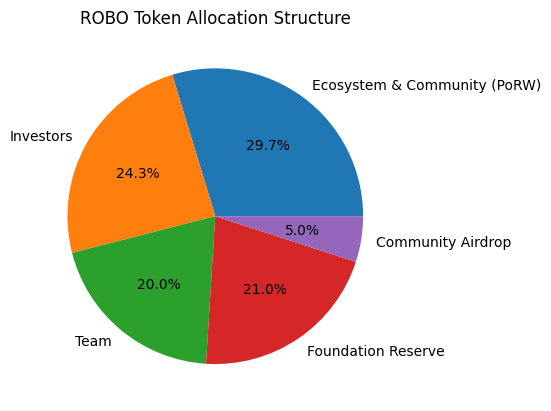
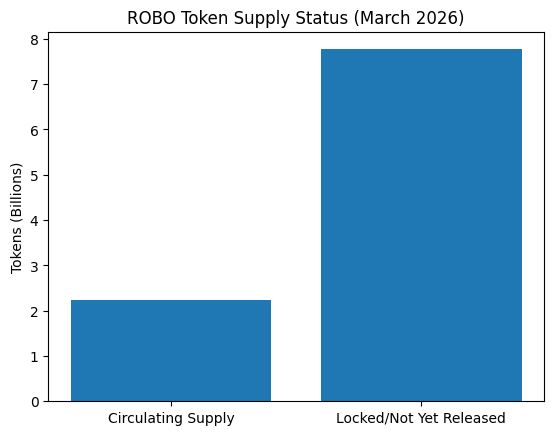
As I sit here on March 7, 2026, reading through my notes on the December 2025 whitepaper, the concept of architectural patience keeps coming to mind. We’ve all seen the "AI bubble" coins of the last few years—projects that launched with massive hype and then collapsed as soon as the first venture capital unlock hit the market. Fabric feels like a different experiment. By implementing a strict twelve-month cliff for the twenty-four point three percent investor allocation and the twenty percent team portion, the foundation has essentially forced a year of silence on its biggest stakeholders. This means that for the entirety of 2026, the people who funded the twenty million dollar seed round led by Pantera Capital in August 2025 are effectively spectators. They are locked into the success of the OM1 operating system and the Fabric Protocol just as much as the smallest retail holder. No, it isn't just a lock; it is a commitment to the "world of atoms" before the "world of fiat." Looking at the real-time circulating supply of roughly two point two three billion ROBO, we can see that the market is currently being driven by a very thin slice of the total pie. This initial liquidity, which primarily came from the five percent community airdrop and the liquidity provisioning at the February 27th launch, is the only real "active" supply. The rest of the ecosystem and community bucket-the largest piece at twenty-nine point seven percent-is tied to the Proof of Robotic Work mechanism. This is the part of my research that I find most fascinating. In most protocols, tokens enter circulation based on time. Here, tokens enter based on verified mechanical labor. If the robots aren't performing tasks or if the service quality drops below that ninety-five percent threshold, the supply doesn't just keep growing blindly. The Adaptive Emission Engine throttles it. It is an economic immune system that rewards reliability over existence. Traders often ask me if the upcoming unlocks in February 2027 are a "death sentence" for the price. Hmmm... it’s a fair question. We are essentially living in a supply vacuum right now. Between today and early next year, we are in a period of artificial scarcity. However, my experiment in tracking on-chain Robot Identities suggests that if the deployment of bipedal and humanoid fleets from partners like UBTech and Fourier continues at its current Q1 2026 pace, the demand sink might actually be ready when those first linear unlocks arrive. Every machine that joins the network needs ROBO for its work bond and its autonomous wallet. This creates a structural need for the token that has nothing to do with speculative "pumping." The tokens aren't just being "held"; they are being utilized as collateral for physical work. Of course, no senior analyst worth their salt would ignore the risks. The graduation from Binance Alpha to Spot on March 4th was a massive win for visibility, but it also increased the beta sensitivity of ROBO to the broader market. If the planned migration from the Base Layer 2 to a machine-native Layer 1 blockchain later this year becomes technically stalled, the vesting schedule won't matter because the utility will be compromised. We are betting on a massive technical transition. But hmmm... even then, the structure of the Foundation Reserve with its forty-month linear vesting suggests that the leadership isn't looking for an exit. They are building a mission-driven institution.Philosophically, I believe we are transitioning from a world of "social trust" to a world of "temporal trust." In 2026, I don't care what a project's Twitter account says; I care what its smart contracts permit. The Fabric Foundation’s token allocation is a declaration of intent. It is a bet that by the time the big money can leave, the machines will have already made themselves indispensable. By forcing a twelve-month cliff, they are giving the robots a head start over the flippers. Trust used to be a human burden, a handshake, a promise. Today, it is just a clock that hasn't finished ticking. If you want to own the robot economy, you have to be willing to be as patient as the code itself. Stay focused on the cliff; it’s the only ledger that truly matters in a world of autonomous labor.
@Fabric Foundation #ROBO $ROBO