

Artificial intelligence is rapidly becoming one of the most powerful technologies in the world. From generating text and images to assisting in decision-making, AI systems are now deeply integrated into many industries. However, one of the biggest challenges facing AI today is trust and verification. Many AI models can produce incorrect information, hallucinated facts, or misleading outputs. This is where comes into play.
The Mira Network is a decentralized AI verification protocol designed to solve the growing problem of AI reliability. By combining artificial intelligence with blockchain consensus mechanisms, the network provides a system where AI outputs can be verified through multiple independent models before being accepted as trustworthy.
The Problem of AI Verification
Modern AI models, especially large language models, are powerful but not perfect. They sometimes generate information that appears convincing but may actually be incorrect. This phenomenon, commonly known as AI hallucination, creates risks in areas such as finance, healthcare, research, and data analysis.
Traditional verification methods rely on centralized authorities or manual fact-checking processes. These approaches are slow, expensive, and often lack transparency. As AI adoption grows, the need for automated and decentralized verification systems becomes increasingly important.
The Mira Network aims to address this issue by creating a trust layer for AI outputs.
How Mira Network Works
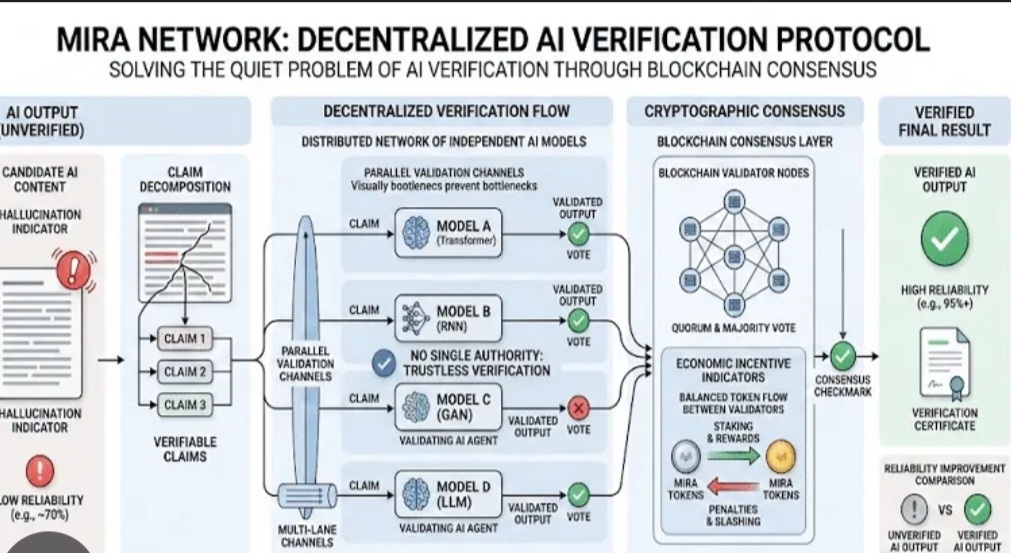
The core concept behind the Mira Network is distributed AI verification. Instead of relying on a single AI model to generate and validate information, the network uses multiple independent models to review and verify claims.
The process begins when an AI system generates a response or output. This output is then broken down into smaller, verifiable claims. Each claim is sent through parallel validation channels where different AI models analyze and verify the information.
For example, one model may specialize in natural language processing, while another may focus on pattern recognition or contextual reasoning. These models evaluate the claim independently and vote on whether the information is accurate or unreliable.
This multi-model approach significantly reduces the chances of errors because the verification process does not depend on a single system.
Blockchain Consensus for AI Trust
Once the AI models complete their validation process, the results move to the blockchain consensus layer. Here, validator nodes review the verification results and participate in a consensus mechanism.
If the majority of validators agree on the accuracy of the output, the information receives a verified status. This verification can be recorded on-chain, providing transparency and immutability.
Blockchain technology ensures that the verification process cannot be manipulated by a single authority. Instead, the network relies on distributed validators who maintain the integrity of the system.
Economic Incentives and Token Mechanism
Another important component of the Mira Network is its economic incentive system. Validators and participants are rewarded for providing accurate verification results. At the same time, malicious or incorrect validations may result in penalties or token slashing.
This economic design encourages honest participation and helps maintain the quality of verification across the network.
By aligning incentives with accuracy, the Mira Network creates a self-regulating ecosystem where reliable AI outputs are rewarded and misinformation is discouraged.
Benefits of the Mira Network
The decentralized architecture of the Mira Network offers several advantages compared to traditional AI verification systems.
First, it improves the reliability of AI outputs by using multiple models instead of relying on a single algorithm. Second, blockchain integration provides transparency and ensures that verification results cannot be altered after confirmation.
Third, the network eliminates the need for centralized trust authorities, making the system more open and scalable. This approach is particularly valuable for industries where data accuracy and trust are critical.
The Future of Verified AI
As artificial intelligence continues to evolve, ensuring the reliability of AI-generated information will become increasingly important. Projects like the Mira Network represent a new generation of infrastructure designed to bring trust and accountability to AI systems.
By combining decentralized verification, blockchain consensus, and economic incentives, the Mira Network introduces a powerful framework for building trustworthy AI ecosystems.
@Mira - Trust Layer of AI #mira $MIRA
