

During this period of uncertainty, investors across all markets are facing a particularly challenging environment.
One of the major sources of these tensions stems from the intensification of frictions around the Strait of Hormuz.
This situation has contributed to pushing the price of oil up by more than 60% since the beginning of the year, further reinforcing the inflationary pressures already present across the global economy.
In this context, prospects for monetary easing remain extremely limited. The probability of a rate cut at the next Federal Open Market Committee meeting is currently estimated at 3.7%, a level that remains close to zero.
Amid these macroeconomic tensions, the cryptocurrency market experienced a particularly volatile week.
After a very strong start to the week, during which total crypto market capitalization increased by around 11%, with nearly $250B added, a large portion of that liquidity left the market by the end of the week. In just a few days, approximately $175B in market capitalization was erased, illustrating the fragility of market sentiment in an uncertain environment.
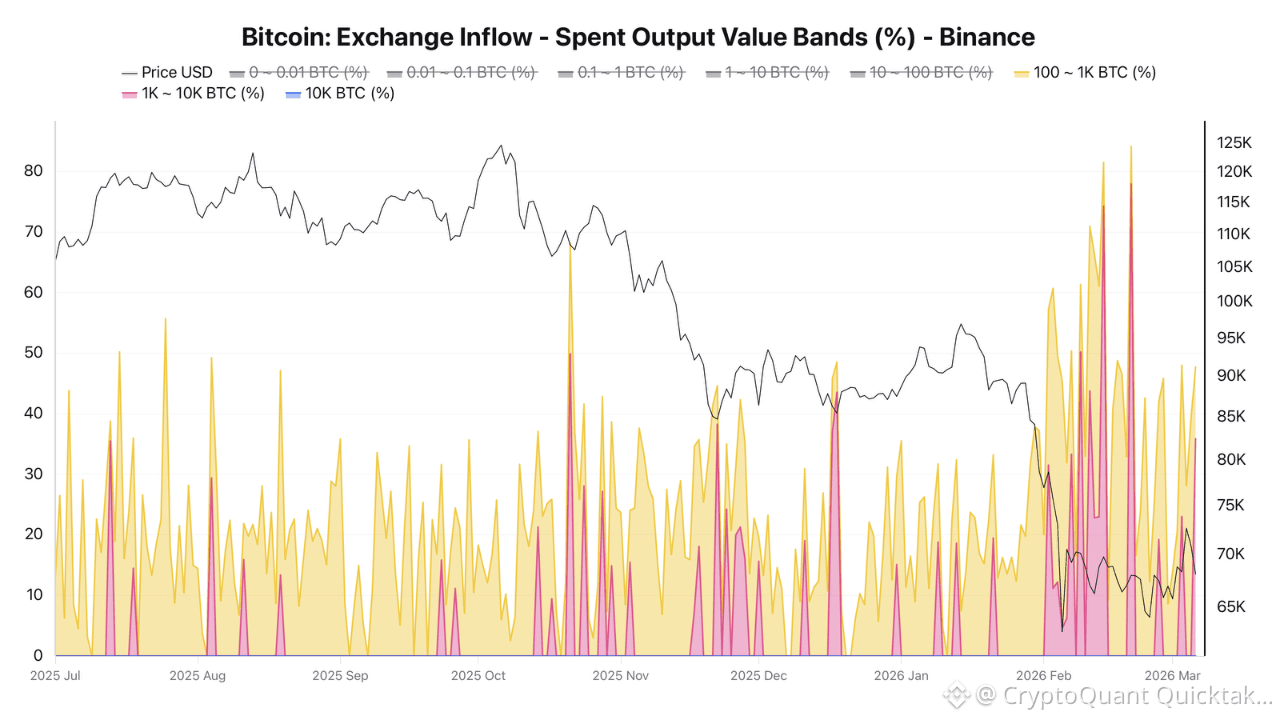
On the Bitcoin side, on-chain activity suggests that the largest holders have become more active during this period. BTC inflows to Binance coming from whales account for a growing share of the observed activity.
Several days were notably marked by inflows on Binance dominated by whale activity, representing more than 70% of total inflows. Here, whales are defined as transactions exceeding 100 BTC.
In this environment, volatility remains elevated across the crypto market, pushing some investors, particularly whales, who are capable of moving large amounts of capital, to adjust their exposure to Bitcoin and potentially exert a significant influence on short-term market dynamics.
Written by Darkfost