A Small Detail in the Documentation That Most People Skip
While going through Fabric Protocol’s documentation after seeing several CreatorPad posts on Binance Square, I noticed something that initially seemed minor. In one of the system diagrams, the $ROBO agents weren’t shown as independent bots executing tasks. Instead, they were arranged in a sequence — almost like a workflow pipeline.
At first I assumed it was just a visualization choice.
But the more I read the architecture notes shared in CreatorPad discussions, the more it became clear that this sequencing is actually the point. Fabric isn’t simply automating tasks on-chain. It’s trying to coordinate them.
And that subtle difference might be the real innovation hiding behind the ROBO label.
Automation in Crypto Usually Breaks at Coordination
Anyone who has experimented with automated DeFi strategies knows the common failure points.
Scripts depend on price feeds that update late.
Bots trigger trades at the wrong time.
Gas spikes interrupt execution.
Most automation tools try to solve this by improving signals or optimizing execution speed.
Fabric seems to be approaching the problem differently. Instead of making bots faster, it restructures how automated actions happen in the first place.
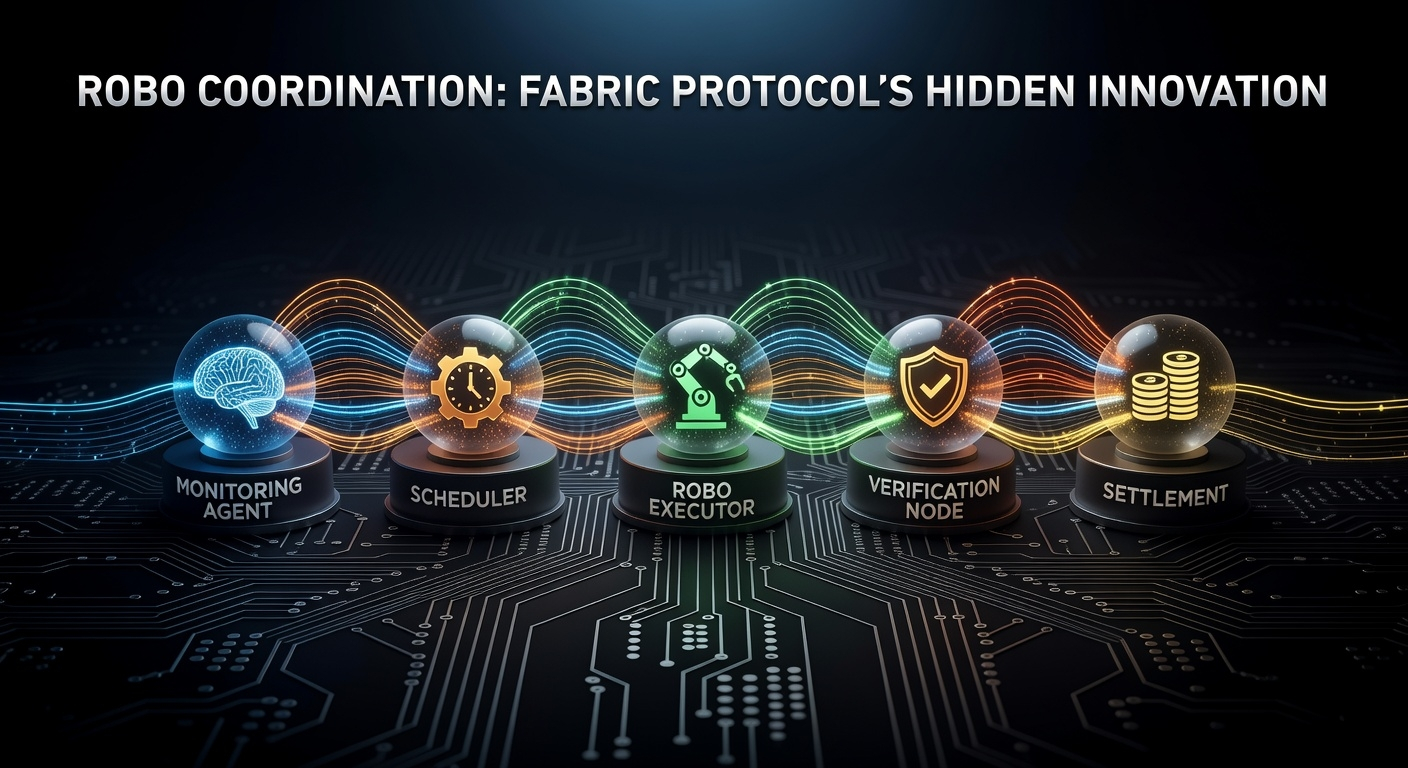
The protocol introduces ROBO agents that participate in coordinated workflows, meaning automation happens in stages rather than through a single trigger.
A simplified version of the process often shared in CreatorPad diagrams looks like this:
Each stage represents a distinct role in the system.
And that separation turns automation into something closer to distributed task management.
Why Coordination Is Harder Than Execution
One thing I’ve noticed across AI and blockchain systems is that execution is rarely the bottleneck anymore.
Modern tools can generate signals instantly and send transactions within seconds.
The real difficulty appears when multiple autonomous components interact.
If a signal is slightly wrong, an automated strategy might cascade into several unintended actions. In DeFi that can mean unnecessary trades, liquidity shifts, or even protocol instability.
Fabric’s ROBO design tries to prevent that chain reaction.
Because actions pass through several stages, each part of the system has the chance to evaluate whether the task should continue. The verification layer especially plays an important role — it checks whether execution results match expectations before final state updates occur.
That extra layer of coordination might sound like a small adjustment, but it introduces a kind of structural safety for automation.
Imagining a Real Use Case for ROBO Coordination
To understand why this matters, I tried mapping the system onto a hypothetical scenario.
Imagine an AI model monitoring multiple DeFi markets for volatility signals.
Instead of directly triggering trades, the AI sends its signals into Fabric’s workflow infrastructure.
The system might process them like this:
A monitoring agent identifies unusual market movement
The scheduler determines whether predefined conditions are satisfied
A ROBO executor performs a liquidity adjustment or hedge
Verification nodes confirm that the transaction succeeded correctly
Settlement distributes rewards or updates system state
The key difference is that no single agent controls the entire operation.
Instead, multiple agents coordinate the process step by step.
That structure becomes particularly useful if automated systems start operating at larger scale.
What CreatorPad Discussions Reveal About the Architecture
Following the CreatorPad campaign on Binance Square has actually been helpful for understanding Fabric’s design.
Several participants shared workflow illustrations explaining #ROBO coordination layers, which made the architecture easier to visualize. One diagram I saw mapped the interaction between monitoring agents, scheduling modules, and execution nodes. @Fabric Foundation