

The Bitcoin market currently appears to be in a structural re-evaluation phase following the correction after its recent all-time high (ATH). The short-term bias remains somewhat bearish, although some supply-side indicators suggest that selling pressure may be easing.
This analysis focuses on the relationship between BTC exchange reserves and ETF holdings. Together, these indicators help track both market supply and institutional demand.
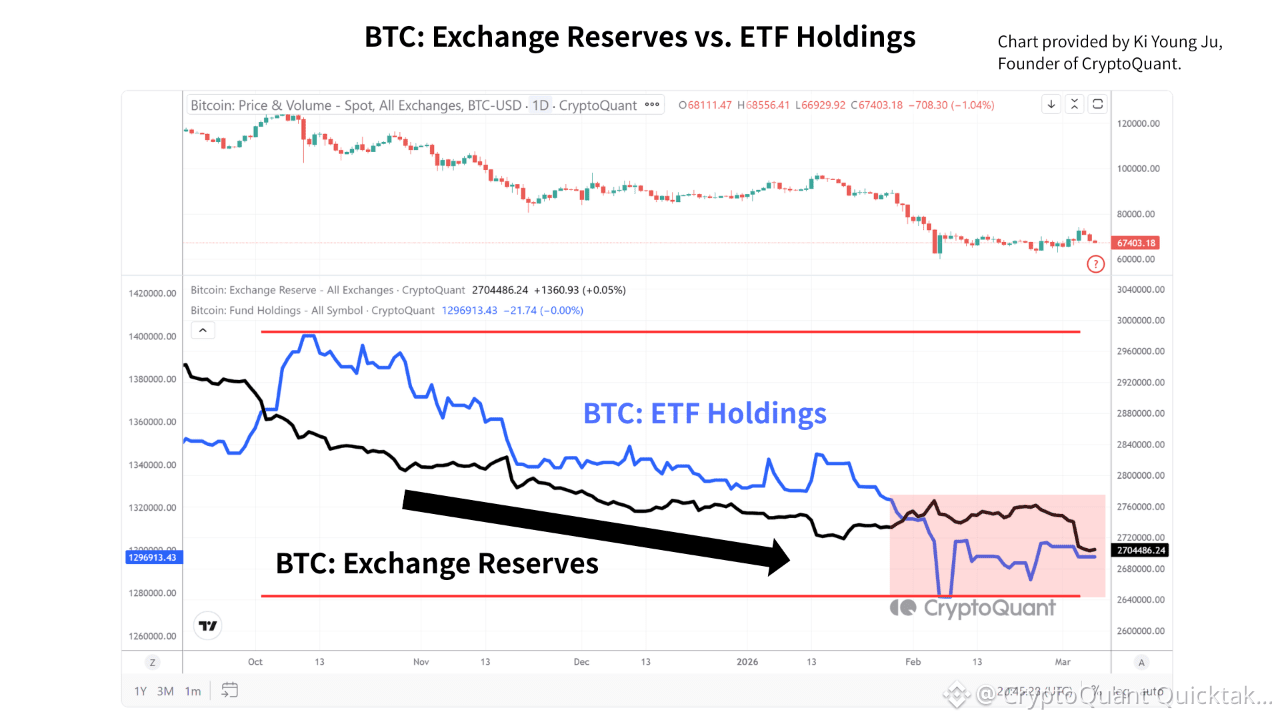
CryptoQuant data, with charts provided by Ki Young Ju, Founder of CryptoQuant, shows that Bitcoin exchange reserves have been gradually declining since late 2024. A reduction in exchange balances generally means fewer coins are immediately available for sale, which can indicate long-term holding behavior or transfers to self-custody.
More importantly, ETF holdings show a notable shift. After Bitcoin reached its ATH, ETF holdings began to decline. Because spot ETFs hold actual BTC, sustained outflows can weaken institutional demand and influence market pricing.
However, recent data suggests that the ETF outflow trend may be stabilizing. The pace of decline has slowed, and recent observations indicate that outflows have largely paused. This could suggest that institutional position adjustments are nearing completion.
Previous analysis by XWIN Research has pointed out that ETF flows often act as a structural driver in Bitcoin market cycles. The post-ATH ETF outflows and the subsequent price correction appear broadly consistent with that framework.
For now, the base scenario is that the market remains in a supply-demand rebalancing phase.
However, if ETF holdings begin trending upward again, this view would need to be reassessed.
Written by XWIN Research Japan