
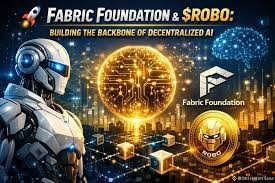
The race toward Artificial General Intelligence (AGI) has long been shadowed by a major concern: transparency. In many AI systems today, we can observe the final output, but the internal decision-making process often remains a mystery. Fabric Protocol, powered by the $ROBO token, aims to challenge that paradigm by introducing a new verification architecture rather than simply offering another speculative crypto narrative.
🛡️ Creating a Trust Layer for AI
At its foundation, Fabric Protocol attempts to replace the traditional “trust the provider” model with a system grounded in cryptographic proof. By integrating blockchain technology, the protocol records the operations of AI models and robotic systems on an immutable ledger.
This means every computation, decision, or machine action can theoretically be traced and verified. In an era where misinformation and synthetic content are becoming more sophisticated, having a verifiable record — essentially a cryptographic receipt for AI activity — could significantly improve transparency and accountability.
⚖️ Where Verification Falls Short
Despite its technical strength, verification does not automatically guarantee ethical outcomes.
A cryptographic proof can confirm that an algorithm executed correctly, but it cannot determine whether the decision itself was morally acceptable or socially responsible.
Key distinction:
Verification ≠ Ethical Validation
An AI system could technically operate exactly as designed while still generating outcomes that are questionable or harmful. This gap highlights one of the deeper philosophical challenges of AI governance.
🤔 Decentralization Comes with Its Own Obstacles
For Fabric Protocol to truly fulfill its vision, several critical hurdles must be addressed:
Validator Concentration
If only a small set of validators control verification, the system risks drifting toward centralization. The incentive model must strongly encourage honesty and discourage collusion.
Tokenomics Balance
The long-term value of $ROBO depends on real utility. If token supply expands faster than the demand for AI verification services, the economic model could become unsustainable.

Regulatory Alignment
For institutions and enterprises to adopt the system, its on-chain audit trails must integrate with existing legal frameworks. Bridging the gap between smart-contract logic and regulatory compliance will be essential.
🚀 Final Perspective
Fabric Protocol represents a bold attempt to introduce algorithmic integrity into the world of artificial intelligence. Its success should not be measured solely by token price, but by whether it can maintain an open, decentralized governance model while delivering real verification infrastructure.
If successful, it could shift the paradigm from a future where we simply trust AI systems to one where we can independently verify their behavior.
The real question is whether that vision can evolve beyond theory and become a widely adopted standard for trustworthy AI.
$ROBO might not just be a token—it could represent an early step toward transparent, accountable machine intelligence.