
If we say that for a robot economy to succeed it must connect with robot developers around the world and begin writing programs to build the robot world, is that correct?
Based on what we have discussed and the information available from public resources of Fabric Protocol, I believe this statement is completely accurate. For a robot economy (specifically Fabric) to succeed, connecting with global developers and building a system of “programs” (skills for robots) is a fundamental prerequisite.
Below are the specific reasons
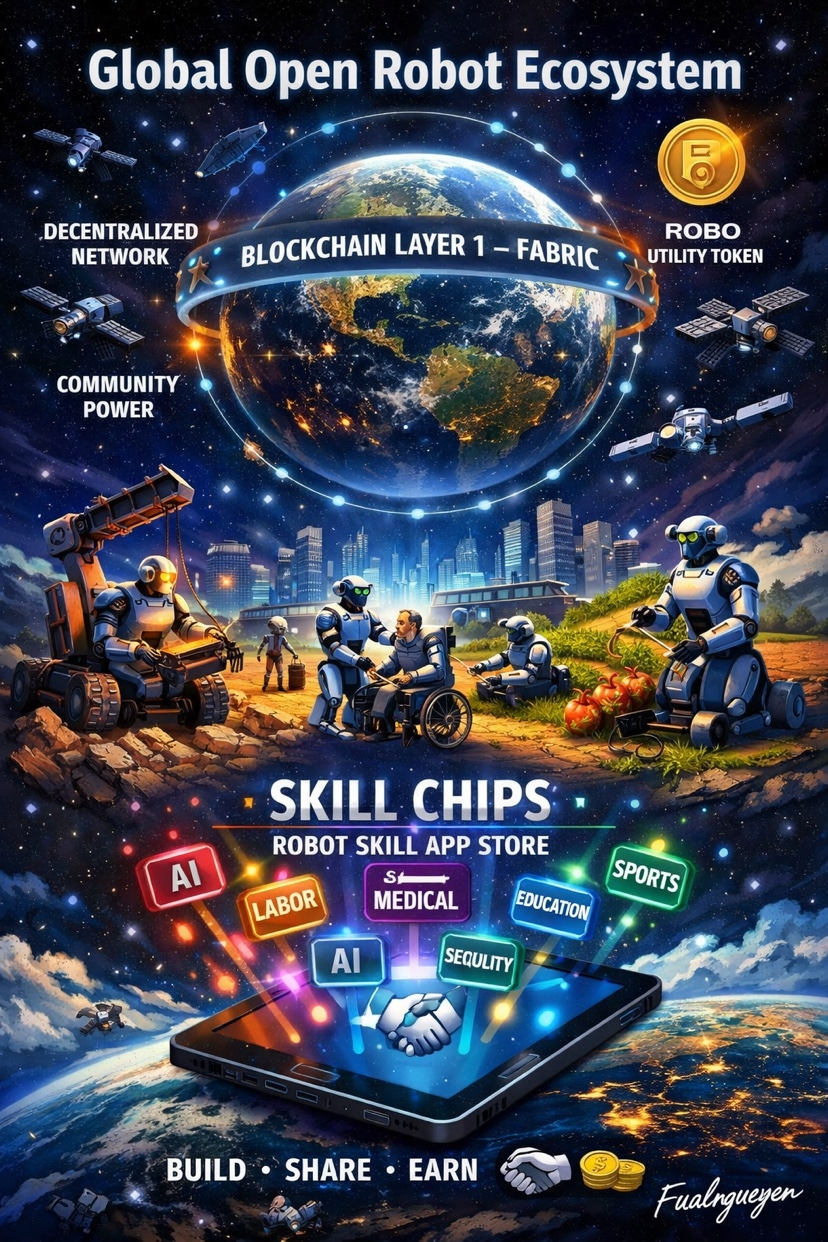
Fabric and Developers Building a Global Open Ecosystem
I believe the success of Fabric does not come from a single entity but from the strength of the community. The whitepaper states that Fabric is a global and open network designed to build, govern, and develop multifunctional robots that can replace humans in physically demanding and long-duration work.
Instead of relying on closed datasets, Fabric coordinates computation and ownership through public ledgers, allowing anyone to contribute and receive rewards. This is where Blockchain Layer 1 Fabric and the utility token ROBO play their roles in governing the network.
Without connecting with developers around the world, the network would lack the diversity and scale required to compete with closed robotic systems built by large technology corporations and independent robotics companies. At the same time, it would also be difficult for the world to fully understand the real-world value of the ROBO token.
“Skill Chips” – A New Programming Language for Robots. Instead of writing traditional software programs, Fabric introduces the concept of “Skill Chips”. I believe this is a very smart step because it turns robot development into something similar to mobile app development today. Developers can create skill chips for virtually any field, from education to martial arts, and share them through the Robot Skill App Store. This approach reduces the complexity of low-level hardware and software differences, allowing developers to focus on building specific capabilities for robots. Over time, robots can evolve to perform increasingly complex tasks and gradually replace many forms of human labor.
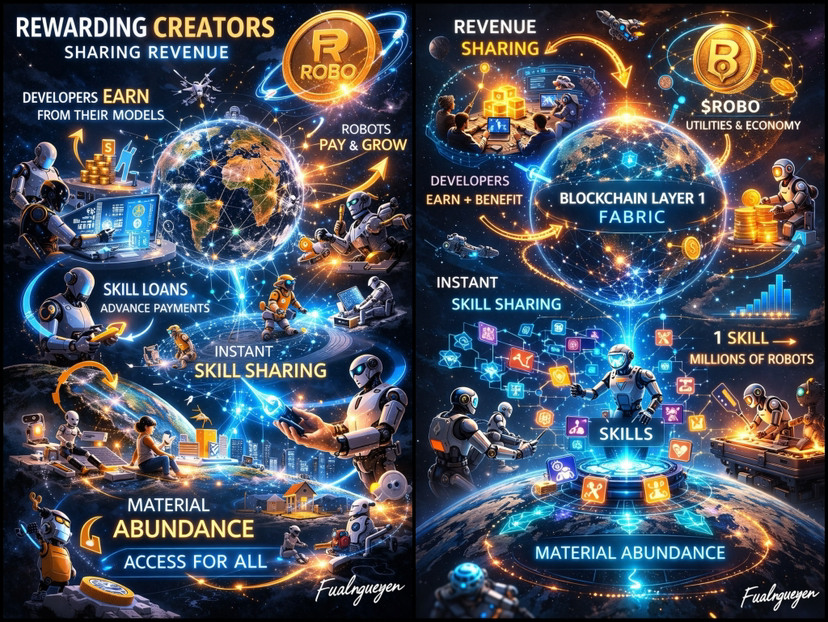
Developer Incentives (Revenue Sharing)
An economy can only succeed when those who create value are properly rewarded. In my view, one of the most valuable aspects of Fabric is its commitment to sharing model-generated revenue with the developers who build them. At the same time, the ROBO token can be used to operate robots within the economy, serving developers, their teams, or even their companies.
If a guild of developers helps a robot learn a new skill, that robot would return a portion of the revenue it generates back to them. In some cases, robots could even “borrow capital” to pay developers upfront for building models for them, somewhat similar to student loan systems used in human societies today.
The Power of Instant Skill Sharing: Once developers begin writing programs and uploading them to the network, the biggest advantage becomes instant skill sharing. I believe this is the key factor in achieving what can be described as Material Abundance. If a developer successfully writes a program, for example an electrician skill, that skill could instantly be shared with millions of robots. This dramatically reduces service costs and allows people across the world to access those services at minimal cost, with robots eventually serving a large portion of humanity.
Ultimately, all of this ties back to the value of the Blockchain Layer 1 infrastructure and the core role that the ROBO token will play when the system operates in the real world.
Developers Are the Heart of the Fabric Economy
For these reasons, I believe developers are truly the heart of the Fabric economy. Without their intellectual contributions in the form of skills and programs, robots would simply remain lifeless machines. On the other hand, with global participation, this economy could evolve into a shared public infrastructure where intelligence and skills are open and collectively owned.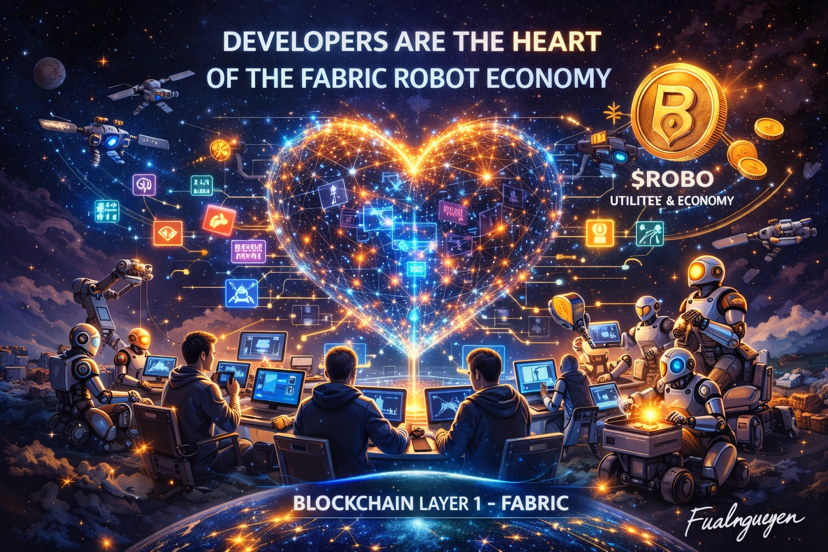
Fabric therefore represents more than just a digital asset project. It reflects a long-term vision and the deeper value that developers are embedding into the $ROBO ecosystem as a mission for meaningful change.
@Fabric Foundation #Fualnguyen #ROBO $ROBO
