
I’ve made this mistake enough times to notice it almost immediately now. A new token launches, your feed fills with polished threads about some massive future category, trading volume explodes, and for a day or two, it feels like adoption has already arrived. Then a week later, reality hits: most people were trading the story, not actually using the infrastructure. That’s exactly what made me pause when I started looking into ROBO.
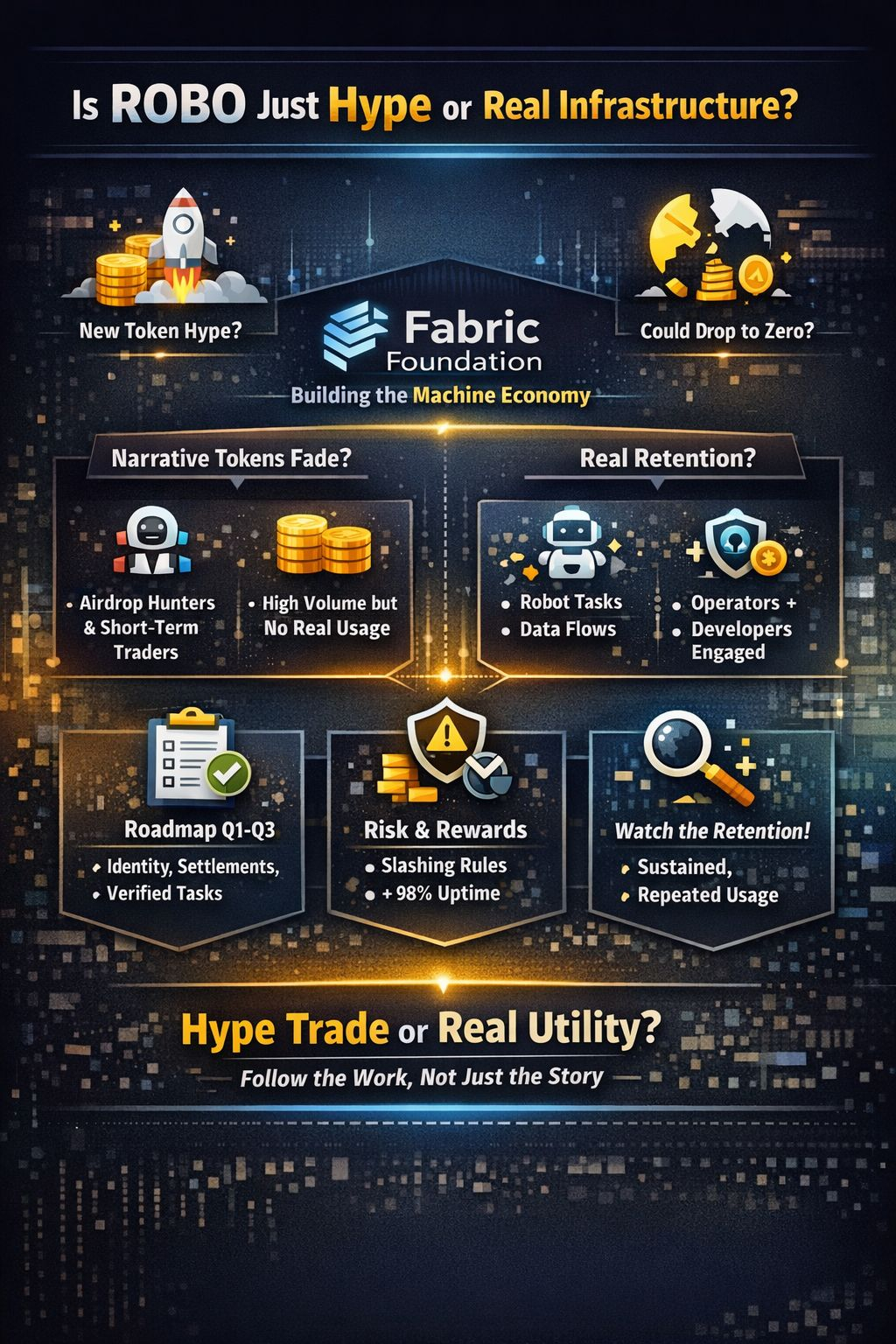
The token is still new, the unlock schedule is real, and the protocol is early enough that a lot of the important parts haven’t been tested in real conditions yet. Even the whitepaper admits it—there’s no sugarcoating.
I won’t lie: the token could lose most of its value, even drop to zero. Liquidity isn’t guaranteed, and governance or technical failures aren’t just hypothetical—they’re real risks here. Allocation also matters: investors hold 24.3%, the team and advisors have another 20%, both locked behind a 12-month cliff and 36-month linear vest. Total supply? 10 billion tokens.
Despite all that, I kept watching. ROBO isn’t selling a far-off “robot future.” It’s selling something subtler: a coordination layer. At first, that sounded abstract. But when I dug into the Fabric architecture, it made sense: robot identity, task settlement, structured data collection, work bonds, validator checks, slashing rules, and fee flows.
I think about it like laying pipes before building a house. Most people want to jump straight to machines earning money on their own. Fabric is focusing on the layer underneath—the part that makes sure those actions can be tracked, priced, challenged, and settled without everything turning into noise.
The whitepaper frames demand around work bonds, fee conversion, and governance locks, aiming for 60–80% of token value to come from actual utility, not speculation. Ambitious? Definitely. But at least it’s the right kind of ambition.
For me, the question isn’t whether the “machine economy” story is big—it obviously is. The question is retention. That’s where narrative tokens quietly die.
Tokens can attract attention easily—curious onlookers, airdrop hunters, short-term traders—but keeping people around after the excitement fades is the real test. ROBO already shows surface activity: CoinGecko lists 2.2B circulating tokens, $88M market cap, and daily volume swinging between $89M and $172M in the first week. Price hit $0.056 on March 2 before cooling to high $0.03s–low $0.04s. That’s discovery, not retention.
Real retention looks different. Operators keep bonding tokens because tasks are actually being executed. Developers plug into the skill layer. Users return because robot services happen often enough that the token becomes operational inventory, not just a chart to watch.
The roadmap hints at what to watch: Q1 focuses on identity, settlement, and early data collection. Q2 moves to contribution-based incentives tied to verified tasks. Q3 pushes toward more complex tasks and, importantly, sustained repeated usage. That last part is key—repeated usage is when a story either hardens into a network or fades back into just another launch.
Even with a solid design on paper, I’m still wary. “Hold and delegate” models won’t cut it here. Rewards have to trace back to verified work, and slashing rules are strict: fraud penalties, uptime above 98%, suspension if quality drops below 85%. But in the real world, verifying tasks isn’t so clean. Fabric admits that cryptography alone can’t prove everything. Economics and challenge mechanisms enforce honesty.
So the tricky part isn’t buying in. It’s waiting to see if the verification loop actually works once real usage, edge cases, and adversarial behavior appear.
What would change my mind? If volume stays high but I don’t see sustained task activity, repeat operator participation, or tokens locked for real network functions, ROBO stays a polished narrative with solid liquidity. Tradable? Yes. Durable? Not yet.
If, however, robot work, data flows, and settlement demand keep people coming back after the airdrop crowd leaves, the market might start pricing ROBO less like another AI ticker and more like early infrastructure. That’s the trade: don’t buy the fantasy—watch the retention. Watch whether tokens are used because machines are doing verified work, not because traders are chasing the next headline.
If you’re looking at ROBO the way I am, stop staring at the story. Start tracking the stickiness. That’s where the real signal shows up—and that’s where this chart will either earn your conviction or lose it.$ROBO @Fabric Foundation #ROBO