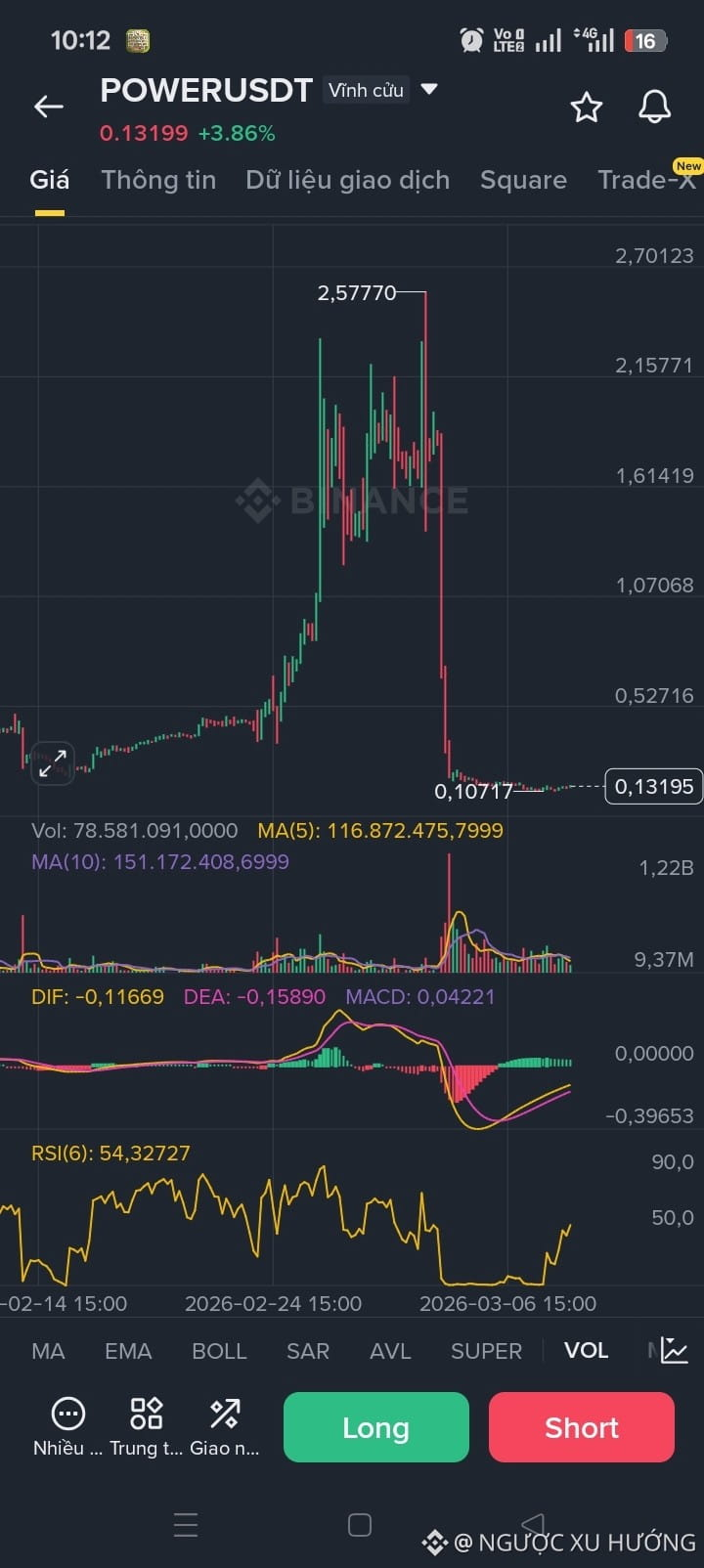
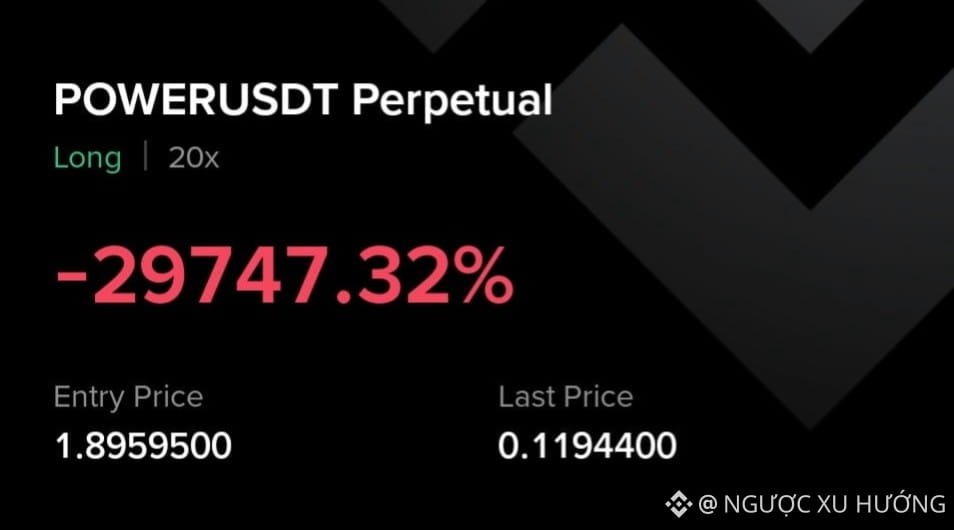
Your position in POWERUSDT Perpetual (Long 20x) shows a loss of nearly -29,747%, with an entry price around 1.8959 while the current price is about 0.1194. This is an extreme drawdown and usually happens when several psychological and technical mistakes occur at the same time. Understanding why this happened is very important, especially for beginners who want to avoid repeating the same situation.
First, the main reason behind holding such a losing position is emotional attachment to the trade. When traders open a position, they often believe strongly in their original analysis. When the price starts moving against them, instead of accepting that the analysis might be wrong, they continue to hold and hope the market will reverse. This behavior is called “hope trading.” In reality, the market does not care about our expectations. Once the trend changes, holding blindly becomes very dangerous.
Second, high leverage (20x) dramatically increases risk. With leverage trading, a small price movement can cause a very large profit or loss. If the market drops 5–10% against your position, the effective loss with leverage becomes extremely large. In this case, the price collapsed from nearly 1.90 down to about 0.11, which means the market dropped more than 90%. No leveraged long position can survive such a massive decline unless the trader closes the trade early.
Third, the chart clearly shows a parabolic pump followed by a sharp crash. When a token rises very quickly, it usually attracts speculative buyers. However, these moves are often unsustainable. After the peak around 2.57, the price formed volatile candles and then experienced a strong vertical drop. This pattern is typical of a blow-off top, where early investors take profit and liquidity disappears. Entering a long position after such a rally is extremely risky because the probability of a correction is very high.
Another reason traders keep holding is loss aversion. Psychologically, people feel the pain of losing money more strongly than the satisfaction of gaining money. Because of this, many traders refuse to close a losing position. They tell themselves: “I will wait until it comes back to my entry.” Unfortunately, in many cases the market continues moving further away instead of recovering.
There is also the issue of not using a stop-loss. A stop-loss is one of the most important tools in risk management. Professional traders always define a maximum acceptable loss before entering a trade. For example, risking only 1–3% of total capital per trade. If the stop-loss is hit, they exit immediately and protect their capital. Without a stop-loss, losses can grow uncontrollably, as seen in this case.
For beginners, several important lessons come from this situation.
1. Never trade without risk management.
Always decide your stop-loss before entering the trade. Capital preservation is more important than chasing profit.
2. Avoid high leverage.
Using 20x leverage is extremely risky, especially for new traders. Lower leverage such as 2x–5x gives more room for the trade to survive normal market volatility.
3. Do not chase parabolic pumps.
When a coin has already increased many times in a short period, the risk of a large correction becomes very high.
4. Accept when you are wrong.
The market will always produce losing trades. Successful traders survive because they cut losses quickly.
5. Focus on probability, not hope.
Trading decisions should be based on market structure, support levels, and confirmation signals—not emotions.
In conclusion, this trade is a powerful reminder that discipline matters more than prediction. Even the best analysis can fail, but strong risk management ensures that one mistake will never destroy a trading account. Learning this lesson early is what separates long-term traders from those who leave the market too soon.